Troubleshooting the GE Mark VIe IS220PDOAH1A: Fixing Relay Inaction and Flashing Red LED Faults
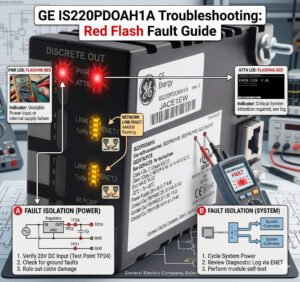
In high-availability critical control environments, clear diagnostic feedback remains essential for maintaining uptime. The GE IS220PDOAH1A discrete output pack serves as a vital execution layer within Mark VIe systems. However, field technicians often encounter a specific scenario where the software issues commands but the physical relays fail to actuate. Concurrently, the module displays a flashing red LED indicator. This failure pattern does not always imply a totally destroyed or defective hardware module. Instead, it frequently signals an underlying loop, power, or wiring infrastructure problem.
GE IS220PDOAH1A Troubleshooting Red Flash Fault Guide
The Core Functional Value of the PDOA Module
The IS220PDOAH1A converts logical commands from controllers into physical signals. These signals control heavy field equipment like solenoids, contactors, and interlock trips. Unlike traditional passive relay boards, this smart module features live execution feedback. It integrates natively into the Mark VIe IONet architecture to provide real-time diagnostic monitoring. Consequently, the system can protect itself by blocking outputs when it detects a hazardous electrical condition.
Advanced Output Health Monitoring and Self-Test Logic
The internal intelligence of the module continuously evaluates the state of the output circuit. It detects faults like short circuits, open lines, and load currents that exceed hardware limitations. When an anomaly occurs, the module automatically enters a protected fault state. As a result, the hardware drops the output and flashes the red indicator. Software tools like ToolboxST will subsequently report an “I/O Fault” or “PDOA Mismatch” status. Therefore, the command appears active in the logic while the field circuit remains safely isolated.
Evaluating 24VDC Field Power Quality and Stability
Industrial control systems require highly stable power distribution networks to initialize sensitive electronic components. The IS220PDOAH1A is highly sensitive to excessive voltage ripple and transient sags. In large petrochemical facilities, activating multiple solenoid valves simultaneously can drop the local 24VDC bus voltage. Standard digital multimeters usually fail to capture these microsecond sags. However, these transient power drops easily confuse the module’s internal boot logic. This confusion results in intermittent red flash errors during heavy plant operations.
Terminal Board Compatibility and Migration Engineering
Hardware mismatches represent another primary cause of initialization failures during facility expansion or upgrade projects. The IS220PDOAH1A must pair with specific terminal boards like the TRLYH1B or SRLY series. Using an incompatible revision or choosing incorrect jumper settings triggers immediate communication blockages. The system will flag a mismatch alarm and refuse to put the I/O pack online. Engineers must cross-reference the official GE compatibility matrix before attempting brownfield hardware modernizations.
Best Practices for Field Installation and Preventative Maintenance
- ✅ Load Circuit Auditing: Always measure field coil impedance before replacing an alarming module.
- ⚙️ Terminal Tightening: Fasten Phoenix connectors annually to mitigate high-vibration signal degradation.
- 🔧 Surge Protection Installation: Fit inductive loads with RC snubbers to block high-voltage inductive kickback.
Strategic Analysis from Powergear X Automation Limited
At Powergear X Automation Limited, we have seen that over half of returned discrete output packs have no actual hardware defects. Most issues stem from field component aging, thermal shorting, or poor grounding topologies. Modern factory automation requires looking past the module itself to diagnose the full circuit loop. If you need original GE Mark VIe components or seek expert engineering consultation, review our technical inventory at https://www.powergearx.com/.
Real-World Application Scenarios
In a gas turbine auxiliary cabinet, constant vibration can loosen terminal block connections over time. This loose contact increases circuit resistance, which the IS220PDOAH1A flags as a loop fault. Similarly, old electro-hydraulic valves can exhibit intermittent coil shorting only when reaching peak operating temperatures. These scenarios prove that systematic troubleshooting must prioritize external loop validation over immediate board replacement.
Frequently Asked Questions (FAQ)
1. How can I definitively isolate an internal module failure from an external loop fault?
Perform a swap test by exchanging the suspect I/O pack with an identical unit in a known-good slot. If the flashing red alarm follows the module, the internal hardware is damaged; if the fault stays on the slot, check the field wiring and power lines.
2. Can I use this specific discrete output pack to replace legacy Mark VI VME cards?
No, this module belongs exclusively to the Mark VIe Ethernet-based IONet architecture. It utilizes different physical form factors, communication network designs, and terminal board interfaces compared to older VME systems.
3. What maximum voltage ripple can this control hardware tolerate safely?
We strongly suggest keeping power supply ripple under 5% using dedicated, isolated 24VDC power sources. Sharing power paths with high-draw inductive solenoids often induces initialization failures and false fault readings.