Over 50,000 hot-selling automation module components.
Bently Nevada 3500-22M TDI Modbus TCP Integration Guide

Optimize Vibration Data with Bently Nevada 3500/22M Interface

Seamless Data Integration with the Bently Nevada 3500/22M Transient Data Interface

Bridging the Gap Between Vibration Monitoring and Plant Control

In high-stakes industries like oil and gas or power generation, communication compatibility often creates a technical bottleneck. The Bently Nevada 3500/22M Transient Data Interface (TDI) serves as the vital gateway between 3500 series machinery protection racks and external control systems. By facilitating reliable data extraction, this module allows operators to push critical machinery health insights directly into DCS or SCADA platforms. Consequently, plants can eliminate the need for complex custom middleware while maintaining high-fidelity asset management.
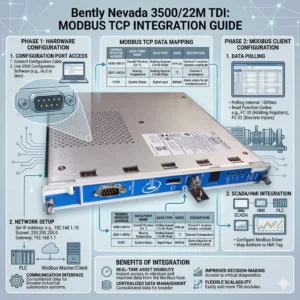
Bently Nevada 3500-22M TDI Modbus TCP Integration Guide

Bently Nevada 3500-22M TDI Modbus TCP Integration Guide

Technical Insights: Mastering Modbus TCP/IP Connectivity

The 3500/22M module utilizes Modbus TCP/IP protocols rather than traditional Modbus RTU serial connections. This shift to an Ethernet-based TCP/IP stack offers significant advantages for modern industrial automation. For instance, it provides higher data throughput and supports multi-client access for remote diagnostics. Therefore, integration with modern Ethernet-based DCS architectures becomes much simpler. However, legacy systems relying on RS-485 Modbus RTU will require an external protocol gateway to bridge the communication gap.

Optimizing Throughput and Reducing Network Latency

Engineers designed the 3500/22M to handle both transient and steady-state high-resolution data. Faster polling cycles through TCP improve real-time vibration monitoring and accelerate alarm response speeds. Nevertheless, heavy network congestion can introduce unwanted latency. To maintain performance, we recommend segmenting condition monitoring traffic via a dedicated VLAN. In our experience at Powergear X Automation Limited, delayed alarms often stem from overloaded plant networks rather than hardware failures within the 3500 rack itself.

System Architecture and Compliance with API 670 Standards

The 3500/22M functions as both a data concentrator and a communication interface for the entire rack. It interfaces with the internal backplane for data acquisition while providing external Ethernet ports for data export. This design effectively separates the deterministic protection system from the analytical monitoring network. As a result, the system maintains strict compliance with API 670 machinery protection standards. This separation ensures that network-level issues do not interfere with critical machine trip functions.

Installation Best Practices for Industrial Environments

Successful deployment of the 3500/22M requires a robust network and electrical design. You should never connect the module directly to a general office LAN. Instead, use industrial-grade switches and establish a dedicated VLAN to prevent broadcast storms. Furthermore, ensure the rack is properly grounded to mitigate electromagnetic interference (EMI). In turbine halls, high-current lines can create noise that leads to “ghost alarms” in the SCADA system if Ethernet cables lack proper shielding.

Evaluating Compatibility for Legacy Brownfield Projects

When upgrading older plants, buyers must verify rack firmware versions before procuring the 3500/22M. While the module is compatible with standard 3500 racks, older systems might not fully exploit TCP-based features. If your current control system is strictly Modbus RTU-dependent, budget for a high-quality industrial TCP-to-RTU converter. This proactive approach prevents unexpected integration costs from exceeding the hardware investment during the commissioning phase.

Expert Commentary from Powergear X Automation Limited

At Powergear X Automation Limited, we believe the 3500/22M is a prerequisite for any facility moving toward Industry 4.0 or digital transformation. The ability to stream high-density vibration data without serial bottlenecks is a game-changer for predictive maintenance. However, we urge engineers to prioritize network security and segmentation. As these interfaces bridge the gap between OT and IT, a secure, isolated communication layer is essential for long-term operational stability.

Application Scenarios and Strategic Solutions

  • Large Compressor Stations: Isolated condition monitoring traffic ensures that transient data does not saturate the primary control network.
  • Petrochemical Refining: Direct integration with Honeywell or Emerson DCS via Modbus TCP simplifies the asset management workflow.
  • Digital Power Plants: Utilizing the TDI for remote diagnostics allows off-site experts to analyze vibration signatures in real-time.

Technical Implementation Checklist

  • ✅ Verify SCADA support for Modbus TCP mapping before installation.
  • ✅ Use shielded Cat6 cables and maintain distance from high-voltage conduits.
  • ✅ Implement an industrial protocol gateway if RS-485 connectivity is mandatory.
  • ✅ Update rack firmware to the latest version to ensure full TDI feature support.

Frequently Asked Questions (FAQ)

Q: Can I use the 3500/22M to replace a 3500/20 Rack Interface Module?
Yes, the 3500/22M is the newer generation Transient Data Interface that provides enhanced Ethernet capabilities. However, you must verify that your configuration software is updated to support the 22M hardware profile to avoid configuration errors.

Q: Why does my SCADA system intermittently lose connection to the TDI?
This is frequently caused by ARP table overflows or broadcast traffic on a shared network. We recommend assigning a static IP address to the 3500/22M and placing it behind a managed industrial switch with IGMP snooping enabled.

Q: Does the 3500/22M support simultaneous connections to System 1 and a third-party PLC?
Yes, the module supports multiple socket connections. This allows Bently Nevada’s System 1 software to collect rich diagnostic data while your plant PLC polls basic alarm registers via Modbus TCP simultaneously.

For more technical specifications and high-performance automation modules, visit the official Powergear X Automation Limited website to view our latest inventory.

Using 1769-SDN with CompactLogix 5370: A Compatibility Guide

Using 1769-SDN with CompactLogix 5370: A Compatibility Guide

Is the Allen-Bradley 1769-SDN Scanner Compatible with CompactLogix 5370?

The 1769-SDN DeviceNet Scanner remains a critical component for bridging legacy networks with modern control systems. While the Allen-Bradley CompactLogix 5370 series natively supports 1769 I/O modules, integrating DeviceNet requires careful planning. This guide explores technical constraints, lifecycle management, and practical field insights for automation engineers.

Using 1769-SDN with CompactLogix 5370: A Compatibility Guide

The Role of 1769-SDN in Modern Industrial Automation

The 1769-SDN acts as a communication bridge between DeviceNet field devices and the CompactLogix 5370 platform. In many factory automation environments, replacing every sensor or valve manifold is cost-prohibitive. Therefore, this module allows plants to upgrade their primary controller while maintaining existing field-level assets. It effectively extends the ROI of legacy hardware during phased system migrations.

Protocol Integration Challenges and EtherNet/IP Dominance

The 5370 series controllers primarily utilize EtherNet/IP for high-speed data exchange and synchronized motion. Adding a 1769-SDN introduces a secondary protocol layer that requires specific configuration via RSNetWorx for DeviceNet. However, this extra layer can complicate system architecture. Modern control systems favor the transparency of Ethernet, making DeviceNet troubleshooting more labor-intensive for maintenance teams.

Managing I/O Data Throughput and Network Latency

DeviceNet operates at significantly lower baud rates compared to 100Mbps Ethernet standards. As a result, large networks with over 40 nodes may experience increased scan times. This latency can impact real-time responsiveness in high-speed packaging or automotive assembly lines. Engineers must prioritize critical I/O data to ensure consistent machine cycle times when using the 1769-SDN scanner.

Critical Installation and Backplane Power Requirements

Technical reliability often depends on proper hardware installation and electrical stability. The 1769-SDN draws considerable current from the 1769 bus, which can strain the system power supply. Consider these technical essentials for a stable deployment:

  • ✅ Verify the total backplane current draw before adding modules.
  • ✅ Use 121-ohm termination resistors at both trunk line ends.
  • ✅ Maintain physical separation between communication and high-voltage cables.
  • ✅ Ensure single-point grounding to prevent EMI and signal noise.
  • ✅ Monitor the module status LEDs for rapid network diagnostics.

Powergear X Automation Expert Perspective on Lifecycle Strategy

At Powergear X Automation, we view the 1769-SDN as a “transition tool” rather than a long-term solution. While it solves immediate compatibility issues, Rockwell Automation classifies DeviceNet as legacy technology. We recommend stocking spare scanners now, as component availability may tighten. Transitioning toward an all-Ethernet architecture remains the most sustainable path for future-proofing your facility.

Real-World Application Scenarios

In a recent retrofit for a chemical processing plant, the 1769-SDN allowed the client to swap an old 1769-L32E for a modern 1769-L33ER. This saved thousands in rewiring costs for existing DeviceNet instrumentation. However, for any greenfield project, we strongly advise using EtherNet/IP-based distributed I/O to take advantage of better diagnostics and faster integration.

Frequently Asked Questions

Can I configure the 1769-SDN entirely within Studio 5000?
No, you still require RSNetWorx for DeviceNet to map the scan list and set node addresses. Studio 5000 only handles the controller-to-module data tags.

What is the most common cause of “Bus-Off” errors on this module?
In our experience, nearly 80% of faults stem from physical layer issues like loose terminations or excessive drop lengths. Always check wiring before replacing hardware.

Is there a direct Ethernet replacement for DeviceNet sensors?
Most manufacturers now offer IO-Link or EtherNet/IP versions of standard sensors. If you are replacing more than 50% of your devices, skip the 1769-SDN and migrate to a modern digital protocol.

For more technical guides and high-quality automation components, visit the Powergear X Automation website to explore our extensive inventory of PLC and DCS modules.

Master ABB CI867A Configuration for Modbus TCP Client Success_

Master ABB CI867A Configuration for Modbus TCP Client Success

Optimizing ABB CI867A Configuration for Modbus TCP Client Integration

The Strategic Role of CI867A in Industrial Connectivity

The ABB CI867A serves as a vital communication bridge within the 800xA architecture. It allows AC 800M controllers to interface seamlessly with third-party PLCs and smart field devices. By utilizing Modbus TCP, engineers can integrate diverse subsystems without expensive hardware gateways. This native integration simplifies the system architecture and reduces potential failure points. Furthermore, centralizing diagnostics within the ABB Control Builder environment streamlines long-term maintenance for plant operators.

Master ABB CI867A Configuration for Modbus TCP Client Success_

Balancing Polling Intervals and Controller Load

System performance depends heavily on the communication cycle time. The CI867A processes Modbus requests through the AC 800M task scheduler. High-speed polling can inadvertently strain the controller CPU. At Powergear X Automation, we recommend a polling interval between 200ms and 500ms for standard process variables. This range ensures data freshness while maintaining overall system stability. Engineers must prioritize critical control loops over non-essential monitoring data to optimize bandwidth.

Navigating Protocol Compatibility and Register Mapping

While Modbus TCP is a standard, implementation varies significantly between manufacturers. Many OEM devices use zero-based addressing, whereas others start at one. Additionally, endianness mismatches often cause data corruption during the commissioning phase. We suggest verifying all register maps with a standalone Modbus polling tool before software binding. Never trust vendor documentation blindly without performing a live communication test. This proactive step prevents logic errors in the DCS application.

Enhancing Network Resilience and Redundancy

The CI867A utilizes standard Ethernet but lacks native protocol-level redundancy for Modbus. Reliability must therefore come from the network infrastructure. Implementing Rapid Spanning Tree Protocol (RSTP) or Parallel Redundancy Protocol (PRP) via managed switches is essential. For mission-critical applications, avoid using Modbus TCP for safety-related interlocks. Instead, reserve this protocol for supervisory control or data acquisition tasks where high availability is less sensitive.

Field-Proven Installation and Hardware Protection

Physical environment factors often dictate communication reliability in heavy industries. High-noise areas like motor control centers require high-quality shielded Ethernet cabling. Always bond the cable shield at a single point to prevent ground loops. Moreover, the CI867A lacks integrated surge suppression. Installing dedicated DIN-rail surge protectors is a cost-effective way to prevent card failure during electrical storms. These small hardware investments significantly extend the lifespan of your automation assets.

Powergear X Automation: The Expert Perspective

In our experience at Powergear X Automation, the CI867A remains a workhorse for industrial integration. While newer protocols like OPC UA offer enhanced security, Modbus TCP stays relevant due to its simplicity. Success with this module requires a disciplined engineering approach rather than a “plug-and-play” mindset. Focus on robust network design and conservative polling strategies to ensure long-term uptime. If you are planning a migration, account for re-mapping time as legacy logic rarely transfers directly.

Technical Implementation Checklist

  • ✅ Verify device IP addresses and subnet masks.
  • ✅ Match Modbus function codes to device capabilities.
  • ✅ Implement shielded CAT6 cabling for noisy environments.
  • ✅ Configure heartbeat logic to detect communication loss.
  • ✅ Use external surge protection for outdoor installations.
  • ✅ Start with a small register block during testing.

Common Application Scenarios

  • Power Management: Integrating smart meters and protection relays into the DCS.
  • Skid Integration: Connecting third-party compressor or water treatment packages.
  • Drive Control: Monitoring variable speed drives for energy efficiency diagnostics.

Frequently Asked Questions (FAQ)

Q1: How do I handle data timeouts and intermittent connection drops?

Timeouts usually stem from network congestion or slow slave response times. First, increase the “Reply Timeout” setting in Control Builder. If the issue persists, check for electromagnetic interference (EMI) near the communication cables.

Q2: Can I use the CI867A for high-speed motion control?

Modbus TCP over the CI867A is generally unsuitable for sub-50ms motion requirements. The overhead of the Ethernet stack and the AC 800M task cycle introduces jitter. Use specialized protocols like PROFINET or EtherCAT for high-speed applications.

Q3: What should I check if data values appear swapped or incorrect?

This is typically a “Byte Swap” or “Word Swap” issue. Check the “Endianness” settings in the CI867A hardware configuration. Adjusting the “Data Format” parameter usually resolves mapping discrepancies without changing the PLC code.

Troubleshooting 140NOM25200C EMI Packet Loss

Troubleshooting 140NOM25200C EMI Packet Loss | Powergear X

Troubleshooting EMI-Induced Packet Loss in Schneider Modicon 140NOM25200C Modules

Defining the Role of Modicon Quantum in Mission-Critical Systems
The Schneider Electric Modicon Quantum 140NOM25200C serves as a cornerstone for Ethernet communication in demanding control systems. This module facilitates continuous data exchange between PLCs, HMIs, and SCADA platforms. In sectors like oil and gas or pharmaceuticals, its value depends on deterministic communication. However, external electromagnetic interference (EMI) often disrupts this stability. Understanding these disruptions helps engineers differentiate between true hardware failure and environmental noise.

Troubleshooting 140NOM25200C EMI Packet Loss

Identifying Intermittent Packet Loss Patterns Under EMI

EMI typically triggers burst-type packet loss rather than total communication blackouts. You may notice that TCP/IP sessions remain active while cyclic data updates experience significant lag. Consequently, SCADA systems might trigger sporadic timeout alarms that clear themselves within seconds. These “ghost faults” often baffle technicians because the hardware passes standard diagnostic tests. At Powergear X Automation, we frequently observe that these patterns point toward shielding issues rather than defective internal circuitry.

Evaluating Environmental Factors and Installation Risks

While the 140NOM25200C meets IEC 61131-2 standards, real-world cabinet conditions often exceed these test parameters. Packet loss frequently occurs when Ethernet cables run too close to high-current VFD motor leads. Furthermore, inconsistent grounding on painted backplates creates a high-impedance path for noise. When EMI penetrates the physical layer, it creates Cyclic Redundancy Check (CRC) errors. These errors force the module to drop frames, leading to the erratic performance seen in factory automation.

Analyzing Protocol Resilience and Latency Impacts

The 140NOM25200C utilizes standard TCP/IP, which offers some resilience through retransmission mechanisms. Nevertheless, excessive interference forces constant re-sending of data packets. As a result, network latency increases and PLC scan times may fluctuate. For high-speed interlocks and synchronized control systems, this jitter is unacceptable. Even if the PLC logic remains running, the delayed data can cause nuisance trips or reduced production efficiency in complex DCS environments.

Implementing Professional Shielding and Grounding Standards

Effective mitigation starts with physical separation and high-quality materials. Engineers should always utilize industrial-grade shielded Cat 5e cables for all Quantum installations.

  • Maintain at least 30 cm of clearance from high-voltage power lines.
  • Bond cable shields to a low-impedance earth ground at cabinet entry points.
  • Avoid floating shields to prevent the cable from acting as an antenna.
  • Install external Ethernet surge protectors for outdoor or refinery applications.
  • Verify that all terminations follow TIA/EIA-568-B industrial standards.

Strategic Insight by Powergear X Automation

In our experience, the 140NOM25200C is a robust piece of hardware, but it is often blamed for system-wide failures that are actually environmental. The industry is shifting toward more sensitive, high-speed data requirements. Therefore, the “it worked yesterday” mentality no longer applies to aging infrastructure. If you are experiencing intermittent “Link” LEDs or CRC errors, look at your grounding before ordering a replacement. Investing in proper EMC hygiene is always more cost-effective than repetitive hardware swaps.

Application Scenario: Chemical Processing Plant

A major chemical facility experienced random SCADA disconnects every time a large centrifuge ramped up. Although the 140NOM25200C was suspected of having a faulty port, a spectrum analysis revealed high-frequency noise leaking from a nearby VFD. By simply upgrading to double-shielded S/FTP cabling and improving the cabinet’s common ground bond, the “faulty” module returned to 100% uptime without replacement.

Frequently Asked Questions (FAQ)

Q: How can I verify if my communication lag is environmental or a module hardware defect?
Check the PLC diagnostic buffer for “Frame Errors” or “CRC Errors.” If these errors coincide with the startup of heavy machinery or VFDs, it is likely EMI. A failing module usually stays offline or fails to initialize regardless of external equipment activity.

Q: When purchasing a 140NOM25200C for an older system, what should I check first?
Check your existing cable type. Older systems often use unshielded twisted pair (UTP). Modern 140NOM25200C modules are more sensitive to noise than legacy serial counterparts, so upgrading to shielded cabling is a prerequisite for a successful retrofit.

Q: Is there a specific diagnostic tool for measuring this packet loss in real-time?
You can use managed switch port statistics or specialized industrial network Analyzers. Look for an increase in “Inbound Errors” on the specific port connected to the Modicon module. If the error count rises only during production hours, your issue is environmental interference.

For professional technical support and high-quality industrial components, visit the experts at Powergear X Automation to optimize your control system’s reliability.

170ENT11001 vs 170ENT11002 Modicon Momentum Guide

Schneider 170ENT11002 Review: High-Performance Industrial Ethernet

Strategic Value of Modicon Momentum Ethernet Modules

Choosing between the Schneider Electric 170ENT11001 and the 170ENT11002 is a critical decision for engineers managing Modicon Momentum platforms. While both modules provide essential Ethernet connectivity, their performance profiles differ significantly in modern industrial environments. This guide, prepared by Powergear X Automation, breaks down the technical nuances to help you optimize your plant-floor communication.

The Schneider Electric 170ENT11001 and 170ENT11002 serve as the primary gateway for Modicon Momentum PLCs to enter the Ethernet TCP/IP ecosystem. These modules provide deterministic communication across various sectors, including oil and gas skids and chemical process units. Their core value lies in bridging the gap between field-level control and plant-wide data monitoring.

170ENT11001 vs 170ENT11002 Modicon Momentum Guide

Ethernet Speed and Network Evolution

The 170ENT11001 supports a fixed 10 Mbps Ethernet speed, which remains adequate for legacy, isolated networks. In contrast, the 170ENT11002 offers 10/100 Mbps Fast Ethernet with auto-negotiation capabilities. Modern plants utilizing VLANs and managed switches often experience bottlenecks at 10 Mbps. Consequently, the 170ENT11002 handles high-traffic volumes more effectively, reducing communication jitter during heavy SCADA polling.

Boosting Communication Response and Stability

Internal processing power distinguishes these two modules during peak operation. The 170ENT11002 features superior buffering, allowing it to manage multiple concurrent Modbus TCP requests from HMIs and historians. In our experience at Powergear X Automation, the 170ENT11001 may trigger intermittent timeouts when several clients access data simultaneously. Therefore, the 11002 is the preferred choice for batching systems in the pharmaceutical industry.

Reliable Diagnostics and System Maintenance

Maintenance teams favor the 170ENT11002 for its seamless integration with contemporary diagnostic tools. It demonstrates better tolerance for modern managed switches compared to its predecessor. A common commissioning pitfall involves the 170ENT11001 struggling with duplex mismatches on high-end switches. By adopting the 11002, engineers can isolate faults faster and minimize “link up but no data” scenarios.

Expert Tips for Field Installation

Proper installation determines the longevity of your communication hardware. Based on industry standards and field observations, we recommend the following technical practices:

Configure Switch Ports: Lock switch ports to 10 Mbps when using the 170ENT11001.

Implement Surge Protection: Use industrial Ethernet surge protectors for outdoor installations.

Ensure Proper Grounding: Bond the Momentum base to a low-impedance ground point.

Mechanical Security: Install DIN rail end stops to prevent vibration-induced disconnects.

Cable Management: Use shielded cables to mitigate electromagnetic interference in high-voltage cabinets.

Strategic Comparison Summary

Feature170ENT11001170ENT11002Data Rate10 Mbps10/100 Mbps (Auto)Network TypeLegacy/IsolatedModern/High-TrafficMulti-Client SupportLimitedHighBest ApplicationSimple Pump StationsComplex Chemical Plants

Author Insights by Powergear X Automation

At Powergear X Automation, we observe a clear trend toward high-bandwidth industrial Ethernet. While the 170ENT11001 is a reliable “workhorse,” the 170ENT11002 is a “future-proof” necessity. As IIoT and Big Data integration accelerate, the 100 Mbps capability becomes non-negotiable for real-time analytics. We advise clients to audit their existing switch infrastructure before selecting a module to ensure full compatibility.

For expert procurement advice and genuine Schneider Electric components, visit Powergear X Automation.

Application Scenarios and Solutions

Scenario A: Remote Water Treatment: An isolated site with one HMI. The 170ENT11001 provides a cost-effective, stable solution here.

Scenario B: Pharmaceutical Batching: High data integrity and rapid alarm response are required. The 170ENT11002 ensures recipe execution remains precise and stable.

Scenario C: Factory Migration: Upgrading from unmanaged to managed switches. The 170ENT11002 prevents the “duplex mismatch” issues common in older hardware.

Frequently Asked Questions (FAQ)

Q1: How do I choose between these modules for a high-vibration environment?

Both modules share the same mechanical housing, but the connection stability depends on your wiring. We suggest using high-quality RJ45 connectors with strain relief. The 170ENT11002 is better if the vibration source also generates electrical noise, as its faster processing handles retries more efficiently.

Q2: Will I need to rewrite my PLC logic if I swap an 11001 for an 11002?

No, they are functionally compatible at the application layer. However, you should verify your software configuration in Unity Pro or Concept. Always ensure the “Module Type” in your hardware configuration matches the physical hardware installed to avoid I/O health errors.

Q3: Is the 170ENT11001 still a viable purchase today?

It is viable for maintaining existing legacy systems where network changes are not planned. However, for any new project or network expansion, we strongly recommend the 170ENT11002. The price difference is often offset by the reduction in troubleshooting time and improved network performance.

Back to Top
Product has been added to your cart