Over 50,000 hot-selling automation module components.
Emerson VE4035S2B1 Guide Installation and DCS Integration

Emerson VE4035S2B1 Guide: Installation and DCS Integration

Resolving “Offline” Status in Emerson DeltaV VE4035S2B1 Interface Modules

Critical Value of Stable I/O Communication in DCS Environments

In high-stakes industries like oil and gas or pharmaceuticals, a single “Offline” status in DeltaV Explorer can halt production. The Emerson DeltaV VE4035S2B1 serves as a vital bridge for data exchange within the Distributed Control System (DCS). When this module loses its software handshake, the controller cannot process field signals. Consequently, maintaining a “Live” state is essential for deterministic control and preventing expensive cascading alarms across the facility.

Emerson VE4035S2B1 Guide Installation and DCS Integration

Emerson VE4035S2B1 Guide Installation and DCS Integration

Understanding Backplane Communication and Physical Integrity

The VE4035S2B1 communicates via a high-speed backplane within the DeltaV carrier system. If the module appears offline, it usually signals a disruption in the cyclic data exchange. According to industry reports from groups like the International Society of Automation (ISA), physical connectivity remains a leading cause of system downtime. Oxidation on terminal connectors or slight misalignments often break these sensitive communication paths. As a result, PID loops may enter safe states or revert to manual mode.

The Importance of Configuration Alignment and Node Matching

Digital configuration must perfectly mirror the physical hardware setup for successful module activation. The DeltaV system verifies the slot position, node assignment, and module type during the boot sequence. However, engineers frequently overlook the “Auto-Sense” step after replacing hardware. If the software configuration does not match the physical slot, the module remains stuck in an offline state. Therefore, proper software binding is just as critical as the hardware itself for industrial automation reliability.

Power Supply Stability and Electrical Sensitivity

The VE4035S2B1 module requires a highly stable 24VDC power bus to initialize correctly. Power dips or electrical noise in high-load cabinets can cause initialization failures. While the hardware may appear powered on, the internal processor might fail to complete its handshake with the controller. In our experience at Powergear X Automation Limited, we recommend dedicated power supplies for I/O banks to minimize interference. Stable voltage prevents intermittent offline events during heavy system startups.

Proven Maintenance Procedures for Rapid Recovery

Restoring an offline module requires a systematic approach to identify the root cause quickly. Follow these professional steps to ensure system health:

  • ✅ Confirm the module is fully seated and locked in the carrier slot.
  • ✅ Inspect the terminal blocks for bent pins or loose wiring connections.
  • ✅ Perform an “Auto-Sense I/O” operation within DeltaV Explorer.
  • ✅ Download the updated configuration to the controller to refresh the binding.
  • ✅ Review the system event logs for specific communication or hardware fault codes.

Expert Commentary from Powergear X Automation Limited

At Powergear X Automation Limited, we believe that preventive maintenance is the best defense against DCS failures. The VE4035S2B1 is a robust component, yet it relies heavily on the environment around it. We often see modules replaced unnecessarily when a simple re-seating or configuration refresh would suffice. As factory automation moves toward more complex architectures, understanding these fundamental handshakes becomes a competitive advantage for maintenance teams.

Application Scenarios and Industry Solutions

  • Chemical Processing: Prevents missing field signals from triggering emergency interlocks in volatile environments.
  • Pharmaceutical Manufacturing: Ensures compliance and data integrity by maintaining constant I/O synchronization.
  • Refinery Operations: Supports redundant controller architectures by providing reliable interface points for critical sensors.

Frequently Asked Questions (FAQ)

Q: How can I distinguish between a hardware failure and a configuration error?
Observe the status LEDs on the front of the VE4035S2B1. If the LEDs show a normal green sequence but the software says “Offline,” the issue is almost certainly configuration-based. A total lack of LED activity usually indicates a dead module or power failure.

Q: Can firmware mismatches keep my module from going online?
Yes. If the controller firmware version is significantly newer or older than the module revision, the handshake may fail. Always check the Emerson DeltaV compatibility matrix when integrating newer hardware into an legacy system.

Q: Is it safe to “hot-swap” the VE4035S2B1 while the system is running?
While DeltaV supports hot-swapping most I/O modules, you should always check the specific carrier and module documentation first. Removing a module during active control will trigger a fault, so ensure your loops are in a safe state before proceeding.

For high-quality spare parts and technical support for your control systems, please visit the official Powergear X Automation Limited website today.

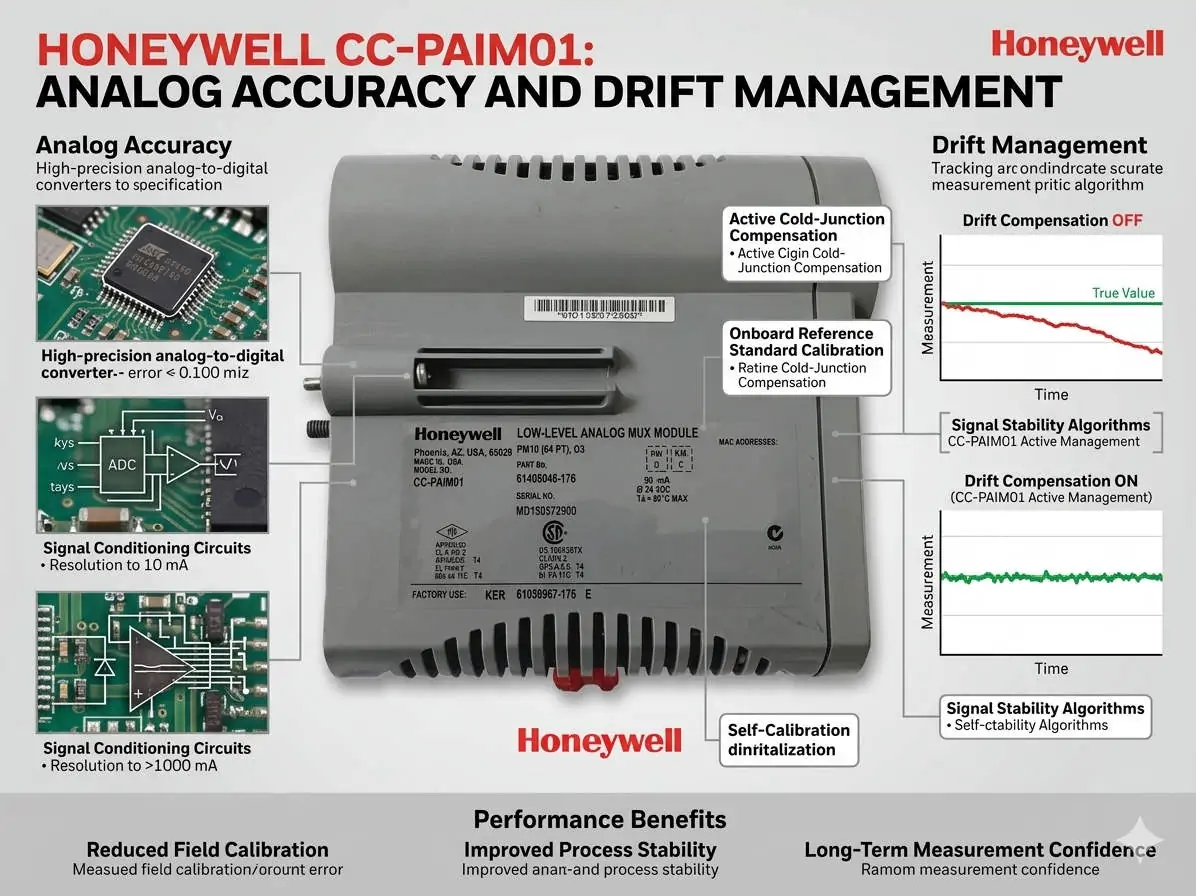
Honeywell CC-PAIM01 Analog Accuracy and Drift Management

Honeywell CC-PAIM01: Analog Accuracy and Drift Management

Maximizing Precision: The Role of Temperature Compensation in CC-PAIM01 Modules

The Critical Value of Thermal Stability in Analog Inputs

The Honeywell CC-PAIM01 analog input module plays a vital role in maintaining high-accuracy signal acquisition. In volatile industries like petrochemicals and pharmaceuticals, thermal drift can compromise process stability. Even minor temperature fluctuations can lead to measurement bias. Therefore, engineers must prioritize internal temperature compensation to ensure product quality. Accurate field calibration maintains signal integrity and prevents the need for premature hardware replacement.

Honeywell CC-PAIM01 Analog Accuracy and Drift Management

Honeywell CC-PAIM01 Analog Accuracy and Drift Management

Understanding the Impact of Temperature Drift Coefficients

While the CC-PAIM01 includes built-in compensation, environmental stress and component aging eventually introduce drift. A typical drift coefficient of ±0.01%/°C might appear insignificant at first glance. However, in high-precision flow or pressure loops, these errors accumulate quickly. As a result, uncompensated drift creates offset errors in 4–20 mA signals. This issue is particularly prevalent in outdoor cabinets that lack strict climate control.

Maintaining High-Resolution Signal Fidelity

Thermal stability directly influences the effectiveness of high-resolution A/D conversion. When temperatures shift, the resulting offset errors reduce the module’s effective resolution. This loss of fidelity can trigger unnecessary control loop oscillations in complex DCS environments. Moreover, advanced control strategies like tight-tolerance PID loops become less reliable. Consistent thermal management ensures that the module provides the granular data required for modern factory automation.

Professional Field Calibration Procedures

Successful calibration requires a stable environment and precise tools. Our team at Powergear X Automation recommends following these technical steps:

  • Isolate the input channel from the process.
  • Connect a precision signal source with ±0.005% accuracy.
  • Allow the module to thermally stabilize for 45 minutes.
  • Execute zero and span calibration via DCS engineering tools.
  • Apply multi-point checks at 4, 12, and 20 mA.

Strategic Cabinet Thermal Management

Hardware placement significantly affects long-term performance. Always install modules away from heat-generating components like power supplies or VFDs. Ideally, maintain cabinet temperature variations within a ±5°C range. In one refinery project, relocating a module 15 cm away from a heat source reduced alarms by 60%. Therefore, physical layout is just as important as software configuration for system reliability.

Expert Insights from Powergear X Automation

At Powergear X Automation, we believe technical discipline drives operational excellence. Many engineers misdiagnose grounding noise as temperature drift. Always verify your single-point grounding and use shielded twisted-pair cables before recalibrating. By combining proper installation with routine verification, you extend the lifecycle of your Honeywell assets while ensuring peak performance.

Technical Summary Checklist

  • ✅ Verify temperature compensation curves during commissioning.
  • ✅ Use precision calibrators for all analog loop checks.
  • ✅ Maintain strict physical separation from power cables.
  • ✅ Implement annual calibration for critical control loops.
  • ✅ Ensure firmware compatibility before replacing legacy modules.

Industrial Application Scenarios

  • Pharmaceutical Batch Processing: Maintaining strict temperature-dependent chemical reactions.
  • Oil and Gas Custody Transfer: Ensuring highly accurate flow measurements for billing.
  • Power Generation: Monitoring turbine pressure sensors in high-heat environments.

Implementation FAQ

Q1: When should I prioritize recalibration over module replacement?
If you notice a consistent offset that correlates with seasonal temperature changes, recalibration is the first step. Modules usually last over a decade, but their compensation curves may shift after 3 to 5 years of continuous operation.

Q2: How does the CC-PAIM01 handle extreme outdoor environments?
While rated for -20°C to +60°C, the module performs best when shielded from direct sunlight. We recommend using air-conditioned panels or sun shields to keep the internal cabinet temperature stable near 25°C.

Q3: What is the biggest mistake made during field calibration?
Skipping the thermal “warm-up” period is a common error. If you calibrate a cold module immediately after opening the cabinet, the settings will drift again as the module reaches its operating temperature.

For more technical guides and high-quality automation hardware, visit the Powergear X Automation website.

Expert Tips for Mapping HART QV with CC-PAIH51 Modules

Honeywell CC-PAIH51 Guide: Multi-Variable HART Integration

Unlocking Multi-Variable Data: A Guide to Honeywell CC-PAIH51 HART Integration

The Strategic Value of the CC-PAIH51 in Modern DCS

The Honeywell CC-PAIH51 module acts as a powerful gateway within the Experion PKS architecture. It enables seamless acquisition of multi-variable HART data from smart field instruments. In sectors like oil and gas or pharmaceuticals, transmitters often capture multiple process values simultaneously. For instance, a single device can monitor pressure, temperature, and flow. By mapping the Quaternary Variable (QV), engineers gain deeper process visibility without installing extra hardware. Consequently, this reduces wiring complexity and lowers the total cost of ownership.

Expert Tips for Mapping HART QV with CC-PAIH51 Modules

Expert Tips for Mapping HART QV with CC-PAIH51 Modules

HART Multi-Variable Support and Engineering Impact

The CC-PAIH51 supports extensive HART 5, 6, and 7 structures, including PV, SV, TV, and QV. Typically, the module retrieves the QV via HART Command 9 or Command 3. If engineers fail to map these variables correctly in the DCS, they lose critical diagnostic data. In refinery applications, this missing information could hide early warning signs of sensor drift. Therefore, proper parsing ensures that secondary measurements contribute effectively to the overall control strategy.

Understanding Scan Time and Update Rate Constraints

HART polling cycles depend on the specific channel configuration and the number of devices on the loop. Generally, secondary variable updates occur more slowly than the primary 4–20 mA analog signal. As a result, the QV is not ideal for high-speed, fast control loops. However, it remains highly valuable for asset monitoring and predictive maintenance. Misusing these variables in critical control logic can lead to sluggish system responses and operational instability.

The Importance of DD/EDD File Compatibility

Accurate interpretation of HART variables relies on matching Device Description (DD) files with the Experion library. If the DD file is outdated, the CC-PAIH51 may read raw data but fail to scale it. This often leads to “unknown parameter” errors on the operator station. Brownfield upgrades frequently encounter this specific challenge. At Powergear X Automation, we recommend verifying your DD library before any major system commissioning to avoid these common integration hurdles.

A Step-by-Step Guide to Parsing the HART QV

The CC-PAIH51 does not expose the Quaternary Variable automatically; it requires explicit configuration. Follow these technical steps for successful mapping:

  • Initialize digital communication over the 4–20 mA loop to identify the HART device.
  • Use standard HART commands to extract dynamic variables like the QV.
  • Assign the QV to a specific parameter block within the Control Builder configuration.
  • Apply correct engineering units and scaling based on the supported DD file.

Our field experience shows that QV issues often stem from missing software files rather than hardware defects. Updating the library usually restores data immediately.

Installation Standards for High Signal Integrity

Reliable HART communication requires a minimum loop resistance, typically around 250 Ohms. In large petrochemical plants with long cable runs, insufficient resistance can prevent successful QV polling. Always use shielded twisted-pair cables to protect the signal from external noise. Furthermore, ground the shields at the control cabinet end only. This practice prevents ground loops that might corrupt digital communication between the field and the DCS.

Addressing and Surge Protection in Harsh Environments

Verify that your transmitters operate in the correct HART addressing mode. Most devices should use point-to-point mode at address 0 to ensure the CC-PAIH51 recognizes all variables. Additionally, industrial environments often face lightning risks or electromagnetic interference. Installing external surge protectors compliant with IEC 61000-4 is essential for offshore platforms. Failure to protect these loops can cause intermittent loss of HART data, often misdiagnosed as module failure.

Expert Insights from Powergear X Automation

As experts at Powergear X Automation, we believe the CC-PAIH51 is more than a simple I/O module. It is a diagnostic engine that transforms basic analog loops into rich data streams. Successful integration requires a holistic approach, aligning device firmware with DCS software versions. We suggest a “pre-install audit” of your transmitter DD files to ensure a smooth startup. If you need help selecting the right Honeywell components, our team is ready to assist.

Technical Implementation Checklist

  • ✅ Verify loop resistance meets the 250 Ohm HART requirement.
  • ✅ Confirm the transmitter firmware supports HART Command 3 or 9.
  • ✅ Ensure the Experion DD library includes the latest device versions.
  • ✅ Use dedicated metallic trays to segregate signal and power cables.
  • ✅ Assign QV parameters to the correct AI channel extended blocks.

Solution Scenarios

  • Coriolis Flowmeter Monitoring: Using QV to track fluid density and temperature for mass flow accuracy.
  • Advanced Pressure Sensing: Monitoring sensor electronics temperature via QV to predict transmitter failure.
  • Asset Management: Routing diagnostic flags from field instruments directly to maintenance workstations.

Frequently Asked Questions

Q1: When is it necessary to enable QV in a HART-enabled system?
You should enable QV when using multi-variable transmitters, such as mass flowmeters or complex pressure sensors. If the device captures density, concentration, or internal diagnostics, QV provides this data without requiring additional physical I/O modules.

Q2: Can the CC-PAIH51 work with older HART 5 transmitters?
Yes, the module is backward compatible with HART 5, 6, and 7. However, the available variables depend on the device’s own capabilities. Some older HART 5 devices may only support PV and SV, so check your instrument manual before configuration.

Q3: What is the most effective way to troubleshoot missing QV data?
First, check the HART communication status in the DCS. If the primary variable is fine but QV is missing, the problem is likely a missing DD file or an unmapped parameter block. Ensure the device address is set to 0 and that the loop resistance is sufficient.

Understanding Honeywell CC-GAOX21 for Experion PKS DCS Systems_

Understanding Honeywell CC-GAOX21 for Experion PKS DCS Systems

Maximizing Precision with the Honeywell CC-GAOX21 Analog Output Module

Strategic Value of CC-GAOX21 in Process Control

The Honeywell CC-GAOX21 module delivers stable analog output signals within the Experion PKS architecture. Engineers rely on its deterministic performance to drive critical actuators in harsh industrial environments. Whether managing control valves or variable speed drives, this module maintains high-integrity loops. In the petrochemical and pharmaceutical sectors, accuracy directly correlates with product consistency. Furthermore, its reliable hardware design ensures long-term uptime for complex plant operations.

Understanding Honeywell CC-GAOX21 for Experion PKS DCS Systems_

Technical Insights into Signal Forcing and FMS

A common technical question involves the Forced Maintenance Signal (FMS) capability. However, the CC-GAOX21 does not natively provide a standalone hardware FMS mode. Instead, the Honeywell DCS handles signal forcing at the controller or software level. Engineers typically execute these forces through Control Builder or the Experion Station. Consequently, the module simply executes the digital command it receives from the C300 controller. This centralized logic improves safety by maintaining a clear audit trail.

Optimizing Loop Stability and Response Time

The update rate of the CC-GAOX21 significantly impacts PID control loop stability. Faster refresh cycles reduce dead time and prevent hunting in sensitive flow applications. Moreover, high-resolution output circuitry ensures precise positioning of field devices. Poor resolution often leads to inconsistent dosing or mechanical wear on actuators. Therefore, maintaining a high-performance output stage is essential for meeting strict ISA-84 safety standards.

Installation Guidance for High-Noise Environments

Industrial plants often present significant electromagnetic interference (EMI) challenges. We recommend using high-quality shielded twisted pair cables for all analog outputs. Always ground the shield at the DCS end only to prevent ground loops. In addition, proper surge protection is vital for long cable runs to outdoor instruments. Without external isolators, electrical transients can damage the sensitive output stage. Secure wiring practices ensure that forced signals remain stable during critical maintenance tasks.

Powergear X Automation: Expert Engineering Analysis

At Powergear X Automation, we prioritize system-level diagnostics over hardware complexity. The simplicity of the CC-GAOX21 makes it a reliable workhorse for factory automation. We often see engineers searching for “hardware forcing” switches that do not exist on this module. Instead, you must verify your user permissions and controller firmware within the software environment. Properly configured software forcing provides better security than physical hardware overrides.

Field Maintenance Checklist

  • ✅ Verify controller permissions before attempting to force signals.
  • ✅ Ensure shielded cables are grounded only at the DCS side.
  • ✅ Install external surge protectors for all outdoor actuators.
  • ✅ Check firmware compatibility between the module and C300 controller.
  • ✅ Validate output resolution during the initial loop commissioning.
  • ✅ Review audit logs after completing maintenance forcing operations.

Industrial Application Scenarios

  • Chemical Dosing: Managing precise reactant flow rates in pharmaceutical batch reactors.
  • Turbine Control: Driving fuel valves for stable power generation in utility plants.
  • Pressure Regulation: Controlling gas headers in complex refinery distribution networks.

Frequently Asked Questions (FAQ)

Q1: Does the CC-GAOX21 support local Forced Maintenance Signal (FMS) modes?

No, this specific module does not include a hardware-based FMS switch. You must implement all signal forcing through the Experion PKS software environment. This approach ensures that all overrides are logged and monitored by the system supervisor.

Q2: How can I troubleshoot an unstable analog output signal?

Start by inspecting the cable shielding and grounding points. If the noise persists, check for interference from nearby high-voltage power lines. In many cases, adding a dedicated signal isolator can clean up the loop performance effectively.

Q3: What are the risks of forcing signals during live operations?

Forcing an output bypasses the normal control logic, which can lead to process upsets. Always verify the safety implications before overriding a signal. We recommend using role-based access control to limit forcing privileges to senior engineers only.

1769-OF4 vs 1769-OF4CI: CompactLogix Analog Output Guide

1769-OF4 vs 1769-OF4CI: CompactLogix Analog Output Guide

Comparing 1769-OF4 and 1769-OF4CI in CompactLogix Systems

Selecting the right analog output module is vital for system stability in industrial automation. Engineers often ask if the 1769-OF4 and 1769-OF4CI are interchangeable. While both belong to the Allen-Bradley CompactLogix family, they serve distinct electrical purposes. This guide explores their technical nuances, signal behaviors, and selection criteria.

1769-OF4 vs 1769-OF4CI: CompactLogix Analog Output Guide

Core Functional Differences and Signal Support

The primary distinction lies in the supported signal types. The 1769-OF4 acts as a universal module. It supports both voltage and current outputs across its four channels. In contrast, the 1769-OF4CI only supports current loops. It specifically handles 0–20 mA or 4–20 mA signals. Therefore, you cannot use the OF4CI if your actuators require a 0–10V signal.

According to reports, the transition toward 4–20 mA standards dominates modern process industries. Current loops offer superior resistance to electromagnetic interference. Consequently, many designers now prefer specialized modules like the 1769-OF4CI for new installations. This specialization reduces the risk of accidental voltage spikes in sensitive current-controlled loops.

The Role of Isolation in Signal Integrity

Signal noise often disrupts factory automation performance. The 1769-OF4CI offers enhanced current-loop isolation compared to the general-purpose OF4. This design choice minimizes ground loop issues in complex electrical environments. High-power motors and variable frequency drives often generate significant electrical noise. Moreover, isolated channels prevent a fault in one loop from affecting other channels.

In my experience at Powergear X Automation, ground loops cause most intermittent analog failures. Using a dedicated current module like the 1769-OF4CI often resolves these stability issues. It simplifies the grounding strategy for the entire control cabinet. This reliability is essential for industries like oil and gas where precision is mandatory.

Simplifying Configuration and Commissioning

The 1769-OF4 requires careful per-channel configuration in Studio 5000. Engineers must manually select between voltage or current modes. This flexibility occasionally leads to human error during rapid deployment. However, the 1769-OF4CI removes this complexity entirely. Since it only supports current, the configuration process becomes much faster and safer.

Standardizing on the 1769-OF4CI reduces spare parts inventory for current-only plants. It also prevents technicians from accidentally wiring a voltage device to a current-configured port. In large-scale DCS applications, such small efficiencies significantly reduce total commissioning time. Simple hardware often leads to more robust software logic.

Technical Maintenance and Installation Tips

  • Always verify the impedance of your field devices before installation.
  • Use twisted-pair shielded cables to further reduce signal degradation.
  • Ensure the external 24V DC power supply remains within specified tolerances.
  • Check the P&ID drawings to confirm no legacy voltage actuators remain.
  • Apply ferrules to all wire ends to ensure vibration-resistant connections.

Strategic Selection: Which Module Should You Buy?

The 1769-OF4 remains the best choice for versatile maintenance needs. It covers every scenario by supporting mixed signal types. Therefore, keep the OF4 in stock for legacy systems with varying requirements. On the other hand, the 1769-OF4CI is the superior choice for modern, current-only architectures. It provides better noise immunity and simpler long-term management.

For high-quality components and expert technical support, visit Powergear X Automation. We provide genuine industrial automation parts to keep your production lines running efficiently. Our team understands the critical nature of PLC hardware compatibility in modern manufacturing.

Application Scenario: Chemical Dosing Control

In a chemical processing plant, precision dosing pumps rely on 4–20 mA signals. The environment contains heavy electrical noise from mixing motors. Here, the 1769-OF4CI is the ideal solution. Its isolated current outputs ensure the pump speed remains constant. This prevents chemical imbalances and ensures high product quality. The dedicated current path protects the CompactLogix backplane from external surges.

Frequently Asked Questions

Q: Can I replace a 1769-OF4 with a 1769-OF4CI without changing the PLC code?
A: No, you must update the I/O configuration in your programming software. The controller must recognize the specific module profile to communicate correctly. Failing to update the hardware profile will result in an I/O configuration fault.

Q: What happens if my loop resistance exceeds the module’s limit?
A: The output will saturate, meaning the signal cannot reach 20 mA. This often causes control valves to stay partially closed. Always calculate the total loop resistance, including wire length, before choosing your module.

Q: Is the terminal block interchangeable between these two modules?
A: Most 1769 series modules use the same 18-point terminal blocks. However, the internal wiring layout differs between voltage and current modules. You must re-verify your wiring diagram to prevent damaging the 1769-OF4CI or your field device.

Troubleshooting Schneider 140AVI03000 Broken Wire Faults

Modicon 140AVI03000 Guide: Analog Input & Loop Diagnostics

Understanding Broken Wire Detection Logic

The Schneider Electric 140AVI03000 analog input module serves as a cornerstone for signal acquisition in high-stakes industrial automation. This Modicon Quantum component reliably captures low-level signals like 4–20 mA from various field instruments. In my experience at Powergear X Automation, we often see engineers treat “Broken Wire” alarms as simple hardware glitches. However, this diagnostic feature is a critical safety tool that prevents process deviations in oil, gas, and pharmaceutical sectors.

The 140AVI03000 utilizes advanced loop supervision to monitor input current levels continuously. When the current falls below a specific threshold, typically 3.5 mA, the module triggers a fault. This mechanism ensures the PLC does not mistake a failed sensor for a valid low process reading. Consequently, operators can trust that their flow or pressure data reflects actual field conditions.

Troubleshooting Schneider 140AVI03000 Broken Wire Faults

Enhancing System Stability Through Input Isolation

Electrical noise from Variable Frequency Drives (VFDs) or large motors often plagues industrial environments. The 140AVI03000 offers robust channel-to-bus isolation to combat these interference issues. This isolation prevents ground loops and induced noise from causing momentary current drops. Without this protection, control systems frequently suffer from “ghost” alarms that disrupt production cycles.

Avoiding Common Wiring Topology Errors

Compatibility with both 2-wire and 4-wire transmitters makes this module versatile for factory automation. Nevertheless, technicians often confuse the power sourcing requirements during the commissioning phase. The 140AVI03000 does not always provide loop power for every configuration. Misunderstanding this distinction remains a leading cause of immediate Broken Wire faults upon system startup.

Proven Field Strategies for Maintenance and Reliability

Statistical data suggests that over 60% of analog signal failures stem from external wiring rather than internal module defects. Before replacing expensive hardware, follow these field-tested steps:

Measure the loop current using a high-precision multimeter.

Verify the external 24 VDC supply for all 4-wire transmitters.

Confirm that the wiring polarity matches the official Schneider diagrams.

Check terminal tightness, especially in high-vibration areas like pump skids.

Install ferrules on all analog signal wires to ensure permanent contact.

Optimizing Shielding and Grounding Standards

Improper grounding often creates intermittent faults that are difficult to diagnose. Experts follow IEC 61158 standards by grounding the cable shield at only one end. Usually, the control cabinet serves as the best single-point ground location. Floating shields or multiple ground points create circulating currents, which mimic the symptoms of a physical break in the wire.

Author Insights: The Future of Analog Diagnostics

At Powergear X Automation, we believe that proactive diagnostics like those in the 140AVI03000 are non-negotiable for modern DCS and PLC architectures. While digital protocols like HART or Foundation Fieldbus are growing, the 4–20 mA standard remains the industry’s backbone. Investing in modules with “Broken Wire” detection ensures your facility meets the traceability requirements of highly regulated industries.

Application Scenarios

  • Chemical Processing: Monitoring hazardous pressure levels where signal loss could lead to tank overpressure.
  • Water Treatment: Ensuring continuous flow data for chemical dosing pumps to maintain water quality.
  • Oil & Gas Skids: Providing reliable feedback in high-vibration environments near large compression units.

Technical Best Practices Checklist

  • ✅ Use shielded twisted-pair cables for all low-level analog signals.
  • ✅ Separate signal cables from high-voltage power lines by at least 30cm.
  • ✅ Implement software filtering to ignore sub-millisecond signal transients.
  • ✅ Document all loop resistance values during the initial commissioning phase.
  • ✅ Test the module annually using a calibrated 4-20 mA loop simulator.

Frequently Asked Questions (FAQ)

Q1: How can I distinguish between a sensor failure and a module channel failure?

The most effective method is the “Channel Swap” test. Move the suspected field wire to a known working channel on the module. If the error moves with the wire, the issue lies in the field. If the error stays on the original channel, the 140AVI03000 hardware may require repair.

Q2: Does this module require specific configuration in EcoStruxure Control Expert?

Yes, you must enable the “Broken Wire” detection feature within the hardware configuration shortcut. If you use a 0–20 mA scale instead of 4–20 mA, you should disable this feature. A 0 mA signal is “normal” for 0-20 mA loops, which would trigger false alarms.

Q3: Can I use the 140AVI03000 for high-accuracy temperature measurements?

While this module handles 4-20 mA signals from temperature transmitters, it is not a direct RTD or Thermocouple module. For maximum accuracy, ensure your transmitter is calibrated. The module’s 12-bit to 16-bit resolution (depending on settings) is generally sufficient for most industrial thermal processes.

For more technical guides, high-quality PLC components, and expert automation support, visit Powergear X Automation. We help you optimize your control systems for maximum uptime.

Yokogawa CP451-50: High-Performance DCS Processor Guide

Yokogawa CP451-50: High-Performance DCS Processor Guide

Understanding the Yokogawa CP451-50 High-Performance Processor for CENTUM VP

In the demanding world of industrial automation, the Yokogawa CP451-50 stands out as a critical component. This processor functions as the “brain” of the Distributed Control System (DCS). It manages complex logic and high-speed data processing. Many engineers view this module not just as hardware, but as a safeguard for plant stability. Therefore, understanding its technical advantages is essential for modern plant management.

Yokogawa CP451-50: High-Performance DCS Processor Guide

The Role of Deterministic Control in Large-Scale Plants

The CP451-50 earns its “high-performance” label by ensuring deterministic control. This means the controller executes tasks at precise intervals regardless of system load. In continuous process industries like oil and gas, timing is everything. If a PID loop lags during a pressure spike, the results can be catastrophic. Consequently, Yokogawa optimized this processor to handle massive I/O counts without compromising scan cycles.

Enhancing Communication Stability within Vnet/IP Networks

Modern factory automation relies heavily on seamless data exchange. The CP451-50 excels in managing Vnet/IP communications. It handles data traffic from Human Interface Stations (HIS) and safety systems simultaneously. Moreover, it maintains peak performance even during “alarm storms” or emergency shutdowns. This capability prevents the processor from becoming a bottleneck during critical operational transitions.

Built for Industrial Durability and Environmental Resilience

Reliability is a cornerstone of the E-E-A-T principle in control systems. The CP451-50 features a robust design that resists electromagnetic interference (EMC). While many commercial processors fail in high-temperature cabinets, this unit maintains thermal stability. My experience at Powergear X Automation shows that thermal management directly correlates with system lifespan. Using hardware with high design margins significantly reduces “grey zone” intermittent faults.

Best Practices for Power Quality and Hardware Installation

Superior hardware still requires a stable environment to function correctly. We often find that CPU instability stems from poor 24 VDC power quality rather than internal defects.

  • ✅ Verify DC power ripple levels during commissioning.
  • ✅ Use external surge suppressors in lightning-prone regions.
  • ✅ Ensure proper cabinet grounding to prevent signal noise.
  • ✅ Maintain clear airflow paths to prevent heat buildup.
  • ✅ Avoid mechanical stress on backplane connectors from heavy cables.

Strategies for Firmware Management and System Upgrades

Consistency in firmware is vital for long-term maintenance. Mixing different versions of CENTUM VP can lead to synchronization errors. Therefore, always consult the Yokogawa compatibility matrix before performing an online download. Our team suggests a “discipline-first” approach to software updates. This prevents subtle communication glitches during redundant controller switchovers.

Technical Summary Table

FeatureCP451-50 AdvantageImpact on Operations
ThroughputHigh-speed instruction executionTighter control over volatile processes
NetworkDual Vnet/IP supportReliable data flow during high traffic
DesignEnhanced thermal dissipationReduced risk of hardware failure
LongevityBackward compatible architectureLower Total Cost of Ownership (TCO)

Expert Commentary by Powergear X Automation

The shift toward “Smart Manufacturing” requires controllers that offer more than just basic logic. The CP451-50 represents a bridge between traditional DCS reliability and modern data demands. At Powergear X Automation, we believe that investing in high-headroom processors is a form of insurance. It allows for future expansions—like adding advanced process control (APC)—without replacing the entire infrastructure.

For genuine parts and expert technical support, we invite you to explore our solutions at Powergear X Automation. Our team helps you optimize your DCS for maximum uptime.

Real-World Application Scenarios

  • Petrochemical Refineries: Managing thousands of PID loops with sub-second response requirements.
  • LNG Terminals: Handling complex sequence tables for ship-to-shore loading operations.
  • Power Plants: Coordinating fast-acting control logic for turbine management and grid synchronization.

Frequently Asked Questions (FAQ)

1. How do I know if my current controller needs an upgrade?
Monitor your CPU load during peak production. If utilization consistently exceeds 60%, or if you experience “communication timeouts” during data-heavy operations, the CP451-50 is a necessary upgrade. High load leaves no room for emergency logic execution.

2. Can I replace an older CP451 model with the CP451-50 directly?
While physical mounting is often compatible, the software environment is the decider. You must verify that your current CENTUM VP revision supports the -50 variant. We recommend a full backup and a revision check to avoid “version mismatch” errors during the hot-swap process.

3. Does the CP451-50 improve plant safety metrics?
Indirectly, yes. By providing a stable, deterministic environment, it ensures that safety-related interlocks and alarms trigger without delay. A high-performance processor reduces the “jitter” in control responses, which is a key factor in maintaining safe operating envelopes.

Reliability Guide for Honeywell CC-TDOR01 Relay Output Modules

Reliability Guide for Honeywell CC-TDOR01 Relay Output Modules

How Honeywell CC-TDOR01 Modules Prevent Relay Contact Sticking

The Honeywell CC-TDOR01 Relay Output Module plays a vital role in modern control systems. In industries like oil and gas, a stuck relay can cause catastrophic failures. If a valve fails to close during an emergency, personnel safety is at risk. Therefore, Honeywell implements rigorous testing and diagnostic strategies to mitigate these risks.

Reliability Guide for Honeywell CC-TDOR01 Relay Output Modules

The Critical Impact of Contact Welding in Industrial Automation

Relay contact sticking, often called “welding,” occurs when contacts fuse together. This prevents the output from turning off, even when commanded. In factory automation, this leads to motors running unexpectedly or safety interlocks being bypassed. High-reliability sectors like chemical processing cannot afford these hidden failures. Consequently, Honeywell focuses on making these faults detectable through smart system architecture.

Verifying Output Integrity via Load Feedback Logic

The CC-TDOR01 does not include internal sensors to detect physical contact position. Instead, it relies on external feedback loops within the Experion PKS logic. Engineers typically pair the relay output with a digital input from the field device. If the controller sends an “OFF” command but the feedback remains “ON,” a discrepancy alarm triggers. This method ensures that stuck contacts do not remain hidden for long periods.

Manufacturing Stress Tests for Enhanced Reliability

Honeywell subjects every CC-TDOR01 module to intense stress testing during production. These tests include repeated on/off cycling under maximum rated loads. Technicians perform both hot and cold switching tests to simulate harsh plant environments. These procedures identify “micro-welding” issues before the hardware reaches the customer. As a result, the modules demonstrate high durability in continuous process applications.

Aligning Diagnostic Coverage with IEC 61508 Principles

While the CC-TDOR01 is not a standalone SIL-certified relay, its design supports safety standards. Honeywell encourages redundant feedback paths to increase diagnostic coverage. This approach aligns with IEC 61508 principles for safety-instrumented systems. By utilizing these system-level checks, operators can maintain a high level of process integrity. Furthermore, this architecture simplifies fault isolation during maintenance routines.

Expert Insights from Powergear X Automation

At Powergear X Automation, we observe that most relay failures stem from improper installation. Many technicians overlook the impact of high inrush currents from large solenoids. These surges cause rapid arcing, which is the primary cause of contact welding. We recommend always using interposing relays for heavy inductive loads. This practice protects your CC-TDOR01 and extends the lifespan of your DCS hardware.

Proven Field Practices for Long-Term Reliability

To maximize the life of your Honeywell modules, follow these technical guidelines:

  • Install External Surge Suppression: Use RC snubbers for AC loads and flyback diodes for DC loads.
  • Implement Periodic Proof Testing: Manually cycle critical outputs during scheduled shutdowns to verify operation.
  • Monitor Load Current: Ensure steady-state and inrush currents remain within the module’s specified limits.
  • Verify Terminal Assignments: Double-check wiring during upgrades to avoid accidental short circuits.

Application Scenario: Emergency Shutdown (ESD) Support

In an ESD scenario, a CC-TDOR01 might control a fuel shut-off valve. By integrating a limit switch feedback into the DCS, the system confirms the valve actually closed. If the relay sticks, the system immediately alerts the operator. This setup transforms a standard relay into a robust safety component through intelligent design.

For high-quality components and expert technical support, visit Powergear X Automation to explore our full range of Honeywell solutions.

FAQ: Understanding CC-TDOR01 Performance

Q1: Does the CC-TDOR01 have built-in surge protection?
No, it does not include internal suppression. You must install external diodes or snubbers to prevent arcing and contact welding.

Q2: Can I use this module for SIL-rated safety loops?
The module itself is not SIL-certified. However, it can be used in safety-related applications if you implement redundant feedback and logic-level diagnostics.

Q3: What is the most common cause of contact sticking in these modules?
Excessive inrush current from inductive loads like motor starters is the leading cause. Using an interposing relay is the best way to prevent this.

GE Fanuc RX3i Applications in Energy and Manufacturing

RX3i PLC: Powering Industrial Automation and Control Systems

The Versatile Powerhouse: GE Fanuc (Emerson) RX3i PLC in Modern Industrial Automation

The RX3i PLC is a flagship product. It was originally from GE Fanuc. Now it is part of Emerson’s suite. It is a critical asset in modern control. This platform is for demanding applications. It offers great reliability. It provides real-time processing. Its adoption is widespread. This confirms its preferred status.

Understanding the RX3i as a Programmable Automation Controller (PAC)

The RX3i is more than a PLC. It is a true PAC. It combines PLC ruggedness with advanced features. These include fast CPUs. It has deterministic Ethernet. It uses modular I/O. Its architecture is very scalable. It supports small machine control. It also runs large factory networks.

✅ Key Characteristics:

High-Speed Processing: It ensures minimal scan times.

Hot-Swap I/O: Replace modules without stopping.

Robust Communication: Supports PROFINET, Modbus, Serial.

System Integration: Handles safety and motion control.

Powering the Grid: Applications in the Energy and Utilities Sector

The energy industry needs robust control. Downtime is costly and hazardous. The RX3i manages key auxiliary functions.

It controls Balance of Plant in thermal plants. It manages boiler controls. And it handles cooling water systems. It aids substation automation. It controls wind and solar farms. Redundancy options are key here. Reliable systems cut unplanned outages.

From Wellhead to Refinery: Reliability in Oil and Gas Operations

The oil and gas sector uses the RX3i. It works in extreme environments.

Common applications include wellhead control. It manages pipeline compressor stations. It automates gas processing separation. And it integrates with SCADA systems. It works with certified safety systems. It manages remote I/O effectively.

Ensuring Public Health: Water and Wastewater Treatment Automation

Water facilities need stable control systems. Public safety depends on it. The RX3i is often chosen.

It controls raw water intake. It manages high-pressure pump stations. And it oversees aeration and sludge handling. Its longevity minimizes maintenance risks. It assures continuous, compliant operation.

Accelerating Production: High-Speed Discrete and Factory Automation

Manufacturing needs speed and synchronization. The RX3i enables higher throughput.

It is used in high-speed packaging. It controls complex assembly cells. And it integrates robotics smoothly. It connects with HMIs and VFDs. This creates adaptable production lines.

My Take: The Value Proposition of Emerson’s RX3i

The RX3i stays relevant for two reasons. It has backward compatibility. It is part of Emerson’s portfolio. This protects prior investment. It also allows for modernization.

It bridges field control and higher systems. These include DCS or MES layers. Engineers trust this workhorse. One platform serves many applications. This is its main advantage.

🔧 Technical Advantages in Implementation:

Simple configuration for redundant CPUs. It handles large tag databases well. It uses a standardized programming environment.

Seamless Data Exchange: Integration with SCADA and DCS Architectures

The RX3i is an intelligent I/O layer. It fits within larger supervisory architectures. It communicates with SCADA and DCS.

This allows reliable field-level control. It provides a stream of data. It supports standard industrial protocols. And it links legacy and modern equipment.

Conclusion: A Trusted Platform for Mission-Critical Control

The RX3i PLC is critically important. It combines high performance and rugged design. It has extensive communication capabilities. And t is a go-to solution for many industries. These include power generation and oil. It works in manufacturing and infrastructure. Its success proves its reliability.

FAQ: Expert Insights on RX3i Deployment

Q1: What is a common migration pitfall?

A common pitfall involves I/O configuration. The RX3i offers a migration path. Older programming was register-based. The new system is tag-based. This must be updated. Thorough testing is essential. This uses the new hardware’s full potential.

Q2: How does its PAC architecture help analytics?

The PAC architecture provides more power. It has greater memory capacity. This handles complex control logic. It manages direct, high-speed data connections. It can push data efficiently. This is great for real-time analytics. It aids predictive maintenance applications.

Q3: When should a smaller plant choose the RX3i?

Choose the RX3i for future scalability. Choose it for inherent redundancy. Use it for high-speed synchronization. Lighter-duty PLCs cannot guarantee this. It future-proofs your system. It provides better security features. And it simplifies later DCS or MES integration.

Explore Advanced Automation Solutions

Learn more about the RX3i PLC. See how it optimizes industrial processes. View specific application case studies. Please visit our website. Powergear X Automation provides expert solutions. We tailor them for complex environments.

Where High-Performance Industrial Automation Is Essential

Where High-Performance Industrial Automation Is Essential

Decoding the Dominance: Industries Reliant on Quantum PLCs in Industrial Automation

Quantum Programmable Logic Controllers (PLCs), a heritage technology from Modicon now central to Schneider Electric’s automation ecosystem, represent a benchmark for high-performance control systems. These controllers excel due to their robust modularity, dependable reliability, and powerful processing capability. They are specifically engineered to manage large-scale, complex, and mission-critical industrial processes, distinguishing them from standard factory automation PLCs. This analysis, informed by my experience at Powergear X Automation, explores the key sectors and demanding application environments where Quantum PLCs consistently deliver optimal control.

Where High-Performance Industrial Automation Is Essential

The Backbone of Process Industries: Chemical, Oil & Gas, and Water

The process industries mandate controllers capable of managing continuous, often volatile, operations with extreme precision. Quantum PLCs are the preferred choice here.

Refining and Chemical Manufacturing

Chemical and petrochemical facilities require exacting control over variables like temperature, pressure, flow rate, and chemical mixing. Quantum PLCs are extensively deployed to manage these continuous processes.

They provide the necessary reliability for high-risk operations.

Moreover, they integrate seamlessly with Distributed Control Systems (DCS) and SCADA platforms, a crucial feature for enterprise-wide process visibility.

This strong integration capacity, according to a recent IEEE report on industrial control stability, positions the Quantum line as a reliable bridge between field devices and supervisory systems.

Oil, Gas, and Midstream Operations

In the energy sector, from upstream extraction to downstream refining, reliability in harsh environments is non-negotiable.

Quantum PLCs actively automate critical functions across this value chain:

  • Pipeline monitoring and compressor station automation.
  • Refinery unit process control.
  • Managing non-Safety Instrumented System (SIS) controls—though often paired with SIS solutions for complete protection.

The PLC’s robust design allows it to operate reliably in extreme heat, cold, or remote, unconditioned locations, providing tangible operational experience.

Municipal and Industrial Water Treatment

Water and wastewater treatment plants are inherently distributed operations requiring constant, system-wide supervision. Quantum PLCs handle the sophisticated logic required for:

  • Pumping station sequences and lift station control.
  • Precise filtration and chemical dosing processes.
  • System-wide flow and level regulation.

Expert Insight: The Quantum platform’s inherent scalability suits municipalities with numerous remote, distributed sites. Its large I/O capacity efficiently consolidates control, avoiding the need for countless smaller controllers.

Power Generation and Large-Scale Energy Management

The complexity of power plant operation—be it fossil fuel, nuclear, or large-scale renewables—demands a controller with high I/O density and robust communication features.

Thermal and Renewable Power Plants

Quantum PLCs provide stable, high-availability control for critical power processes:

  • Boiler and combustion control systems in thermal power stations.
  • Turbine governor and auxiliary systems.
  • Substation automation and grid synchronization systems.
  • Monitoring and control of large wind and solar farms.

Key Technical Advantages:

  • ✅ High I/O Count Handling: Manages thousands of physical and virtual I/O points efficiently.
  • ⚙️ Network Versatility: Communicates reliably over Modbus TCP/IP, Ethernet/IP, and proprietary fieldbuses, essential for utility applications.

Heavy Industrial Manufacturing: Metals and Pulp/Paper

Manufacturing sectors characterized by continuous, high-speed material transformation rely on the Quantum for its speed and redundancy features.

Metals and Steel Production

Steel mills and primary metals processing require intense, real-time control.

  • Furnace control systems demand high processing speed and temperature accuracy.
  • Rolling mill automation relies on high-speed I/O processing to maintain product gauge and quality during rapid throughput.
  • Material-handling systems, particularly large cranes and conveyors, use the PLC’s complex logic capability.

Pulp and Paper Mills

The pulp and paper industry is defined by extensive continuous processes and high synchronization requirements.

  • Quantum PLCs manage the sequential and analog control of pulp digestion and chemical recovery.
  • They control the demanding processes of the paper machine wet and dry ends, requiring precise speed and tension control for consistent sheet formation.

Author’s Comment: The ability of Quantum PLCs to support CPU redundancy ensures maximum uptime in these 24/7 continuous operations, a critical factor given the high cost of unscheduled downtime in paper production.

Infrastructure and Large Machinery Automation

The stability of the Quantum platform makes it highly suitable for complex infrastructure and significant capital equipment.

Transportation and Smart Infrastructure

In large-scale public and private infrastructure, system reliability is paramount.

  • Transportation systems: Control for rail signaling, metro logistics, and automated baggage handling at airports.
  • Tunnel ventilation and fire safety systems.
  • District heating/cooling networks and large-building mechanical systems.

Its ability to manage physically distributed I/O across vast areas makes it an excellent choice for city-scale projects.

Heavy Equipment and Assembly Lines

Large machinery applications leverage the PLC’s robust architecture for complex, repetitive logic.

  • Automating gantry and overhead cranes.
  • Control systems for heavy mining machinery.
  • Managing complex sequencing on large automotive or aerospace assembly lines.

The capacity for handling complex motion and massive I/O points makes the Quantum an enduring choice for specialized machine builders.

Conclusion and Next Steps

Quantum PLCs maintain a dominant position in the demanding world of industrial automation. They specifically target applications that require high reliability, expansive process control, and seamless integration with supervisory systems. Industries like petrochemicals, power generation, heavy metals manufacturing, and critical infrastructure consistently choose the platform for its stability and scalability.

If you are currently evaluating a robust control system for a large-scale project—whether it involves continuous process control or complex machine automation—the Quantum family offers proven performance and longevity.

Interested in exploring how this high-performance technology can be specifically integrated into your facility? Click here to visit the Powergear X Automation website for detailed solutions and application case studies: https://www.powergearx.com/

Frequently Asked Questions (FAQ)

Q1: How does a Quantum PLC differ from a smaller, compact PLC in practical experience?

A: The main difference lies in scale and power. In my experience, a Quantum PLC handles significantly more complexity. It supports a much greater number of I/O points, offers built-in redundancy options (dual CPUs), and processes logic much faster, which is essential for continuous processes like distillation or rolling mills. Compact PLCs are generally limited to smaller machines or isolated automation tasks.

Q2: Can Quantum PLCs be used as a primary Safety Instrumented System (SIS)?

A: While the standard Quantum PLC is highly reliable and handles many non-SIS safety functions, it is generally not certified for use as a primary SIS component. For TÜV-certified functional safety (SIL 2/3), users should integrate dedicated Safety PLCs (like Schneider Electric’s own Triconex or specialized safety relays) with the Quantum, which acts as the primary process controller.

Q3: What role does its networking capability play in modern plant operations?

A: Its advanced networking is crucial. A Quantum PLC’s ability to use protocols like Modbus TCP/IP allows it to connect massive numbers of field devices and integrate seamlessly with higher-level systems (SCADA, MES, ERP) across an Ethernet plant network. This high-level connectivity facilitates data acquisition for analytics and digital transformation initiatives, which is vital for modern predictive maintenance and efficiency improvements.

Back to Top
Product has been added to your cart