
Over 50,000 hot-selling automation module components.
Troubleshooting 3500-62 Monitor OK, TX RX, and Bypass LED Meanings

Troubleshooting 3500/62 Monitor: OK, TX/RX, and Bypass LED Meanings

Advanced Diagnostic Guide for Bently Nevada 3500/62 Process Variable Monitor LED Indicators

Maximizing Operational Intelligence in Machinery Protection

The Bently Nevada 3500/62 serves as a vital bridge between field instrumentation and complex protection systems. This six-channel monitor processes critical variables like pressure, temperature, and flow. For field engineers, the front panel LEDs provide a real-time window into system health. Mastery of these indicators reduces Mean Time to Repair (MTTR) significantly. Consequently, teams can isolate faults without immediately resorting to external diagnostic software.

Troubleshooting 3500-62 Monitor OK, TX RX, and Bypass LED Meanings

Troubleshooting 3500-62 Monitor OK, TX RX, and Bypass LED Meanings

Interpreting the OK LED for System Integrity Verification

The OK LED acts as the primary heartbeat of the hardware. A solid green light confirms the module passed its internal self-tests successfully. Conversely, an extinguished or red LED signals a serious hardware fault or configuration error. Technicians often encounter a non-OK status after hot-swapping modules with mismatched firmware versions. Moreover, backplane communication failures frequently cause these intermittent drops. Maintaining a stable OK status is essential for SIL-rated safety loops in hazardous environments.

Analyzing TX/RX Indicators for Communication Health

The TX/RX LED monitors the data exchange between the module and the 3500 rack backplane. Rapid blinking indicates active and healthy digital communication. If the light remains off, the module is likely isolated from the system controller. This often points to wiring faults or incorrect baud rate settings in the rack configuration. In high-speed industrial automation environments, consistent communication ensures your DCS receives the most current process values.

Understanding the Safety Implications of the Bypass LED

The Bypass LED warns personnel when the module’s alarm or trip logic is inactive. A lit LED means the protection for one or more channels has been intentionally suppressed. Technicians use this mode during sensor calibration or routine maintenance to prevent false trips. However, leaving a module in bypass after service poses a severe risk to machinery. Therefore, many petrochemical plants integrate these bypass statuses directly into their SCADA alarm hierarchies for better visibility.

Proactive Maintenance and Installation Strategies

Successful deployment starts with verifying the module immediately after rack insertion. The OK LED should stabilize within a few seconds under normal conditions. If faults persist, check the slot configuration in the 3500 Rack Configuration Software. Additionally, observe the TX/RX behavior before assuming a hardware failure. Many integration issues stem from protocol mismatches rather than physical component damage. Always log every bypass event to ensure compliance with API 670 standards.

Expert Commentary from Powergear X Automation Limited

At Powergear X Automation Limited, we see a growing trend toward predictive maintenance. While the 3500/62 is a legacy powerhouse, its role in modern DCS and PLC architectures remains critical. We recommend that engineers treat the LEDs as a primary diagnostic tool rather than just “status lights.” High-reliability systems depend on the technician’s ability to read these visual cues quickly. Always maintain a validated configuration backup to facilitate rapid module replacement during outages.

Solution Scenarios for Field Engineering

  • Oil & Gas Refineries: Use the 3500/62 to monitor compressor suction pressure and ensure anti-surge protection.
  • Power Generation: Monitor steam turbine bearing temperatures to prevent catastrophic mechanical failure.
  • Chemical Processing: Integrate flow rate monitoring into safety instrumented systems (SIS) for emergency shutdowns.

Technical Troubleshooting Checklist

  • ✅ Confirm rack power supply voltage before replacing a non-responsive module.
  • ✅ Verify firmware compatibility between the 3500/62 and the Rack Interface Module (RIM).
  • ✅ Ensure all proximity probe or RTD wiring is secure to prevent “Not OK” channel faults.
  • ✅ Check that the bypass key switch on the rack is in the correct position for operation.

Frequently Asked Questions (FAQ)

Q: Can a module be “OK” if the sensors are disconnected?
Usually, no. If a channel is configured and the sensor is missing, the module will report a “Not OK” status for that specific channel, which often clears the global OK LED. You must bypass or configure unused channels to maintain a green OK status.

: How does the TX/RX LED help with Modbus troubleshooting?
If your external gateway isn’t receiving data, check the TX/RX LED. If it isn’t blinking, the 3500/62 isn’t being polled correctly by the Rack Interface Module. This narrows the problem to the rack’s internal bus or configuration software.

Q: Is it safe to hot-swap the 3500/62 while the plant is running?
The 3500 system supports hot-swapping; however, you must engage the module bypass first. Without a bypass, the transition might cause a transient signal that triggers a false trip in the protection logic.

For high-quality modules and expert technical support, visit the official Powergear X Automation Limited website to view our latest inventory.

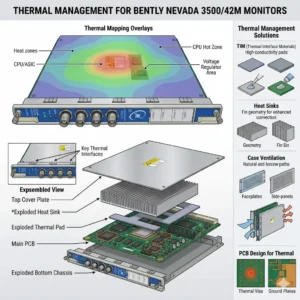
Thermal Management for Bently Nevada 3500-42M Monitors

Thermal Management for Bently Nevada 3500/42M Monitors

Thermal Management Risks for Bently Nevada 3500/42M Proximitor Seismic Monitors

Critical Role of Vibration Monitoring in Industrial Automation

The Bently Nevada 3500/42M serves as a vital component in high-reliability vibration and position monitoring. In sectors like oil and gas or power generation, this module protects critical rotating machinery. However, thermal stress can compromise its signal accuracy. Excessive heat directly undermines system stability. As a result, operators may face false alarms or missed mechanical faults.

Thermal Management for Bently Nevada 3500-42M Monitors

Thermal Management for Bently Nevada 3500-42M Monitors

Technical Impact of Overheating on Signal Integrity

The standard operating range for the 3500/42M typically spans from 0°C to 65°C. When internal temperatures exceed these limits, signal conditioning circuits begin to drift. Moreover, high heat accelerates the aging of electrolytic capacitors. This degradation shortens the module’s overall lifespan significantly. In many refinery environments, poor ventilation pushes temperatures above 70°C, causing intermittent channel dropouts.

Operational Risks and Response Stability Challenges

Heat introduces electrical noise and ADC instability within the monitor’s analog front-end. Consequently, proximitor signal scaling may drift away from calibrated values. These deviations often lead to false high-vibration alarms. Such errors trigger unnecessary machinery shutdowns and lost production time. Conversely, drift might mask early-stage bearing wear. This delay turns minor maintenance into a catastrophic unplanned outage.

System-Level Reliability in Rack Architectures

The 3500 system architecture relies on seamless integration between modules and power supplies. An overheating 3500/42M module increases the total thermal load of the entire rack. This heat transfer can trigger system-wide watchdog resets. Furthermore, redundant configurations suffer when thermal stress affects both primary and backup channels simultaneously. Maintaining a balanced thermal profile is essential for modern control systems.

Installation and Maintenance Best Practices

Field experience suggests that most overheating issues stem from installation errors rather than hardware defects. Engineers must prioritize cabinet thermal management to ensure longevity. Proper airflow prevents heat pockets from forming around sensitive electronics. In addition, dust accumulation acts as a thermal insulator, blocking essential cooling paths.

  • ✅ Maintain minimum airflow clearance at the top and bottom of the rack.
  • ✅ Avoid placing racks near heat sources like VFD panels or transformers.
  • ✅ Inspect and clean cabinet air filters monthly in dusty environments.
  • ✅ Utilize positive-pressure cabinets to keep internal components clean.
  • ✅ Verify total rack power load against the Power Supply Unit (PSU) rating.

Strategic Selection and Compatibility Insights

The 3500/42M offers backward compatibility within the 3500 rack series. However, hardware revisions and firmware versions must align for optimal performance. Older racks often lack the optimized airflow designs found in newer chassis. Therefore, users should verify rack revision levels before performing upgrades. Ignoring environmental conditions during selection often leads to premature module failure.

Expert Commentary from Powergear X Automation Limited

At Powergear X Automation Limited, we believe thermal management is a core part of machinery protection strategy. High-performance modules like the 3500/42M require stable environments to deliver precision. We often see random alarms disappear simply by redistributing modules to improve airflow. Treating cooling as an afterthought is a risk no plant manager should take. For high-quality automation parts and expert support, explore our solutions at Powergear X Automation Limited.

Application Scenarios and Solutions

  • High-Speed Turbines: Requires precise displacement monitoring where even 1°C of drift can trigger a safety trip.
  • Refinery Compressors: Utilizes seismic monitoring in harsh, ambient heat conditions requiring active cooling.
  • Remote Pumping Stations: Depends on self-diagnostics to alert maintenance teams of thermal rising before a fault occurs.

Frequently Asked Questions (FAQ)

Q: How can I detect overheating before it causes a system shutdown?
We recommend using thermal imaging cameras during routine inspections. This technique reveals hot spots that standard temperature sensors might miss. Also, monitor the “System Event List” for frequent self-test warnings or intermittent channel status changes.

Q: Will adding more fans to the cabinet always solve the problem?
Not necessarily. If the internal rack airflow is blocked by cabling or overpacking, external fans won’t help. You must ensure a clear path for air to move through the module slots themselves.

Q: Does the 3500/42M have a built-in automatic shutdown for heat?
The module includes self-protection logic, but it usually triggers a “Module Fault” rather than a clean shutdown. By the time this happens, your machinery protection is already compromised. Prevention through environmental control is the only safe approach.

Looking for reliable Bently Nevada modules or expert advice on rack configuration? Visit Powergear X Automation Limited today for global shipping and technical excellence.

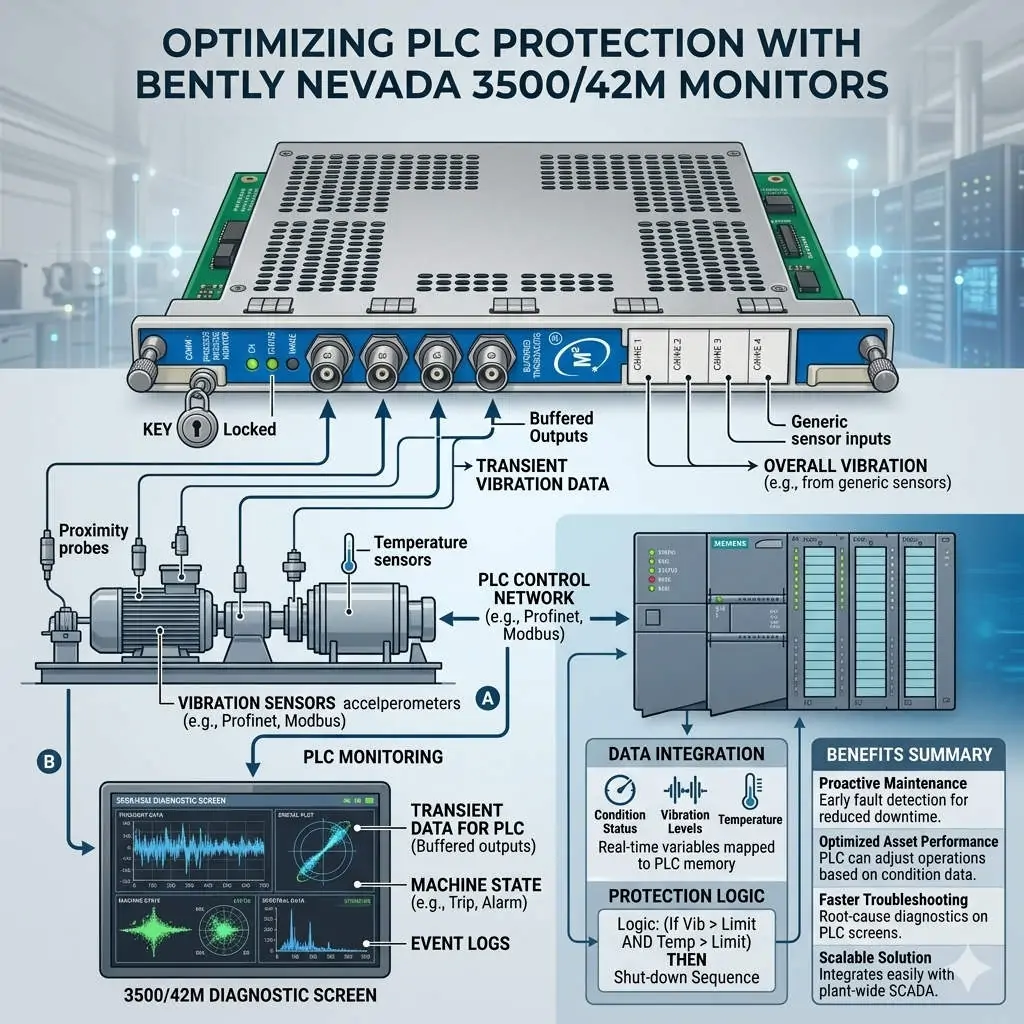
Optimizing PLC Protection with Bently Nevada 3500-42M Monitors

Optimizing PLC Protection with Bently Nevada 3500/42M Monitors

Optimizing Machinery Protection with Bently Nevada 3500/42M Proximitor Seismic Monitors

The Vital Role of 3500/42M in Industrial Automation

The Bently Nevada 3500/42M serves as a critical guardian for high-value rotating assets. It integrates multiple sensor inputs to facilitate precise alarm decisions across various industrial sectors. This module significantly enhances safety in oil and gas, petrochemical, and power generation environments. By reducing false trips, it ensures continuous production while maintaining strict safety standards. Consequently, plants can avoid the massive financial losses associated with unplanned downtime.

Optimizing PLC Protection with Bently Nevada 3500-42M Monitors

Optimizing PLC Protection with Bently Nevada 3500-42M Monitors

Advanced Boolean Logic for Tailored Control Systems

The 3500/42M supports sophisticated Boolean alarm logic, including OR, AND, and NOT configurations. Engineers use OR logic for early fault detection when any single bearing exceeds limits. Conversely, AND logic requires multiple simultaneous conditions, which effectively filters out transient noise during machine startup. Furthermore, NOT logic allows operators to suppress specific alarms during necessary maintenance intervals. These flexible configurations ensure that the monitor reacts only to genuine mechanical threats.

Enhancing Reliability Through Voting and Time Delays

Reliability improves further through the integration of time delays and channel voting behaviors. For instance, a 2-out-of-3 (2oo3) logic prevents a single faulty sensor from triggering a full system shutdown. This approach aligns perfectly with API 670 standards for machinery protection systems. As a result, the 3500/42M balances the need for sensitivity with the necessity of operational stability. Proper delay settings prevent nuisance trips caused by momentary process disturbances.

Strategic Multi-Channel Integration for Factory Automation

Each module processes both proximity and seismic inputs, allowing for comprehensive multi-channel correlation. Instead of viewing sensors in isolation, engineers can analyze radial and axial vibration together. This holistic view significantly improves the accuracy of fault diagnosis and predictive maintenance. Moreover, integrating these signals into a broader DCS or PLC network streamlines plant-wide monitoring. Precise data correlation extends equipment life by preventing both under-protection and unnecessary mechanical stress.

Best Practices for Field Commissioning and Maintenance

Successful deployment requires more than just hardware installation; it demands rigorous logic validation. During commissioning, experts at Powergear X Automation Limited recommend avoiding default OR logic for all shutdown parameters. Instead, use simulated signals to test the response of every logic gate before the actual startup. Additionally, ensure that maintenance bypasses are clearly visible on human-machine interfaces (HMI). Proper grounding and shielded cabling remain essential to prevent intermittent signals in high-vibration zones.

Author Insights: The Future of Machinery Protection

At Powergear X Automation Limited, we believe the 3500/42M represents a shift toward more intelligent protection. Modern industry reports from MarketsandMarkets suggest the vibration monitoring market will grow as AI integration increases. However, the fundamental reliability of hardware-based logic remains the gold standard for safety. We advise users to maintain strict firmware version control to ensure seamless backward compatibility. Investing in high-quality monitoring today prevents catastrophic mechanical failures tomorrow.

Industrial Solution Scenarios

  • Gas Turbine Protection: Use AND logic with 2oo3 voting to protect turbines from excessive vibration during load changes.
  • Remote Pumping Stations: Implement OR logic for early alerts to dispatch maintenance teams before a failure occurs.
  • Refinery Compressors: Combine NOT logic with digital inputs to safely calibrate probes without tripping the unit.

Technical Implementation Checklist

  • ✅ Verify firmware compatibility between the 3500/42M and the existing 3500 rack.
  • ✅ Use single-point grounding for all shielded cables to eliminate ground loops.
  • ✅ Configure “Alert” levels with OR logic for maximum sensitivity.
  • ✅ Configure “Danger” levels with AND logic to ensure high-integrity shutdowns.

Frequently Asked Questions (FAQ)

Q: How does the 3500/42M improve Mean Time Between Failures (MTBF)?
By using AND logic and voting, the system filters out “nuisance” data that would otherwise cause unnecessary wear from frequent startups and stops. This stabilization allows the machinery to operate within its design limits more consistently.

Q: Can I mix different sensor types on a single 3500/42M module?
Yes, the 42M is highly versatile. It can process signals from Proximitor sensors, velocity transducers, and accelerometers simultaneously, provided the configuration software is updated to match the specific transducer constants.

Q: What is the most common error during module replacement?
Failure to upload the specific configuration file from the old module often leads to incorrect logic behavior. Always back up your 3500 rack configuration using the Bently Nevada software before attempting a hardware swap.

For high-quality industrial spare parts and expert technical support, visit the official Powergear X Automation Limited website today.

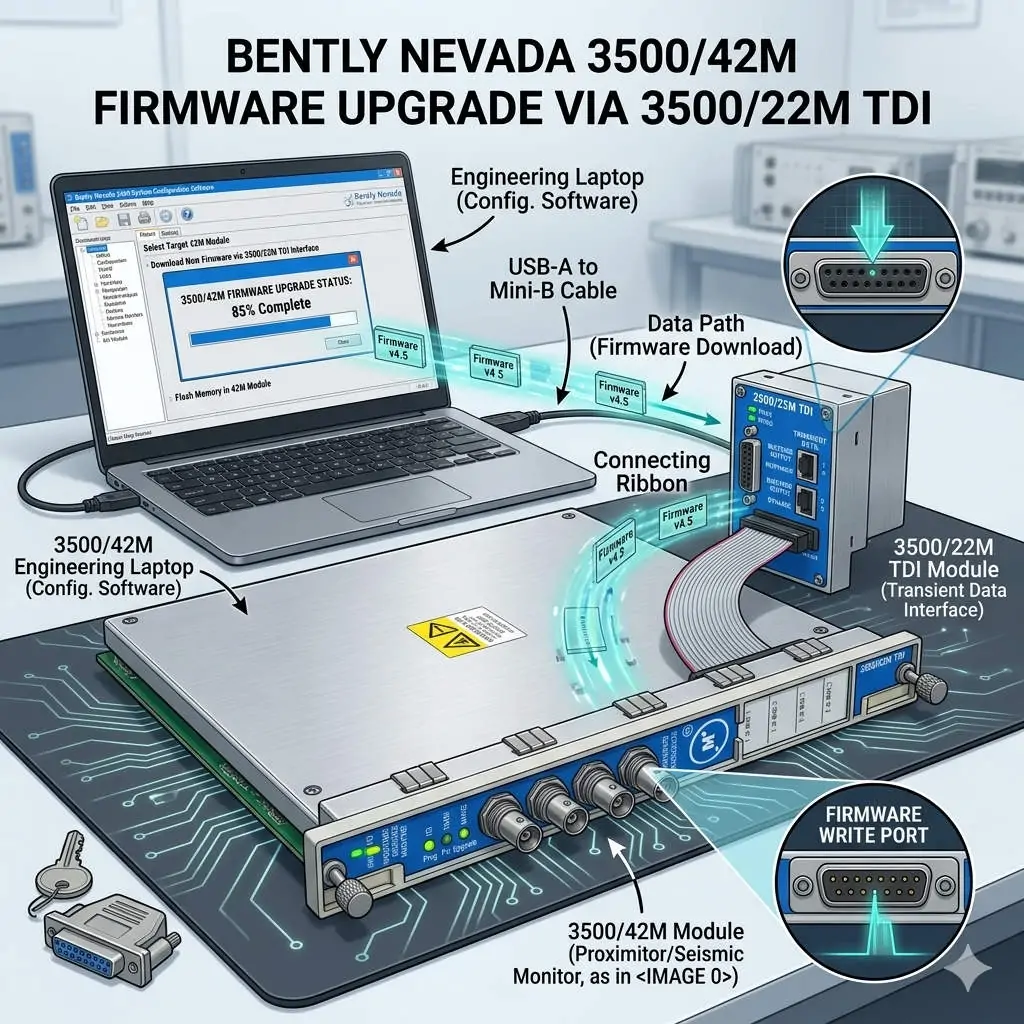
Bently Nevada 3500-42M Firmware Upgrade via 3500-22M TDI

Bently Nevada 3500/42M Firmware Upgrade via 3500/22M TDI

Seamless Firmware Upgrades for 3500/42M via the 3500/22M Communication Module

Enhancing Reliability in Machinery Protection Systems

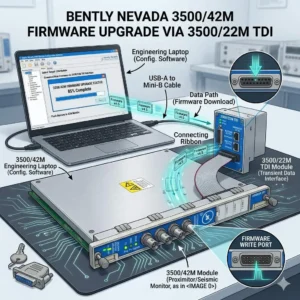
In the world of industrial automation, maintaining firmware consistency is vital for system health. The Bently Nevada 3500 series represents the gold standard for machinery protection. Specifically, the 3500/42M Proximitor/Seismic Monitor requires precise firmware to deliver accurate vibration diagnostics. By utilizing the 3500/22M Transient Data Interface (TDI) as a gateway, engineers can perform updates remotely. This method eliminates the need to remove hardware from the rack, ensuring continuous mechanical integrity.

Bently Nevada 3500-42M Firmware Upgrade via 3500-22M TDI

Bently Nevada 3500-42M Firmware Upgrade via 3500-22M TDI

Understanding the TDI Communication Gateway Architecture

The 3500/22M module serves as the primary bridge between the rack backplane and configuration software. It manages data traffic for both Ethernet and serial connections. During a firmware flash, the TDI module receives data packets and distributes them to the targeted 3500/42M monitor. This centralized architecture simplifies maintenance in complex factory automation environments. However, a stable network link is mandatory. Consequently, any communication dropout during the process could potentially corrupt the module memory.

Navigating Firmware Compatibility and Revision Control

Strict revision control defines successful Bently Nevada system management. Each monitor module must align with the rack’s overall firmware version. Mismatched versions often cause channel misinterpretation or alarm logic failures. Moreover, the configuration software version must support the specific firmware build. Powergear X Automation Limited experts recommend consulting the official “Firmware Compatibility Matrix” before starting. This proactive step prevents communication instability and ensures the DCS or PLC receives accurate data.

Strategic Scheduling for System Availability

Upgrading a single module typically takes between three and ten minutes. During this window, the 3500/42M module stops monitoring active vibration signals. This creates a temporary “blind spot” for critical rotating equipment like turbines or compressors. Therefore, engineers should only initiate upgrades during planned maintenance windows. Alternatively, perform updates while the machinery is in a standby state. Proper planning protects the assets while the control systems receive necessary security and feature patches.

Operational Best Practices for Safe Flashing

Field experience suggests that power stability is the most critical factor during firmware transfer. Voltage fluctuations can interrupt the write process and “brick” the hardware. In addition, avoid using high-latency connections like VPNs for firmware tasks. Local direct-cable connections offer the highest success rate. While the 3500 system supports hot-swapping, you must never reseat a module during an active flash. Following these technical guidelines ensures the longevity of your industrial hardware investment.

Industry Standards and Technical Insights

According to reports, the global machinery monitoring market is shifting toward digitalized maintenance. Standardizing firmware across your plant enhances diagnostic accuracy and audit readiness. For regulated sectors like petrochemicals, maintaining validated firmware levels is essential for compliance. At Powergear X Automation Limited, we believe that staying current with firmware is a cost-effective way to unlock advanced vibration analysis features without replacing physical modules.

Application Scenarios and Solutions

  • Oil & Gas Refineries: Use the 3500/22M to update monitors across large-scale compressor stations without entering hazardous zones.
  • Power Generation: Ensure turbine protection modules have the latest patches for improved transient data capture during start-up.
  • Water Treatment: Maintain high availability by upgrading backup pump monitors during low-demand periods.

Technical Execution Checklist

  • ✅ Verify the 3500/22M TDI is online and stable in the configuration software.
  • ✅ Confirm the target 3500/42M module slot is correctly identified.
  • ✅ Ensure the rack power supply is connected to a reliable UPS.
  • ✅ Back up the existing rack configuration before initiating any firmware changes.
  • ✅ Validate the module status and reload the configuration after the update finishes.

Expert Frequently Asked Questions

Q: Will my existing configuration be lost after a firmware upgrade?
Generally, the configuration remains, but firmware changes can sometimes alter memory mapping. We always recommend saving a copy of the rack configuration to your PC. After the upgrade, verify that all setpoints and delay timings remain unchanged.

Q: Can I upgrade multiple 3500/42M modules simultaneously?
Most configuration software allows for sequential updating. However, upgrading modules one by one is safer. This approach limits the “blind spot” to a single monitoring group at any given time, maintaining better overall rack protection.

Q: What should I do if the upgrade progress bar freezes?
Do not cycle power immediately. Wait at least 15 minutes to ensure no background processes are active. If the module remains unresponsive, check the TDI communication status. You may need to perform a “bootloader” recovery if the primary firmware image is corrupted.

For high-quality modules and expert technical support, visit the official Powergear X Automation Limited website to secure your system components.

Bently Nevada 3500-22M TDI Modbus TCP Integration Guide

Optimize Vibration Data with Bently Nevada 3500/22M Interface

Seamless Data Integration with the Bently Nevada 3500/22M Transient Data Interface

Bridging the Gap Between Vibration Monitoring and Plant Control

In high-stakes industries like oil and gas or power generation, communication compatibility often creates a technical bottleneck. The Bently Nevada 3500/22M Transient Data Interface (TDI) serves as the vital gateway between 3500 series machinery protection racks and external control systems. By facilitating reliable data extraction, this module allows operators to push critical machinery health insights directly into DCS or SCADA platforms. Consequently, plants can eliminate the need for complex custom middleware while maintaining high-fidelity asset management.

Bently Nevada 3500-22M TDI Modbus TCP Integration Guide

Bently Nevada 3500-22M TDI Modbus TCP Integration Guide

Technical Insights: Mastering Modbus TCP/IP Connectivity

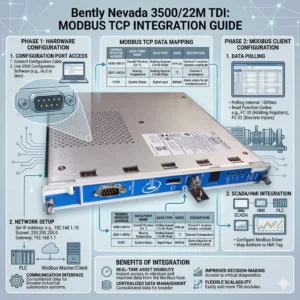
The 3500/22M module utilizes Modbus TCP/IP protocols rather than traditional Modbus RTU serial connections. This shift to an Ethernet-based TCP/IP stack offers significant advantages for modern industrial automation. For instance, it provides higher data throughput and supports multi-client access for remote diagnostics. Therefore, integration with modern Ethernet-based DCS architectures becomes much simpler. However, legacy systems relying on RS-485 Modbus RTU will require an external protocol gateway to bridge the communication gap.

Optimizing Throughput and Reducing Network Latency

Engineers designed the 3500/22M to handle both transient and steady-state high-resolution data. Faster polling cycles through TCP improve real-time vibration monitoring and accelerate alarm response speeds. Nevertheless, heavy network congestion can introduce unwanted latency. To maintain performance, we recommend segmenting condition monitoring traffic via a dedicated VLAN. In our experience at Powergear X Automation Limited, delayed alarms often stem from overloaded plant networks rather than hardware failures within the 3500 rack itself.

System Architecture and Compliance with API 670 Standards

The 3500/22M functions as both a data concentrator and a communication interface for the entire rack. It interfaces with the internal backplane for data acquisition while providing external Ethernet ports for data export. This design effectively separates the deterministic protection system from the analytical monitoring network. As a result, the system maintains strict compliance with API 670 machinery protection standards. This separation ensures that network-level issues do not interfere with critical machine trip functions.

Installation Best Practices for Industrial Environments

Successful deployment of the 3500/22M requires a robust network and electrical design. You should never connect the module directly to a general office LAN. Instead, use industrial-grade switches and establish a dedicated VLAN to prevent broadcast storms. Furthermore, ensure the rack is properly grounded to mitigate electromagnetic interference (EMI). In turbine halls, high-current lines can create noise that leads to “ghost alarms” in the SCADA system if Ethernet cables lack proper shielding.

Evaluating Compatibility for Legacy Brownfield Projects

When upgrading older plants, buyers must verify rack firmware versions before procuring the 3500/22M. While the module is compatible with standard 3500 racks, older systems might not fully exploit TCP-based features. If your current control system is strictly Modbus RTU-dependent, budget for a high-quality industrial TCP-to-RTU converter. This proactive approach prevents unexpected integration costs from exceeding the hardware investment during the commissioning phase.

Expert Commentary from Powergear X Automation Limited

At Powergear X Automation Limited, we believe the 3500/22M is a prerequisite for any facility moving toward Industry 4.0 or digital transformation. The ability to stream high-density vibration data without serial bottlenecks is a game-changer for predictive maintenance. However, we urge engineers to prioritize network security and segmentation. As these interfaces bridge the gap between OT and IT, a secure, isolated communication layer is essential for long-term operational stability.

Application Scenarios and Strategic Solutions

  • Large Compressor Stations: Isolated condition monitoring traffic ensures that transient data does not saturate the primary control network.
  • Petrochemical Refining: Direct integration with Honeywell or Emerson DCS via Modbus TCP simplifies the asset management workflow.
  • Digital Power Plants: Utilizing the TDI for remote diagnostics allows off-site experts to analyze vibration signatures in real-time.

Technical Implementation Checklist

  • ✅ Verify SCADA support for Modbus TCP mapping before installation.
  • ✅ Use shielded Cat6 cables and maintain distance from high-voltage conduits.
  • ✅ Implement an industrial protocol gateway if RS-485 connectivity is mandatory.
  • ✅ Update rack firmware to the latest version to ensure full TDI feature support.

Frequently Asked Questions (FAQ)

Q: Can I use the 3500/22M to replace a 3500/20 Rack Interface Module?
Yes, the 3500/22M is the newer generation Transient Data Interface that provides enhanced Ethernet capabilities. However, you must verify that your configuration software is updated to support the 22M hardware profile to avoid configuration errors.

Q: Why does my SCADA system intermittently lose connection to the TDI?
This is frequently caused by ARP table overflows or broadcast traffic on a shared network. We recommend assigning a static IP address to the 3500/22M and placing it behind a managed industrial switch with IGMP snooping enabled.

Q: Does the 3500/22M support simultaneous connections to System 1 and a third-party PLC?
Yes, the module supports multiple socket connections. This allows Bently Nevada’s System 1 software to collect rich diagnostic data while your plant PLC polls basic alarm registers via Modbus TCP simultaneously.

For more technical specifications and high-performance automation modules, visit the official Powergear X Automation Limited website to view our latest inventory.

Bently Nevada 177230 Guide: RMS Velocity for Vibration Monitoring

Bently Nevada 177230 Guide: RMS Velocity for Vibration Monitoring

Optimizing Machine Health with Bently Nevada 177230 Seismic Transmitters

The Role of RMS Velocity in Modern Industrial Automation

The Bently Nevada 177230 Seismic Transmitter measures machine casing vibration to provide a stable 4–20 mA output. Unlike peak-value sensors, this device focuses on Root Mean Square (RMS) velocity. This distinction is vital because RMS reflects the true destructive energy within a mechanical system. Most DCS and PLC systems in factory automation rely on this steady signal for real-time monitoring.

Bently Nevada 177230 Guide: RMS Velocity for Vibration Monitoring

Alignment with ISO Vibration Severity Standards

Maintenance teams often use ISO 10816 or ISO 20816 to determine equipment health. These standards define vibration severity limits specifically in RMS units. Therefore, using the 177230 eliminates the need for manual mathematical conversions. This alignment ensures that your alarm and trip setpoints remain accurate and consistent across the plant.

Technical Advantages of Integrated Signal Conditioning

This transmitter integrates the seismic sensor and signal processor into a single, rugged housing. By filtering out transient high-frequency noise, it prevents the “spikes” that often trigger false alarms in peak-detecting systems. Consequently, operators experience fewer unnecessary shutdowns, which directly improves overall equipment effectiveness (OEE) in chemical processing and power generation.

Seamless Integration into DCS and PLC Networks

The 4–20 mA loop design makes the Bently Nevada 177230 highly compatible with existing control systems. The current-driven signal offers high immunity to electromagnetic interference (EMI), which is common in VFD-heavy environments. Furthermore, you can install these transmitters over long distances without losing signal integrity or accuracy.

Expert Tips for Mechanical Installation and Coupling

Proper mounting is the most overlooked factor in vibration monitoring. You must attach the transmitter to a rigid, flat surface as close to the bearing housing as possible. Poor coupling attenuates vibration energy and leads to undervalued RMS readings. Avoid mounting on thin covers or flexible brackets, as these create false resonance and distort data.

Managing Electrical Noise and Surge Protection

High-noise industrial environments require shielded twisted-pair cabling to ensure signal purity. You should ground the shield at only one end to prevent ground loops. For outdoor installations in the oil and gas sector, I highly recommend using external surge arresters to protect the internal circuitry from lightning or power surges.

Technical Excellence Summary

  • True RMS velocity output ensures compliance with ISO 10816 standards.
  • Onboard signal conditioning reduces false trips from transient vibration spikes.
  • Rugged 4–20 mA loop design supports long-distance, noise-immune transmission.
  • Direct compatibility with PLC and DCS simplifies control system architecture.
  • Compact form factor allows for installation in tight bearing housing spaces.

Author Insight by Powergear X Automation

In my experience, many facilities struggle with “nuisance trips” because they use peak-detecting sensors on aging equipment. Switching to an RMS-based system like the Bently Nevada 177230 provides a much smoother trending curve. It allows the maintenance team to see the gradual degradation of a bearing rather than reacting to every minor mechanical jar. If you are upgrading from legacy mechanical switches, this is the most cost-effective way to modernize your plant’s reliability program.

For more technical guides and high-quality automation components, visit the experts at Powergear X Automation.

Practical Application Scenarios

  • Centrifugal Pumps: Continuous monitoring of bearing housing vibration to prevent catastrophic seal failure.
  • Cooling Tower Fans: Detecting blade imbalances or gearbox wear in harsh, moisture-heavy environments.
  • Electric Motors: Providing early warning for stator eccentricity or rolling-element bearing defects.
  • Industrial Compressors: Monitoring high-speed rotation to ensure compliance with safety interlocking protocols.

Frequently Asked Questions (FAQ)

Q1: How do I verify if the transmitter is functioning correctly during commissioning?
Establish a baseline reading while the machine is running under normal, stable conditions. If the RMS value drifts significantly without a change in machine load, inspect the mounting torque first. Most “failures” are actually caused by loose mechanical coupling or improper cable grounding.

Q2: What is the biggest mistake to avoid when replacing a peak-detecting sensor?
Never copy your old alarm setpoints directly. Peak values are mathematically higher than RMS values (Peak ≈ 1.414 × RMS for pure sine waves). If you don’t recalculate your thresholds, your new system may be too “relaxed” and fail to trip during a genuine fault.

Q3: Can this transmitter be used in hazardous or explosive environments?
Yes, but you must select the specific model variant with the appropriate certifications (such as ATEX, IECEx, or CSA). Always verify the part number suffix to ensure the housing and electrical ratings match your local safety classification.

Bently Nevada 3300 NSv Probe: Solving Tight Space Vibration Monitoring

Bently Nevada 3300 NSv Probe: Solving Tight Space Vibration Monitoring

Optimizing Vibration Monitoring with Bently Nevada 3300 NSv Probes

Modern industrial automation relies on precise data to prevent catastrophic machine failure. While standard 8 mm proximity probes serve most factory automation needs, tight mechanical constraints often require a specialized approach. The Bently Nevada 3300 NSv (Narrow Side-view) system bridges this gap by providing high-accuracy sensing in confined spaces. At Powergear X Automation, we observe that selecting the right sensor geometry is as critical as the control system logic itself.

Bently Nevada 3300 NSv Probe: Solving Tight Space Vibration Monitoring

The Practical Hurdles of Standard Proximity Probes

Conventional 8 mm sensors are the workhorses of condition monitoring. However, their physical footprint creates significant integration hurdles in compact machinery. These probes require a large “view” area to maintain a stable linear range. When a shaft surface is too narrow, the magnetic field “bleeds” over the edges. Consequently, this causes signal distortion and false vibration readings. Furthermore, standard probes often demand excessive radial clearance, which many modern high-speed pumps simply do not have.

Engineering Benefits of the Narrow Side-view Design

The 3300 NSv probe features a specialized tip designed for lateral precision. Unlike standard probes that project a wide electromagnetic field, the NSv focuses its energy. Therefore, it can monitor narrow target “lands” without interference from adjacent shoulders or bearings. This design is essential for technicians who must retrofit legacy DCS or PLC systems with modern protection hardware. In addition, the probe’s smaller diameter reduces the risk of mechanical contact during thermal expansion cycles.

Reliability in High-Pressure Process Environments

Industrial compressors often operate under extreme pressure and gas density. These conditions can fluctuate, affecting the dielectric constant of the medium between the probe and the shaft. The 3300 NSv is engineered to maintain signal integrity despite these environmental shifts. Its robust construction ensures that chemical exposure does not degrade the sensor tip over time. As a result, maintenance teams experience fewer “nuisance trips” and more consistent data trends.

Seamless Integration with Industrial Control Systems

A major advantage of the 3300 NSv is its backward compatibility. It integrates directly into existing Bently Nevada 3300 or 3500 monitoring racks. This compatibility reduces the need for extensive rewiring or hardware overhauls. For engineers managing complex factory automation projects, this modularity saves significant time during commissioning. Moreover, the calibration remains stable, ensuring long-term trust in the automated safety shutdown systems.

Expert Perspective from Powergear X Automation

In our experience at Powergear X Automation, we see many facilities struggle with “side-view” interference on small gearboxes. Standard probes often pick up the movement of nearby gears rather than the shaft itself. We recommend the 3300 NSv because its narrow field of view ignores peripheral metal surfaces. Choosing the right probe isn’t just about the sensor; it’s about understanding the specific mechanical envelope of your asset.

Technical Highlights and Specifications

Miniature Footprint: Fits into bores as small as 1/4-28 or M8 threads.

Target Precision: Operates on targets as narrow as 6 mm (0.25 inches).

Chemical Resistance: Specifically designed to withstand corrosive process gases.

Linear Range: Provides a reliable 1.0 mm (40 mil) operating range.

System Compatibility: Fully supports 3300 XL Proximitor® sensor interfaces.

Application Scenarios

High-Speed Turbochargers: Where shaft diameters are too small for standard 8 mm probes.

Aero-derivative Gas Turbines: Locations with extreme space constraints near the bearing housing.

Reciprocating Compressor Rods: Measuring rod drop in environments with limited axial clearance.

Centrifugal Pump Retrofits: Adding vibration monitoring to older pumps with tight seal chambers.

To find the best hardware for your specific machinery protection needs, visit the specialists at Powergear X Automation. We provide the technical expertise to ensure your assets stay online and optimized.

Frequently Asked Questions (FAQ)

Q: Can I replace an 8 mm probe with an NSv probe without changing the Proximitor?

A: No, you must use the specific 3300 NSv Proximitor. The electrical characteristics of the smaller coil require a matched driver to maintain the correct scale factor and linearity.

Q: What is the biggest mistake during the installation of NSv probes?

A: In our field experience, the most common error is improper gapping. Because the linear range is shorter than standard probes, installers must use a digital voltmeter to set the “DC Gap” precisely at the midpoint.

Q: Does the NSv probe work on all types of metal shafts?

A: Like most eddy-current sensors, it is calibrated for 4140 steel. If your shaft uses a different alloy, the system requires custom calibration to ensure the vibration readings are accurate.

Why High-Speed Compressors Require Bently Nevada 3300 NSv

Why High-Speed Compressors Require Bently Nevada 3300 NSv

Why 3300 NSv is Essential for Small Bearings and Centrifugal Compressors

In the world of industrial automation and condition monitoring, precision is not a luxury; it is a requirement. Bently Nevada’s 3300 series proximity probes set the industry standard for protecting rotating machinery. However, technicians often face a dilemma when dealing with compact equipment. While the 3300 XL is a powerhouse for large-scale assets, the 3300 NSv (Narrow Side view) is the superior choice for specialized applications. Choosing the wrong sensor can lead to signal distortion or even mechanical failure.

Why High-Speed Compressors Require Bently Nevada 3300 NSv

Understanding the Design Differences Between 3300 XL and NSv

The 3300 XL proximity probe system typically utilizes an 8 mm probe tip. This design provides a wide linear range suitable for massive industrial motors and turbines. In contrast, the 3300 NSv features a smaller 5 mm tip. Engineers optimized this “Narrow Side view” version for environments with restricted side clearance. Because the NSv system generates a narrower magnetic field, it ignores surrounding metal surfaces better than the standard XL model.

Navigating Physical Space Constraints in Small Bearings

Small journal bearings present unique installation challenges due to thin housing walls and limited radial clearance. The 3300 XL probe requires significant mounting depth and lateral space to function correctly. If you force an XL probe into a small bearing, you risk structural damage to the housing. The 3300 NSv solves this through its compact form factor. It integrates seamlessly into tight geometries without compromising the mechanical integrity of the bearing.

Solving Linearity Issues on Small Diameter Shafts

Shaft curvature significantly impacts eddy current sensor accuracy. Standard 3300 XL probes are calibrated for larger targets and struggle with shafts under 3 inches in diameter. On a small centrifugal compressor shaft, the wide magnetic field of an XL probe “wraps around” the curve. This causes non-linear readings and false vibration data. The 3300 NSv is specifically calibrated for small-diameter shafts, providing a clean, linear signal for critical monitoring.

Meeting High-Frequency Requirements for Centrifugal Compressors

Centrifugal compressors operate at extreme rotational speeds, often exceeding 15,000 RPM. These high speeds generate vibration frequencies that standard sensors may miss. The 3300 NSv system features an enhanced frequency response tailored for high-speed rotors. Its coil design reduces signal noise and prevents attenuation. Consequently, maintenance teams receive a high-fidelity representation of the machine’s dynamic behavior, which is vital for early fault detection.

Ensuring Compliance with OEM and API 670 Standards

Many Original Equipment Manufacturers (OEMs) specify the 3300 NSv during the design phase. They perform validation tests using these specific sensors to ensure safety and performance. Substituting a standard XL probe can void warranties or violate API 670 standards. Following OEM guidelines ensures that the monitoring system aligns with the machine’s original mechanical assumptions. This compliance is critical for high-stakes process gas compressors.

Expert Insight from Powergear X Automation

“At Powergear X Automation, we frequently see reliability issues caused by ‘over-speccing’ sensors. Bigger is not always better in vibration monitoring. The 3300 NSv isn’t just a smaller version of the XL; it is a precision tool designed to mitigate ‘side-view’ interference from nearby metal. For any shaft under 50mm, we almost always recommend the NSv to ensure the highest data integrity.”

Key Technical Advantages of the 3300 NSv

Narrow magnetic field prevents interference from probe mounts.
The 5 mm tip fits into confined bearing housings.
Improved linearity on small-diameter curved surfaces.
Higher frequency response for high-speed centrifugal applications.
Reduced thermal drift in compact, high-temperature environments.

Application Scenarios

Small Centrifugal Compressors: Ideal for shafts between 1.0 and 3.0 inches.
Aero-derivative Gas Turbines: Used where space for sensors is extremely limited.
Reciprocating Compressor Rods: Effective for monitoring rod position in tight packings.
High-Speed Gearboxes: Fits into compact gear housings with complex internals.
If you are looking to upgrade your vibration monitoring system or need expert guidance on Bently Nevada components, explore the technical resources at Powergear X Automation.

Frequently Asked Questions (FAQ)

1. Can I use a 3300 NSv Proximitor with a 3300 XL probe?

No, you cannot mix these components. The Proximitor, probe, and extension cable must match. Each system is calibrated to specific electrical characteristics to ensure accurate displacement readings.

2. How do I know if my shaft is too small for a standard 8mm probe?

As a rule of professional experience, if the shaft diameter is less than 3 inches (approx. 76 mm), the 8mm probe’s magnetic field will likely experience “edge effects.” In these cases, the NSv is the safer technical choice.

3. Is the 3300 NSv more sensitive to temperature than the XL?

Actually, the NSv is designed for compact environments where heat often builds up. While all eddy current probes experience some drift, the NSv maintains excellent stability within its specified range, provided the installation follows the manufacturer’s standoff distance.

330500 Sensor: Stable Calibration for Industrial Control Systems

330500 Sensor: Stable Calibration for Industrial Control Systems

Why the 330500 Proximitor Sensor Eliminates Periodic Physical Calibration Needs

In the demanding world of industrial automation and machinery protection, maintenance efficiency defines profitability. Traditional sensors often require frequent manual adjustments to combat signal drift. However, the 330500 Proximitor® Sensor breaks this cycle. This article explores the engineering excellence behind its “calibration-free” design and how it optimizes control systems performance.

330500 Sensor: Stable Calibration for Industrial Control Systems

The Stability of Non-Contact Eddy Current Technology

The 330500 utilizes the eddy current principle for high-precision displacement monitoring. Unlike mechanical sensors, it generates an electromagnetic field to measure the gap between the probe and target. Because the sensor never touches the rotating shaft, it avoids physical friction and mechanical fatigue. This non-contact approach ensures the core measurement physics remain unchanged over years of continuous operation.

Precision Factory Matching for Seamless Integration

Bently Nevada designs the 330500 as part of a tightly integrated measurement chain. This system includes the proximity probe, the extension cable, and the Proximitor itself. Engineers calibrate these components as a single unit at the factory. This rigorous process accounts for sensitivity (mV/mil) and linearity across the entire range. Consequently, users gain a “plug-and-play” experience that maintains accuracy without field-level tuning.

Solid-State Electronics Prevent Long-Term Drift

Many legacy factory automation sensors suffer from material creep or aging of internal strain gauges. The 330500 employs advanced solid-state circuitry that resists these common failure modes. The electronic components are selected for their predictable lifecycle and low thermal noise. At Powergear X Automation, we observe that these units maintain their voltage-to-gap ratio even after a decade in high-heat environments.

Robust Design for Harsh Industrial Environments

Reliability in DCS and PLC environments requires protection against external interference. The 330500 features internal temperature compensation and high-grade shielding. These features neutralize the effects of electrical noise and ambient temperature fluctuations. By mitigating environmental impact at the hardware level, the need for seasonal recalibration becomes obsolete.

Streamlined Verification Over Manual Calibration

Modern maintenance teams prioritize verification over physical adjustment. You can verify the 330500 system through simple gap voltage checks or static calibration audits. These steps confirm that the loop is healthy without altering the factory-set parameters. If a reading is off, it usually indicates a loose mounting or a damaged cable rather than a sensor calibration error.

Strategic Advantages Over Traditional Sensors

Traditional contact-based sensors often experience hysteresis or mounting stress. These issues necessitate frequent downtime for technician intervention. The 330500 avoids these pitfalls through its rigid design and stable electronic signature. This shift from reactive calibration to proactive verification significantly lowers the Total Cost of Ownership (TCO) for critical rotating assets.

Author Insights by Powergear X Automation

From our experience at Powergear X Automation, the 330500 represents a shift toward “maintenance-free” instrumentation. While the hardware is remarkably stable, we recommend that users maintain strict records of target material properties. Since eddy current sensors are sensitive to material conductivity and permeability, changing the shaft material will necessitate a system re-evaluation. For those upgrading legacy control systems, the 330500 offers the most reliable path to reducing instrumentation overhead.

Technical Excellence Summary

  • Zero mechanical wear due to non-contact sensing.
  • Factory-matched components ensure high linearity.
  • Solid-state design minimizes electronic signal drift.
  • Built-in compensation handles extreme temperature swings.
  • Verification protocols replace time-consuming physical adjustments.
  • High resistance to industrial electromagnetic interference.

Application Scenarios

  • Steam Turbine Protection: Monitoring radial vibration and axial thrust in high-temperature zones.
  • Centrifugal Compressors: Providing real-time shaft position data to prevent catastrophic bearing failure.
  • Hydroelectric Generators: Measuring air gap and vibration in massive rotating structures.
  • Discover more high-performance solutions for your facility by visiting Powergear X Automation. Our team provides the expertise you need for reliable machinery protection.

Frequently Asked Questions (FAQ)

  • 1. If the sensor is calibration-free, why do I see different voltage readings after a probe replacement?
  • Output variations usually stem from “interchangeability error.” Even high-precision probes have slight manufacturing tolerances. While the Proximitor doesn’t need recalibration, you must verify the new “Average Scale Factor” to ensure it meets your specific alarm setpoints.
  • 2. Can I use a 330500 Proximitor with a different brand’s extension cable?
  • We strongly advise against this. The system’s stability relies on the specific electrical impedance of the matched cable. Using third-party cables will compromise the linearity and void the “calibration-free” status of the system.
  • 3. Does shaft “runout” affect the calibration of the sensor?
  • Runout is a mechanical or magnetic imperfection in the shaft, not a sensor calibration issue. The 330500 accurately measures the runout it “sees.” To fix this, you must treat the shaft surface rather than adjusting the sensor electronics.
Bently Nevada 330500 Sensor Diagnostics for Industrial Automation

Bently Nevada 3500/42M Wiring & Configuration for 330500 Sensors

Integrating 330500 Proximitor Sensors with Bently Nevada 3500/42M Monitors

The Bently Nevada 3500 Series remains the global benchmark for machinery protection in industrial automation. Specifically, the 3500/42M Proximitor/Seismic Monitor serves as a critical bridge between physical hardware and digital insights. Connecting the 330500 (3300 XL Proximitor) sensor correctly is vital for monitoring high-speed rotating assets. This guide outlines the technical procedures and professional best practices for a seamless integration.

Bently Nevada 330500 Sensor Diagnostics for Industrial Automation

Core Components of the 3300 XL Proximitor System

The 330500 Proximitor is the “brain” of the 3300 XL 8mm transducer system. It converts the radio frequency (RF) signal from the probe into a usable voltage output. This system typically includes the proximity probe, an extension cable, and the Proximitor sensor itself. Because these components are calibrated together, mixing different lengths or brands can lead to significant linearity errors in your data.

Technical Capabilities of the 3500/42M Module

The 3500/42M is a versatile four-channel module designed for diverse factory automation environments. It processes signals for radial vibration, axial position, and even eccentricity. In my experience at Powergear X Automation, we often see users overlook the module’s programmable nature. This flexibility allows it to adapt to various transducers, but it requires precise software configuration to ensure machine safety.

Step-by-Step Wiring for Reliable Signal Integrity

Proper wiring prevents signal interference and ensures the longevity of your control systems. Most Bently Nevada systems follow a standard three-wire color code, though you should always verify with the specific datasheet.

Connect Power: Link the module’s -24 VDC terminal to the Proximitor’s power input (usually the red wire).

Attach Signal: Route the white signal wire to the designated channel input on the 3500/42M.

Establish Common: Connect the black common wire to the COM terminal to complete the circuit.

Grounding and Shielding for Industrial Environments

Electrical noise is the primary enemy of precision vibration monitoring. You must ground the cable shield at the 3500 rack end only. This prevents ground loops which cause erratic readings. Furthermore, always run sensor cables through dedicated conduits. Separation from high-voltage power lines is essential for maintaining a clean signal-to-noise ratio.

Software Configuration and Calibration Procedures

Physical wiring is only half the battle; the software must match the hardware. Use the 3500 Rack Configuration Software to set the sensor type to “3300 XL 8 mm.” Ensure the scale factor reflects the standard 200 mV/mil (7.87 V/mm). If these parameters are incorrect, your alarms will not trigger during a genuine mechanical fault, risking catastrophic equipment failure.

Professional Commissioning and Field Validation

Testing is the final hurdle before live operation. We recommend verifying the “Gap Voltage” while the machine is at rest. A healthy gap typically reads around -10 VDC. If the voltage is near 0 or -24 VDC, you likely have a wiring fault or a probe clearance issue. Documenting these initial values creates a baseline for all future predictive maintenance efforts.

Author Insights from Powergear X Automation

At Powergear X Automation, we observe a growing trend toward integrating 3500 systems with broader DCS and IoT platforms. While the 3500/42M provides hardware-level protection, the real value lies in the data it generates. We suggest always using genuine Bently Nevada components to maintain system certification and ensure the highest level of E-E-A-T (Experience, Expertise, Authoritativeness, and Trustworthiness) in your maintenance strategy.

Technical Best Practices Checklist

  • ✅ Use calibrated torque wrenches for probe mounting to avoid housing damage.
  • ✅ Verify that extension cable lengths match the Proximitor’s specific calibration (e.g., 5m or 9m).
  • ✅ Inspect BNC connectors for moisture or debris before final assembly.
  • ✅ Label every wire clearly at both ends to simplify future troubleshooting.
  • ✅ Confirm that the Proximitor mounting plate is electrically isolated from the machine frame.

Solutions for Common Installation Scenarios

Scenario: High Temperature

Recommended Action: Use specialized high-temp extension cables and ceramic-tipped probes.

Scenario: Long Distance

Recommended Action: Ensure the total loop resistance does not exceed the 3500/42M limits.

Scenario: Corrosive Area

Recommended Action: Install Proximitors inside NEMA 4X or IP66 rated stainless steel enclosures.

For high-quality components and expert technical support for your next project, visit Powergear X Automation to explore our comprehensive inventory of monitoring solutions.

Frequently Asked Questions (FAQ)

Q: Can I use a 3300 XL probe with an older 7200 series Proximitor?

A: No. The internal circuitry and RF frequencies differ between generations. Mixing components leads to non-linear output and will compromise your machinery protection system’s accuracy.

Q: Why is my gap voltage reading -24V constantly after installation?

A: This usually indicates an “Open Circuit.” Based on field experience, check for a snapped extension cable or a loose connection at the Proximitor terminal block.

Q: How often should I recalibrate the 3500/42M and 330500 system?

A: Industry standards like API 670 suggest a full loop check every 18 to 24 months. However, verify the calibration anytime you replace a probe or extension cable.

Back to Top
Product has been added to your cart