
Over 50,000 hot-selling automation module components.
ABB CI522A Redundancy Guide for AC800M Control Systems

ABB CI522A Redundancy Guide for AC800M Control Systems

Does CI522A Support Redundancy? Implementing ABB AC800M Serial Interfaces

The Role of CI522A in Industrial Control Systems

The ABB CI522A serves as a vital communication interface within the AC800M DCS ecosystem. It provides essential serial connectivity, typically supporting RS-232 or RS-485 protocols for third-party device integration. However, engineers must understand that the CI522A does not offer native hardware redundancy. Unlike high-level Ethernet modules like the CI854A, it operates as a single-channel interface. Consequently, designers must plan for system-level availability rather than relying on module-level failover.
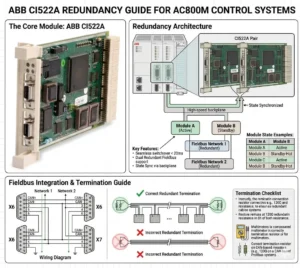
ABB CI522A Redundancy Guide for AC800M Control Systems

ABB CI522A Redundancy Guide for AC800M Control Systems

Technical Architecture and Communication Constraints

The internal design of the CI522A lacks dual-port circuitry or hot-standby capabilities. As a result, any failure in the module or the serial physical link causes an immediate communication loss. In critical sectors like oil and gas, this single-point failure poses a significant risk to data acquisition. Therefore, maintenance teams must prioritize external backup strategies. Industry reports suggest that while serial protocols remain relevant, their inherent lack of built-in redundancy drives the shift toward smarter gateways.

Integration with Redundant AC800M Controllers

While the module itself is non-redundant, you can utilize the CI522A within redundant PM861 or PM864 controller pairs. In this configuration, each controller hosts its own independent CI522A module. This setup maintains high availability at the controller level during a switchover. However, the field device must support dual communication paths to ensure a seamless transition. Many legacy Modbus RTU devices only allow one master, which creates a significant bottleneck in automated production lines.

Optimizing Protocol Redundancy via Modbus and Custom Serial

The CI522A primarily handles Modbus RTU and proprietary serial strings. Since Modbus RTU follows a strict master-slave architecture, achieving redundancy requires complex application-level logic. Moreover, any disruption in the master’s polling sequence can lead to device timeouts. As a result, many modern facilities deploy serial-to-Ethernet converters. This allows the system to leverage ABB’s Redundant Network Routing Protocol (RNRP) for much higher reliability than traditional serial links.

Installation Standards for High-Reliability Environments

Reliable operation starts with proper physical layer installation. Serial communication is notoriously sensitive to electromagnetic interference (EMI) and ground loops. To maintain signal integrity, follow these technical standards:

  • ✅ Use high-quality shielded twisted-pair (STP) cables for all RS-485 runs.
  • ✅ Ensure the cable shield is grounded at only one end to prevent loop currents.
  • ✅ Implement isolated repeaters to segment long daisy chains and limit failure propagation.
  • ✅ Install surge protection for any outdoor cable runs exceeding 50 meters.

Strategic Maintenance and Field Engineering Insights

From the perspective of Powergear X Automation Limited, we recommend treating the CI522A as a legacy bridge. While it is highly reliable for its intended purpose, it represents a “non-redundant edge” in your control system. If your project demands 99.99% uptime, consider migrating to Ethernet-based I/O. However, for retrofitting existing systems where downtime must be minimized, the CI522A remains a cost-effective solution for interfacing with localized analyzers and older PLCs.

Application Scenarios and Practical Solutions

  • Chemical Processing: Use dual gateways to bridge CI522A serial data into the redundant Ethernet backbone of the AC800M.
  • Power Plants: Distribute critical sensors across multiple CI522A modules to ensure that a single module failure does not blind the entire operator station.
  • Water Treatment: Leverage the CI522A for non-critical monitoring while keeping core control on redundant Ethernet modules.

Frequently Asked Questions (FAQ)

Q: Can the AC800M firmware automatically switch between two CI522A modules if one fails?
No, the firmware does not perform an automatic “bumpless” switch for serial modules. You must write specific logic in Control Builder M to detect a “Module Error” and manually redirect communication tasks to a secondary module or port.

Q: Is the CI522A compatible with all versions of the PM866 controller?
The CI522A is compatible with most AC800M controllers, including the PM866. However, always verify that your specific firmware version supports the serial protocol you intend to use, as some older versions have library limitations for custom serial strings.

Q: How can I prevent data collisions when using two controllers with two CI522A modules?
The most effective way is to use a “Heartbeat” logic. Only the active controller should enable its CI522A communication block. If the backup controller takes over, it enables its communication port after a brief delay to ensure the serial bus is clear.

For high-quality modules and expert technical support for your control systems, visit the official Powergear X Automation Limited website to view our latest inventory.

Allen-Bradley 1769-SM1 Guide: Master Modbus RTU Connectivity

Allen-Bradley 1769-SM1 Guide: Master Modbus RTU Connectivity

Optimizing Industrial Connectivity with the Allen-Bradley 1769-SM1 Modbus RTU Module

The Strategic Role of Serial Communication in Modern PLC Architectures

The Allen-Bradley 1769-SM1 serves as a critical bridge between high-performance CompactLogix controllers and the massive ecosystem of Modbus RTU devices. While many modern systems transition to Ethernet, serial protocols remain dominant in field devices like power meters and variable frequency drives (VFDs). By integrating this module, engineers eliminate the need for expensive external protocol gateways. Consequently, this streamlined approach reduces system complexity and lowers the total cost of ownership for industrial automation projects. Moreover, it maintains deterministic control within the native Logix environment.

Allen-Bradley 1769-SM1 Guide: Master Modbus RTU Connectivity

Technical Deep Dive into Modbus RTU Master Functionality

The 1769-SM1 operates primarily as a Modbus RTU Master, initiating all data requests across the serial network. This architecture ensures a predictable scan cycle, which is essential for stable factory automation. According to industry reports, the demand for legacy protocol integration remains high despite the rise of IIoT. The module supports adjustable baud rates and timing parameters to optimize performance. However, engineers must carefully calculate polling intervals to avoid network congestion, especially when connecting multiple slave nodes to a single 1769-SM1 channel.

Ensuring Signal Integrity in High-Interference Environments

Electrical noise is the primary enemy of reliable serial communication in control systems. The 1769-SM1 features robust hardware design, but installation quality determines its ultimate success. For instance, high-power equipment like VFDs can induce significant electromagnetic interference (EMI) on unshielded lines. Therefore, using high-quality shielded twisted-pair (STP) cabling is non-negotiable. Proper grounding at a single point prevents ground loops that could otherwise corrupt data frames or damage sensitive electronic components.

Advanced Installation and Maintenance Protocols

Successful deployment of the 1769-SM1 requires adherence to strict physical layer standards. From our extensive field experience, most communication failures stem from improper termination or biasing. Follow these essential technical steps:

  • Termination: Install 120-ohm resistors at both extreme ends of the RS-485 daisy chain to eliminate signal reflections.
  • ⚙️ Biasing: Verify if the network requires active biasing to maintain a stable voltage state during idle periods.
  • 🔧 Surge Protection: Implement external transient voltage suppressors in outdoor installations to protect the module from lightning or power surges.
  • Firmware: Always verify that the CompactLogix controller firmware supports the specific revision of the 1769-SM1 module.

Strategic Selection: 1769-SM1 vs. Protocol Converters

When selecting communication hardware, engineers often weigh the 1769-SM1 against third-party Modbus-to-Ethernet converters. The 1769-SM1 offers superior integration because the data resides directly in the controller’s I/O tree. This eliminates the latency introduced by external “black box” devices. However, if your DCS (Distributed Control System) requires high-bandwidth data logging from hundreds of points, a transition to Modbus TCP might be a more scalable long-term investment. For localized machine control, the 1769-SM1 remains the industry standard for reliability.

Expert Commentary from Powergear X Automation Limited

At Powergear X Automation Limited, we believe that the “simplest path is often the most reliable.” The 1769-SM1 simplifies the hardware stack by keeping communication internal to the PLC rack. While the industry pushes toward 100% Ethernet-based solutions, the reality in the field involves a mix of legacy and modern tech. We recommend the 1769-SM1 for applications where reliability and ease of configuration outweigh the need for high-speed data throughput. It is a workhorse that, when installed correctly, provides years of maintenance-free service.

Common Application Scenarios and Solutions

  • Oil & Gas Monitoring: Collecting real-time flow and pressure data from remote Modbus-enabled sensors.
  • Water Treatment: Standardizing communication across multiple chemical dosing pumps and flow meters.
  • Energy Management: Integrating multi-circuit power meters into a central SCADA system for efficiency tracking.

Professional Frequently Asked Questions (FAQ)

Q: How many Modbus slave devices can I realistically connect to a single 1769-SM1?
While the RS-485 standard theoretically supports up to 32 nodes, practical performance usually peaks between 10 and 15 devices. Increasing the node count beyond this typically results in higher latency and slower response times for critical control loops.

Q: What is the most common cause of “Timeout” errors in new installations?
In our experience, mismatched parity or stop bit settings are the usual culprits. Modbus RTU is extremely sensitive to these parameters. Ensure every slave device matches the 1769-SM1 configuration exactly before troubleshooting the physical wiring.

Q: Can this module support Modbus ASCII or other serial protocols?
The 1769-SM1 is specifically optimized for Modbus RTU. While some “generic” serial modules allow for custom ASCII strings, the 1769-SM1 provides a pre-built instruction set for Modbus, making it much easier to deploy but less flexible for non-Modbus protocols.

For more technical insights or to purchase high-quality automation hardware, visit Powergear X Automation Limited to explore our comprehensive product catalog.

Back to Top
Product has been added to your cart