Over 50,000 hot-selling automation module components.
GE IS200EPDMG1BAA Power Board Surge Protection Guide

Replace GE IS200EPDMG1BAA MOVs After Lightning Surges?

Should You Replace the MOV on the GE IS200EPDMG1BAA Board After a Lightning Strike?

In high-availability heavy industries, unseen electronic degradation poses a severe threat to operational continuity. The GE IS200EPDMG1BAA Power Distribution Board serves as a foundational power conditioning component. It supports critical Mark VI, Mark VIe, and EX2100 control systems. A core element of its protective layout is the Metal Oxide Varistor (MOV). However, field technicians often wonder if they must replace an internally stressed MOV that looks perfectly fine. This article explores the hidden degradation mechanisms of surge protection in critical infrastructure.

GE IS200EPDMG1BAA Power Board Surge Protection Guide

GE IS200EPDMG1BAA Power Board Surge Protection Guide

The Functional Role of the IS200EPDMG1BAA in Factory Automation

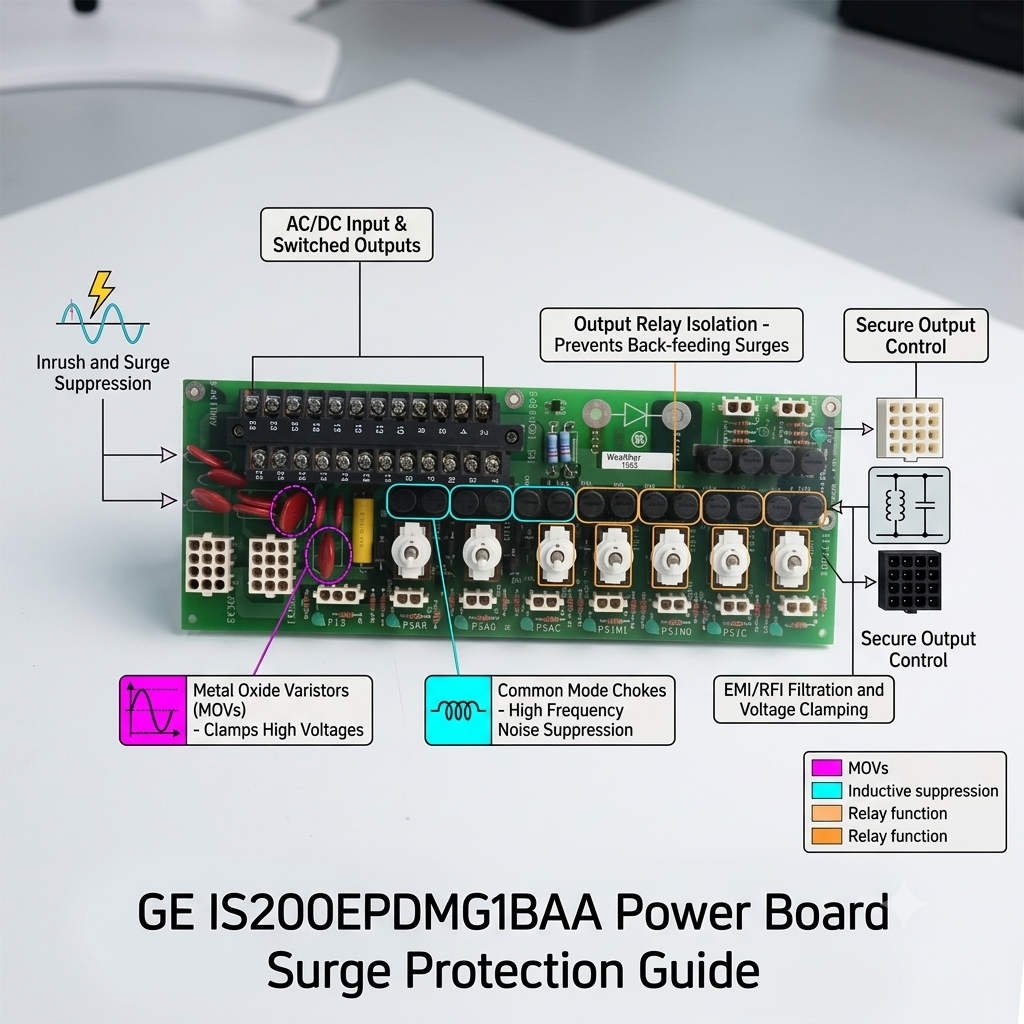
The IS200EPDMG1BAA board safely allocates control power across complex modern turbine and excitation cabinets. It ensures steady DC and AC voltage delivery to sensitive I/O packs and processing cores. Consequently, any failure on this board can interrupt communication networks or drop key field outputs. The integrated MOVs act as the primary defense mechanism against incoming voltage spikes. Therefore, the board absorbs high-energy disturbances before they reach microprocessors downstream.

Technical Principles of Cumulative MOV Aging and Clamping Deviations

An MOV does not always clear a fault by exploding or scorching its exterior shell. Instead, the internal zinc oxide microstructure degrades incrementally with each absorbed surge event. High-transient lightning currents create microscopic conduction paths inside the component matrix. As a result, the device experiences an immediate increase in baseline leakage currents. This hidden wear lowers the original clamping voltage threshold over time without showing any visual clues. A compromised component will ultimately fail to protect adjacent circuits during subsequent overvoltage transients.

Industry research from the IEEE Standards Association indicates that over 30% of surge module failures involve cumulative silent degradation. When clamping voltage stability drifts, downstream insulation experiences much higher electrical stress during power fluctuations. This continuous strain shortens the life expectancy of connected power supply modules. Furthermore, increased leakage current generates internal localized heating on the circuit board. This thermal stress can eventually provoke random controller resets and unexplained diagnostic alarms.

Application Scenarios and Selection Criteria for Advanced Power Boards

Power distribution reliability remains paramount in oil & gas facilities, chemical plants, and remote compressor skids. These exposed environments frequently experience direct lightning activity and severe switching transients. Choosing the IS200EPDMG1BAA ensures that your control network complies with strict industrial transient safety margins. However, sourcing replacement components requires thorough validation of your specific cabinet layout. Engineers must carefully match the product revision suffix to ensure absolute mechanical and electrical compatibility.

Replacing a legacy power distribution board involves verifying firmware boundaries and matching power supply connections. Some earlier module iterations lack the exact fuse ratings found on the “1BAA” version. Therefore, unverified substitution can create protection gaps or cause premature branch trips during normal operations. For accurate selection data and genuine replacement parts, procurement specialists frequently collaborate with Powergear X Automation Limited.

Field Maintenance Rules for High-Risk Surge Infrastructure

  • ✅ Electrical Verification: Perform leakage current and insulation testing rather than relying solely on visual inspection.
  • ⚙️ Upstream Inspection: Check primary surge protective devices and cabinet grounding paths during every turnaround.
  • 🔧 Proactive Replacement: Swap out the power board if nearby lightning trips external breakers or corrupts baseline data.

Strategic Insights from Powergear X Automation Limited

At Powergear X Automation Limited, we prioritize structural reliability over simple visual diagnostics. In high-stakes industrial automation, treating surge protection as a disposable asset is the safest operational approach. Proactive replacement of a potentially weakened board prevents catastrophic downtime that can easily cost thousands of dollars per minute. To view our full inventory of verified control components, explore our solutions at https://www.powergearx.com/.

Real-World Solutions for Turbine Control Rooms

In a coastal power station, a severe storm induced a major voltage surge across the main excitation busbar. The IS200EPDMG1BAA board continued operating normally, and visual checks revealed no physical damage. However, the maintenance team followed proactive protocols and replaced the distribution card during a brief outage. Subsequent bench tests proved the original MOV had lost 40% of its surge capacity. This preventive step saved the plant from a total turbine trip during a secondary storm two weeks later.

Frequently Asked Questions (FAQ)

1. How can a field technician test an MOV on the power board without specialized lab equipment?
You can use a high-voltage insulation tester to check the varistor voltage at a specified DC leakage current. If the measured voltage deviates significantly from the original manufacturer specifications, the internal structure is degraded.

2. Can I replace just the individual degraded MOV on the board instead of buying a new card?
While physically possible, component-level soldering on multilayer industrial boards is not recommended for live field environments. It voids certifications, alters trace impedance, and may introduce hidden micro-cracks into nearby paths.

3. Does the system generate a specific diagnostic alarm when the MOV begins to wear out?
Standard systems do not monitor individual MOV degradation paths directly. Instead, you might see secondary symptoms like unstable branch power supply logs or random I/O faults caused by unmitigated transient noise.

Troubleshooting GE IS220PDOAH1A Loop Current Fault Alarms

Troubleshooting GE IS220PDOAH1A Loop Current Fault Alarms

How to Diagnose a “Loop Current Fault” on the GE Mark VIe IS220PDOAH1A Module

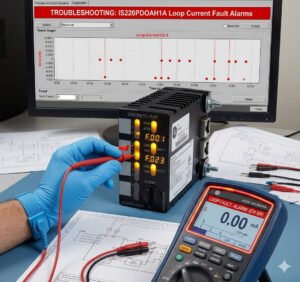
In high-availability control systems, a single diagnostic alarm can prevent a catastrophic plant trip. The GE Mark VIe IS220PDOAH1A discrete output module acts as a critical field interface. It directly drives field components like solenoids, relays, and emergency trip valves. However, operators frequently encounter the critical “Loop Current Fault” alarm on this card. This technical guide outlines how to determine if the issue stems from an external solenoid short or an internal contact failure.

Troubleshooting GE IS220PDOAH1A Loop Current Fault Alarms

Troubleshooting GE IS220PDOAH1A Loop Current Fault Alarms

The Functional Architecture of Discrete Output Modules

The IS220PDOAH1A serves as a specialized Ethernet-ready I/O pack within the GE Speedtronic family. It communicates directly with the controller over the proprietary IONet protocol. This module monitors output conduction current, open-circuit states, and short-circuit faults in real-time. In addition, it provides galvanic isolation to shield sensitive logic circuits from harsh field environments. Gas turbine auxiliaries and petrochemical refinery networks rely heavily on this module for fail-safe operations.

Understanding the Loop Current Fault Detection Mechanism

The internal circuitry monitors the electrical current running through each individual output channel continuously. Under normal conditions, the current stabilizes at the rated holding specification of the connected solenoid. However, the module triggers a fault if it detects an abnormally high current. This alert also activates if current flows when the command status remains completely off. Therefore, the alarm warns maintenance teams before a complete failure disrupts factory automation loops.

Isolating External Solenoid Shorts via Load Testing

To isolate the root cause, engineers must first disconnect the external field wiring terminal block. If the alarm disappears immediately after removal, the problem exists in the field circuit. Aging solenoids from major brands often experience degraded internal insulation under extreme heat. Consequently, they draw excessive current that trips the IS220PDOAH1A diagnostic sensors. Technicians should verify coil resistance and check the electrical cable insulation utilizing a 500V insulation tester.

Identifying Internal MOSFET or Relay Device Breakdown

If the alarm persists after disconnecting the load, suspect an internal hardware failure. The IS220PDOAH1A utilizes solid-state MOSFET switches to control output channels. High inductive voltage spikes can puncture these components over time, causing a permanent short. In this state, the channel output LED remains illuminated even when the software command is off. As a result, the channel supplies continuous voltage, presenting an immediate safety risk to the DCS loop.

The Importance of Surge Suppression Design

Inductive feedback remains a primary killer of discrete output electronics in heavy industries. Unsuppressed DC solenoids release massive inductive energy surges into the module backplane upon de-energization. Therefore, engineers must install freewheeling diodes in parallel with DC field coils. Moreover, AC applications require properly sized RC snubber networks. Omitting these simple mitigation components accelerates component aging and leads to repeated current loop errors in industrial automation setups.

Field Maintenance Protocols and Power Quality Safeguards

  • ✅ Isolate Load Terminals: Disconnect field wiring to determine if the fault is internal or external.
  • ⚙️ Measure Coil Resistance: Verify that solenoid coil resistance matches standard manufacturer specifications.
  • 🔧 Inspect Surge Diodes: Check the integrity of flyback diodes across all highly inductive field loads.

Strategic Sourcing Recommendations by Powergear X Automation Limited

At Powergear X Automation Limited, we emphasize that system upgrades require comprehensive infrastructure evaluation. When migrating from legacy Mark VI to modern Mark VIe platforms, simply swapping modules is insufficient. Engineers must re-evaluate grounding structures and 24VDC power supply ripple factors. High power supply ripple often destabilizes initialization protocols inside modern electronics. To browse our inventory of genuine Mark VIe hardware, please visit https://www.powergearx.com/ for verified industrial parts.

Application Solution: Turbine Lubrication Oil System

In a gas turbine power plant, the lubrication skid uses multiple directional valves controlled by the IS220PDOAH1A. During a recent routine inspection, an operator noticed an intermittent loop current alarm. Following standard MOC guidelines, engineers performed a swap-test and isolated a partially shorted solenoid coil on a backup pump valve. Replacing the valve coil immediately cleared the alarm, ensuring the trip circuit remained functional and preventing an unplanned blackout.

Frequently Asked Questions (FAQ)

1. Can a faulty module terminal board (TBDT) cause a current loop error?
Yes. Loose terminal screws or cracked copper traces on the terminal layer create intermittent connections. These physical hardware failures mimic electronic output issues in complex control panels.

2. What is the typical resistance value for a healthy 24VDC industrial solenoid?
Most standard 24VDC solenoids measure between 40 and 200 ohms. Any reading under 10 ohms indicates a critical internal coil short that requires immediate component replacement.

3. Is it safe to temporarily bypass this diagnostic alarm in the controller software?
Absolutely not. This alarm often indicates a stuck-on condition that prevents safety valves from closing during an emergency shutdown. Bypassing it compromises the integrity of plant safety interlocks.

Back to Top
Product has been added to your cart