Over 50,000 hot-selling automation module components.
Allen-Bradley 1769-L33ER vs 1769-BA PLC Reliability Guide

Allen-Bradley 1769-L33ER vs 1769-BA: PLC Reliability Guide

Optimizing Industrial Uptime: From 1769-BA Batteries to 1769-L33ER Controllers

The Critical Role of Power Backup in Legacy Control Systems

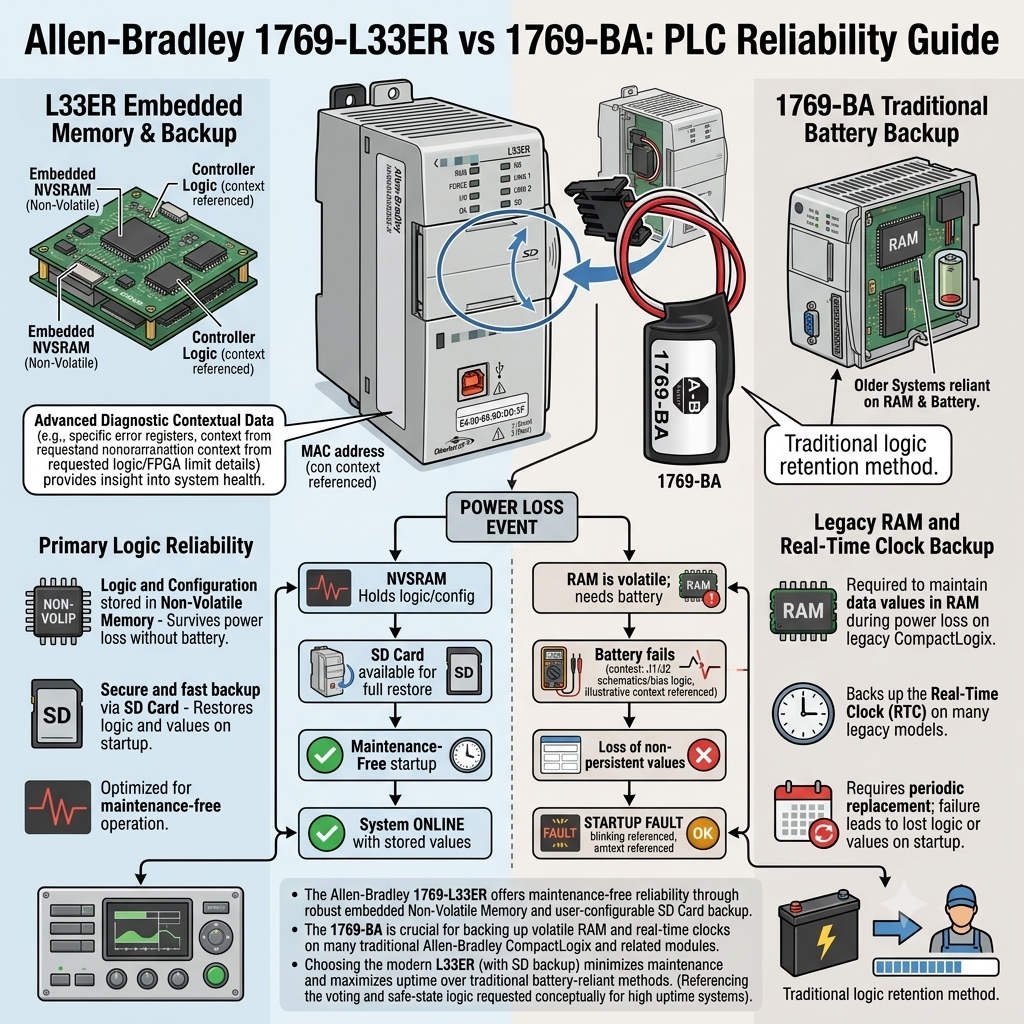
In traditional factory automation, the 1769-BA battery serves as a vital safeguard for legacy CompactLogix controllers. This lithium cell maintains volatile RAM during power interruptions. Without a functional battery, a controller loses its entire user program and tag data. Consequently, unplanned outages often result in extensive recovery times. Maintenance teams must then manually re-download code via Studio 5000. This vulnerability creates a significant risk for continuous processes like chemical manufacturing or pharmaceutical production.
Allen-Bradley 1769-L33ER vs 1769-BA PLC Reliability Guide

Allen-Bradley 1769-L33ER vs 1769-BA PLC Reliability Guide

Transitioning to Battery-Free Reliability with 1769-L33ER

Modern engineering standards prioritize hardware that eliminates single points of failure. The 1769-L33ER represents a major technological leap in the Allen-Bradley CompactLogix family. Unlike its predecessors, this controller utilizes non-volatile flash memory to store logic. It effectively removes the dependency on the 1769-BA battery for data retention. As a result, the system remains robust during extended power losses. This architecture is particularly beneficial for remote oil and gas assets where routine maintenance is difficult.

Technical Comparison: Volatile RAM vs. Non-Volatile Flash

Understanding the underlying memory mechanics is essential for system selection. Older L3x series controllers rely on battery-backed SRAM. If the 1769-BA fails while power is off, the RAM clears instantly. However, the 1769-L33ER writes data to internal flash memory. This design ensures the program survives indefinitely without external power. Furthermore, the L33ER supports dual Ethernet/IP ports for DLR (Device Level Ring) topologies. This integration improves both data security and network resilience compared to older serial-based units.

Impact of Environmental Factors on Battery Longevity

Field data suggests that ambient temperature dictates the lifespan of industrial batteries. A standard 1769-BA typically lasts about five years under ideal conditions. Nevertheless, high-heat environments like steel mills can reduce this by 50%. Frequent power cycling also accelerates the depletion of the lithium cell. Automation managers should implement predictive replacement schedules to avoid CPU faults. Alternatively, upgrading to battery-free controllers like the 1769-L33ER simplifies the long-term maintenance of the control cabinet.

Best Practices for Installation and Migration

  • Live Replacement: Always swap 1769-BA batteries while the PLC power is on to protect memory.
  • Firmware Verification: Ensure your Studio 5000 version supports the L33ER hardware profile before migration.
  • Code Documentation: Maintain a current .ACD backup file regardless of your memory type.
  • SOP Updates: Remove battery inspection steps from your PM checklists after installing L33ER units.
  • Thermal Control: Keep control panels below 40°C to protect sensitive electronic components.

B2B Solution Scenarios

  • Remote Pump Stations: Use the 1769-L33ER to ensure the station reboots instantly after a power failure without technician intervention.
  • High-Speed Packaging: Deploy L33ER controllers to utilize integrated Motion over Ethernet/IP for better synchronization.
  • Legacy Plant Refresh: Replace aging L32E units with L33ER controllers to eliminate the 1769-BA replacement cycle.

Expert FAQ

Q: Can I use a 1769-BA battery in a 1769-L33ER controller?
A: No, the L33ER does not have a battery slot. It uses an internal capacitor and flash memory for data retention.

Q: What happens if my L32E battery light turns red?
A: This indicates a low voltage state. You must replace the battery immediately while power is applied to avoid losing the program.

Q: Is the 1769-L33ER compatible with my existing 1769 I/O modules?
A: Yes, it supports the standard 1769 Compact I/O bus, making it an excellent drop-in replacement for older systems.
Bently Nevada 176449 Rear IO Module Selection Guide_

3500 System Machinery Protection: 176449 I/O Modules

Decoding Bently Nevada 176449 Series Rear I/O Modules for 3500 Machinery Protection Systems

In high-stakes industrial automation, continuous condition monitoring safeguards multimillion-dollar rotating assets. The Bently Nevada 3500 system relies heavily on specialized backplane connectivity to process field sensor data. Specifically, the 176449 series Rear I/O modules provide critical electrical termination and signal routing. Choosing the wrong dash-number option can compromise your entire machinery protection strategy. This comprehensive guide breaks down the variations, technical principles, and installation rules for these critical components.

Bently Nevada 176449 Rear IO Module Selection Guide_

Bently Nevada 176449 Rear IO Module Selection Guide_

The Functional Architecture of 176449 Rear Interface Boards

The 176449 family acts as the physical interface between field-mounted transducers and front-end monitor cards. Each module routes raw analog voltages from proximity probes, accelerometers, or pressure sensors safely into the rack. Moreover, the internal circuitry isolates delicate processing microprocessors from unpredictable field surges. This isolation maintains signal stability in noisy environments near massive turbomachinery. Therefore, these rear boards form the foundation of any reliable API 670 protection loop.

Understanding Core Model Variances and Monitor Pairings

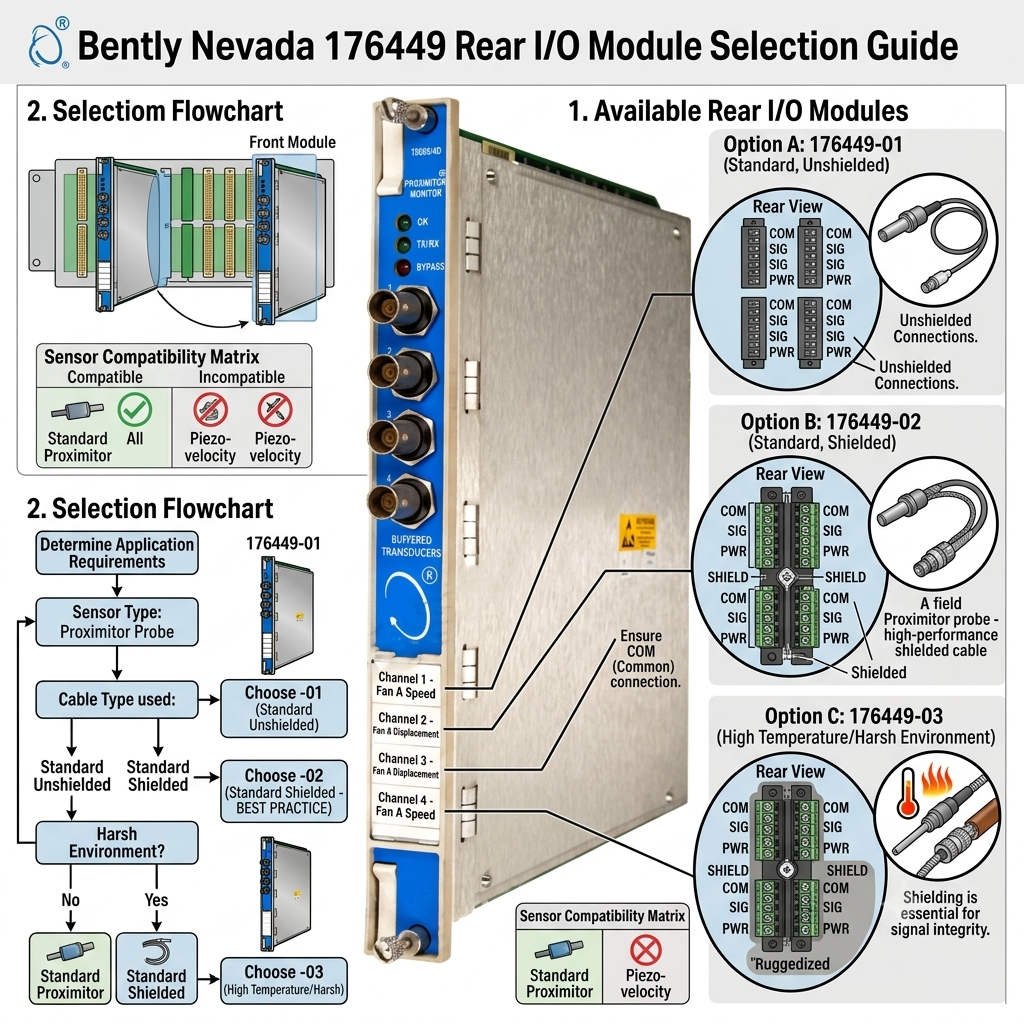
Rear I/O Part NumberAssociated Monitor CardPrimary Target Application
176449-013500/40M ProximitorShaft vibration and dynamic radial position monitoring
176449-023500/42M Proximitor/SeismicCombined velocity, acceleration, and case expansion tracking
176449-043500/45 PositionThrust position, differential expansion, and valve metrics
176449-073500/77M Recip PressureReal-time reciprocating compressor cylinder diagnostics

Signal Conditioning and Channel Topology Principles

Each variations within the 176449 family utilizes distinct input resistance paths and grounding layouts. For instance, the 176449-01 matches the negative voltage modulation typical of eddy-current proximity probes. In contrast, the 176449-07 handles rapid transient pressure spikes inside combustion or compression chambers. Consequently, mixing these cards up causes severe scaling errors or complete signal dropouts. The front processor card simply cannot normalize a signal conditioned by an incompatible rear board.

The API 670 Standard and System Interlocking Integrity

In power generation and petrochemical refining, machinery protection systems operate under strict API 670 compliance rules. This standard mandates that component failures must not prevent an emergency trip from executing properly. A degraded terminal block or a loose jumper on the Rear I/O card can mask dangerous shaft deflections. As a result, the DCS might receive faulty baseline data, delaying automated shutdown procedures. Proactive maintenance teams always treat rear hardware with the same care as front-facing processing modules.

Best Practices for Field Commissioning and Maintenance

  • Verification First: Double-check the precise dash-number configurations before sliding any module into the rack chassis.
  • ⚙️ Torque Optimization: Secure terminal strip screws tightly to eliminate intermittent signal noise caused by cabinet vibration.
  • 🔧 Shield Management: Drain cable shields strictly according to the Bently Nevada manual to prevent dangerous grounding loops.

Strategic Sourcing Commentary from Powergear X Automation Limited

At Powergear X Automation Limited, we observe widespread issues stemming from the use of unchecked surplus parts. Many plants buy replacement modules from unverified brokers without cross-referencing their specific revision histories. A physical board might fit perfectly into a 3500 slot while remaining electronically incompatible with your sensor software setup. We recommend auditing your entire spare parts inventory every year to ensure exact compatibility. For certified, high-performance machinery protection hardware, explore our validated listings at https://www.powergearx.com/.

Real-World Deployment and Solutions

During a recent gas terminal overhaul, engineers faced recurring channel errors on a critical centrifugal compressor. While the 3500/42M monitor tested perfectly on the bench, it threw persistent faults when installed in the rack. The troubleshooting team eventually tracked the issue to an old 176449-02 board suffering from micro-fractures along its backplane connector pins. Replacing the worn rear module instantly restored full diagnostic visibility, preventing an expensive forced outage during plant startup.

Frequently Asked Questions (FAQ)

1. Why does my 3500 software report a configuration mismatch when the front monitor matches the sensor?
This error usually indicates that the installed rear terminal module does not match the channel profile expected by the monitor. The 3500 rack verifies the ID of both the front and rear modules before allowing communication to initialize.

2. Can I use a 176449-02 card to pull dynamic signals into a standalone diagnostic data collector?
Yes. The 176449-02 provides buffered output terminals on the rear face for easy analyzer connection. This configuration allows technicians to connect diagnostic instruments without disturbing active safety trip loops.

3. What environmental factors cause the highest rate of failure on these specific rear cards?
Corrosive gas exposure, particularly hydrogen sulfide (H2S) in refinery settings, accelerates the oxidation of the exposed terminal contacts. Always ensure your marshalling enclosures maintain positive pressure and active chemical air filtering.

Preventing Industrial EMI CC-TDI110 Installation Best Practices_

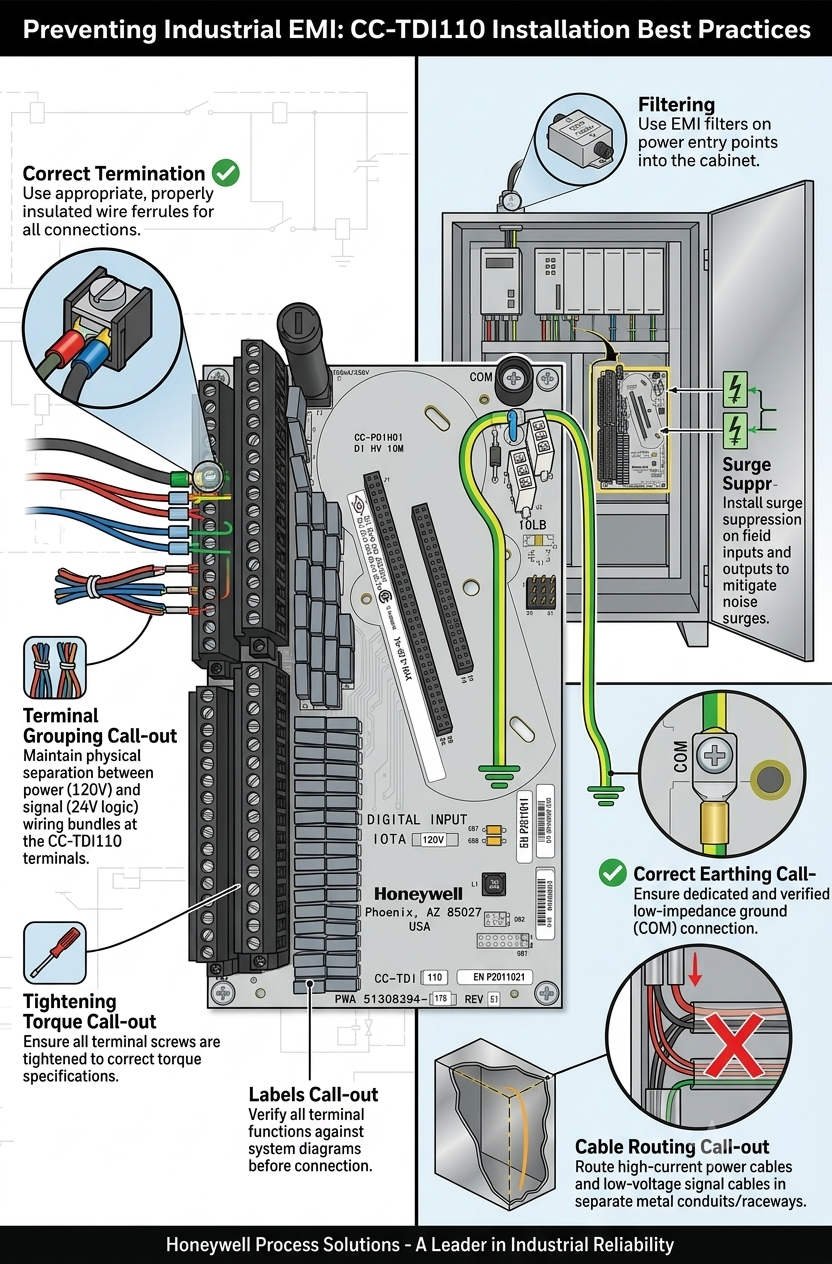
Preventing Industrial EMI: CC-TDI110 Installation Best Practices

Maximizing Signal Reliability with the Honeywell CC-TDI110 Digital Input Module

The Core Role of Digital Inputs in DCS Reliability

Modern industrial automation relies on precise data acquisition from field devices to the Distributed Control System (DCS). The Honeywell CC-TDI110 Digital Input Module serves as a critical bridge in this communication chain. Specifically, it excels in high-power environments like petrochemical plants and heavy manufacturing lines. Maintaining signal integrity is paramount in these settings. Consequently, engineers must prioritize proper shielding to prevent costly false trips or missed alarms.

Preventing Industrial EMI CC-TDI110 Installation Best Practices_

Preventing Industrial EMI CC-TDI110 Installation Best Practices_

Enhancing Isolation Against Electromagnetic Interference

The CC-TDI110 features robust channel-to-channel and channel-to-ground isolation. This design allows the module to detect digital states accurately despite nearby high-voltage cables. However, isolation alone cannot solve all noise problems. Electrical noise often originates from poor cable routing rather than internal component failure. Therefore, system integrators should treat internal isolation as a secondary defense rather than a primary solution.

Managing Common-Mode Noise in VFD Environments

Industrial facilities frequently utilize large motors and Variable Frequency Drives (VFDs). These devices generate significant Common-Mode Interference that can overwhelm standard control systems. The CC-TDI110 offers a high tolerance to this noise, ensuring stable performance. Nevertheless, if signal cables sit too close to power lines, induced voltages might exceed these rejection thresholds. Reliable factory automation requires a strict physical separation between signal and power conductors.

Advanced Input Filtering and Debounce Mechanisms

Transient noise can trigger nuisance alarms if a module lacks proper filtering. The CC-TDI110 addresses this through configurable debounce times that suppress short-lived electrical spikes. While these filters improve stability, they are not a cure for chronic interference. Excessive noise persisting beyond the filter window can still cause unintended shutdowns. As a result, Powergear X Automation recommends validating filter settings during the commissioning phase.

Best Practices for Shielded Cable Installation

Proper installation is the foundation of long-term system stability. When routing signals near motor feeders or lines exceeding 220V AC, always use shielded twisted-pair cables. Maintain at least 300 mm of clearance according to IEC 61000-5-2 guidelines. Furthermore, ensure any unavoidable crossings occur at a 90-degree angle. This technique effectively minimizes inductive coupling and preserves the purity of the digital signal.

Critical Shield Grounding and Segregation Strategies

A frequent mistake in the field involves grounding cable shields at both ends. This creates ground loops that introduce more noise into the system. For the CC-TDI110, engineers should ground the shield only at the DCS cabinet. Additionally, never share cable trays between high-current power lines and sensitive signal wires. We have observed cases where segregating cables into dedicated metallic trays instantly resolved intermittent DI flickering.

Strategic Insights from Powergear X Automation

In our experience at Powergear X Automation, hardware quality is only half the battle. The CC-TDI110 is a world-class module, but its performance depends on the surrounding infrastructure. We recommend a “holistic shielding” approach that combines high-quality Honeywell hardware with strict adherence to IEC standards. Investing in proper wiring today prevents expensive downtime in the future.

Technical Summary Checklist

  • Use shielded twisted-pair cables for all digital inputs.
  • Ground shields at the DCS side only to prevent loops.
  • Maintain 300 mm separation from high-power cables.
  • Configure debounce times to match field device characteristics.
  • Install Surge Protection Devices (SPD) in lightning-prone areas.

Practical Application Scenarios

  • Refinery Safety Interlocks: Ensuring emergency shutdown valves report status without EMI-induced false positives.
  • Power Plant Turbine Control: Monitoring high-speed digital states near heavy electrical switching equipment.
  • Chemical Batch Processing: Maintaining accurate sequence control where VFDs are used extensively for agitation.

Expert FAQ: CC-TDI110 Implementation

Q1: How do I choose between the CC-TDI110 and legacy Honeywell DI modules?
Evaluate your current electromagnetic environment first. While the CC-TDI110 is often backward compatible, it offers superior noise rejection features necessary for modern VFD-heavy plants. If your facility has upgraded its power hardware, upgrading your I/O modules is a wise technical move.

Q2: What is the most common cause of “flickering” signals in new installations?
Usually, it is a grounding issue. Ensure your shields are not creating loops and check for 90-degree crossings at power intersections. If the issue persists, increase the software debounce time slightly within the DCS configuration.

Q3: Does this module require specialized maintenance during its lifecycle?
The CC-TDI110 is largely maintenance-free. However, we recommend annual inspections of the terminal blocks and grounding bars. Loose connections are a silent killer of signal integrity in high-vibration industrial settings.

1769-L24ER-QB1B vs 1769-L23E: Upgrade Guide | PLCDCS HUB

1769-L24ER-QB1B vs 1769-L23E: Upgrade Guide | PLCDCS HUB

1769-L24ER-QB1B vs 1769-L23E: Essential Migration Guide for Industrial Automation

The Evolution of CompactLogix Control Systems

The 1769-L24ER-QB1B represents a significant leap in factory automation compared to the legacy 1769-L23E. This modern controller delivers enhanced processing power and integrated motion capabilities. It specifically addresses the networking bottlenecks found in older hardware. However, transitioning between these two units requires a strategic engineering approach rather than a simple swap.

1769-L24ER-QB1B vs 1769-L23E: Upgrade Guide | PLCDCS HUB

Processing Power and Memory Advancements

The L24ER-QB1B offers superior user memory and execution speeds for complex control systems. These improvements directly impact high-speed applications like automated packaging or precision bottling.

  • Faster scan times significantly reduce command latency.
  • Expanded memory supports advanced data logging and complex logic.
  • Improved task multitasking prevents processor overloads during peak cycles.
  • PLCDCS HUB observes that faster execution may require recalibrating legacy timers.

Revolutionizing Connectivity with Dual Ethernet Ports

Unlike the single-port 1769-L23E, the L24ER-QB1B features dual Ethernet/IP ports with an embedded switch. This architecture is vital for modern industrial automation environments requiring high uptime.

  • Supports Device Level Ring (DLR) topologies for network resiliency.
  • Eliminates the need for expensive external managed switches.
  • Simplifies wiring within the control cabinet.
  • Reduces hardware failure points in continuous processing plants.

Integrated Motion Control via Ethernet/IP

One primary advantage of the L24ER-QB1B is its ability to handle integrated motion. This feature allows engineers to manage servo drives directly through the controller.

  • Reduces system complexity by removing dedicated motion modules.
  • Enhances synchronization between multiple axes of movement.
  • Minimizes mechanical wear through smoother motion profiles.
  • Lowers the total cost of ownership for specialized machinery.

Critical Installation and Software Requirements

Upgrading to the L24ER-QB1B involves shifting from RSLogix 5000 to Studio 5000 Logix Designer. This software transition is mandatory for accessing the latest firmware features.

  • Always verify firmware compatibility before attempting a project download.
  • Maintain proper physical spacing to ensure optimal heat dissipation.
  • Utilize shielded cabling to protect integrated I/O from EMI.
  • Check grounding points to prevent unexpected signal noise interference.

Expert Analysis from PLCDCS HUB

At PLCDCS HUB, we see the 1769-L24ER-QB1B as a cornerstone for digital transformation. While the initial investment is higher, the long-term reliability justifies the cost. Legacy systems often struggle with modern security protocols that this controller handles with ease. We recommend this upgrade for any facility aiming for PLC-based network redundancy.

Application Scenarios and Solutions

  • High-Speed Packaging: Utilizing DLR for zero-downtime communication between stations.
  • Pharmaceutical Production: Leveraging increased memory for strict 21 CFR Part 11 data tracking.
  • Food and Beverage: Implementing integrated motion for precise filling and capping operations.

Technical Implementation Checklist

  • ✅ Verify that your existing I/O mapping matches the QB1B integrated points.
  • ✅ Ensure all network nodes support the chosen Ethernet topology.
  • ✅ Confirm Studio 5000 version alignment with the hardware revision.
  • ✅ Audit the power supply capacity for the updated controller load.

Frequently Asked Questions

How do I handle I/O differences during a hardware migration?
The L24ER-QB1B features integrated I/O which differs from the modular L23E layout. You must rewrite the I/O configuration in Studio 5000 and update physical wiring diagrams.

What is the most common pitfall when upgrading these controllers?
The most common issue involves faster logic execution affecting old “one-shot” instructions. Always perform a dry run to ensure the faster scan time doesn’t break logic.

Is it better to repair an old L23E or buy the L24ER-QB1B?
If you need motion control or network redundancy, buy the L24ER-QB1B. For simple, isolated machines with no growth plans, a repair might suffice temporarily.

Explore our extensive inventory of high-performance controllers at PLCDCS HUB Limited to find the right solution for your facility.

Honeywell CC-PWRN01 Guide Thermal Management in DCS Cabinets

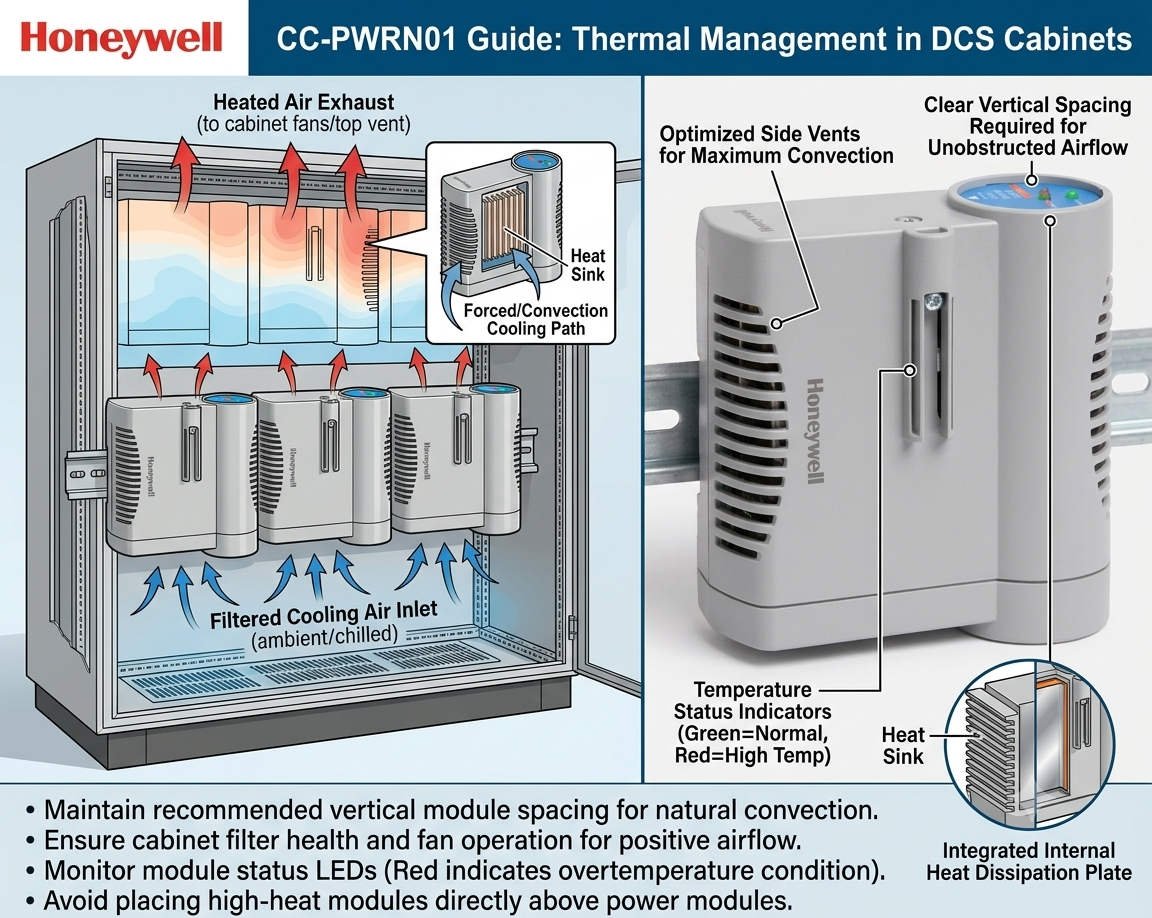
Honeywell CC-PWRN01 Guide: Thermal Management in DCS Cabinets

Ensuring DCS Stability: Thermal Management for the Honeywell CC-PWRN01 Power Module

The Critical Role of Reliable Power in Industrial Automation

The Honeywell CC-PWRN01 power module provides essential redundant energy to modern Distributed Control Systems (DCS). It secures continuous operations in demanding sectors like oil, gas, and pharmaceutical production. However, system reliability depends heavily on proper thermal management. Overheating remains a leading cause of premature component failure in industrial environments. Therefore, engineers must prioritize vertical installation spacing to maintain long-term system health.

Honeywell CC-PWRN01 Guide Thermal Management in DCS Cabinets

Honeywell CC-PWRN01 Guide Thermal Management in DCS Cabinets

Optimizing Vertical Spacing for Natural Convection

For the CC-PWRN01, maintaining a vertical clearance of 50–75 mm is vital for air circulation. Natural convection moves heat from the bottom to the top of the cabinet. If you obstruct this flow, internal temperatures may exceed the +70°C design limit. Moreover, restricted airflow significantly shortens the lifespan of sensitive electrolytic capacitors. In our experience, tight spacing creates hot spots that sit 15°C above the ambient cabinet temperature.

Managing Load Capacity to Reduce Heat Generation

Power modules generate substantially more heat when operating at peak capacity. Continuous high-load conditions accelerate the aging process of internal electronics. As a result, the risk of cascading failures in redundant configurations increases. At Powergear X Automation, we suggest designing systems for 60–70% of the nominal load. This conservative approach provides a safety buffer during seasonal temperature spikes or ventilation issues.

Adapting Cabinet Ventilation for Harsh Climates

The CC-PWRN01 typically relies on passive cooling within the control cabinet. Sealed or high-IP-rated enclosures require even larger spacing to prevent heat accumulation. In regions like the Middle East or Southeast Asia, ambient heat demands stricter standards. We frequently increase vertical spacing to ≥80 mm for these high-temperature projects. Furthermore, integrating heat exchangers or fan trays becomes mandatory when passive cooling reaches its physical limits.

Installation Best Practices for Power Modules

Proper physical placement ensures that heat does not affect other critical system components. Engineers should always stack power modules vertically to align with natural airflow. Additionally, avoid placing sensitive controllers or I/O processors directly above a heat-generating power supply. We once resolved recurring communication faults in a refinery by simply relocating a controller away from a module’s heat path. These small adjustments prevent significant thermal stress on the entire DCS architecture.

Routine Maintenance and Thermal Inspection Strategies

Regular inspections keep your factory automation system running at peak efficiency. Use infrared thermometers to measure the surface temperature of the CC-PWRN01 during operation. If surface readings exceed 65°C, you must immediately investigate airflow obstructions or spacing issues. Moreover, dust accumulation can reduce heat dissipation efficiency by up to 20%. Therefore, cleaning internal components during scheduled shutdowns is a simple yet effective reliability strategy.

Professional Insights from Powergear X Automation

At Powergear X Automation, we believe that thermal design is as important as electrical wiring. Modern power modules like the CC-PWRN01 are highly efficient, but they still follow the laws of thermodynamics. Neglecting a few centimeters of space can lead to millions in lost production due to an unexpected trip. We recommend a comprehensive thermal audit for every cabinet upgrade to ensure modern hardware performs within its optimal environment.

Technical Installation Checklist

  • Maintain a minimum of 50–75 mm vertical clearance between units.
  • Mount modules vertically to support natural bottom-to-top airflow.
  • Use perforated cable ducts to avoid trapping heat near the module.
  • Avoid tight cable bundling directly above the power supply vents.
  • Verify that the total load stays under 75% for unventilated cabinets.

Industrial Application Scenarios

  • Offshore Platforms: Maintaining redundant power in compact, high-ambient-temperature control rooms.
  • Chemical Processing: Preventing thermal-induced shutdowns in sealed cabinets protected from corrosive gases.
  • Pharmaceutical Batching: Ensuring high-availability power for critical sequence controllers during long production cycles.

Expert FAQ: CC-PWRN01 Implementation

Q1: How do I verify if my current cabinet spacing is sufficient?
If your vertical spacing is ≥50 mm and the cabinet interior stays below 40°C under full load, your setup is generally safe. However, if you notice the module shell feels excessively hot to the touch, consider increasing the gap to 80 mm or adding an exhaust fan to the cabinet roof.

Q2: Can I replace legacy Honeywell power supplies with the CC-PWRN01 directly?
While they are often mechanically compatible, never skip a thermal audit. Newer modules might have higher power densities and different heat profiles than 20-year-old units. Ensure the existing cabinet layout can handle the heat dissipation of the new module before finalizing the retrofit.

Q3: What are the signs of a power module failing due to heat?
Look for discolored plastic housing, bulging capacitors visible through the vents, or frequent “redundancy lost” alarms. If you detect a sweet or burnt smell during a cabinet inspection, the module is likely overheating and requires immediate replacement to avoid a total system failure.

For more technical guides and high-quality automation components, visit Powergear X Automation today.

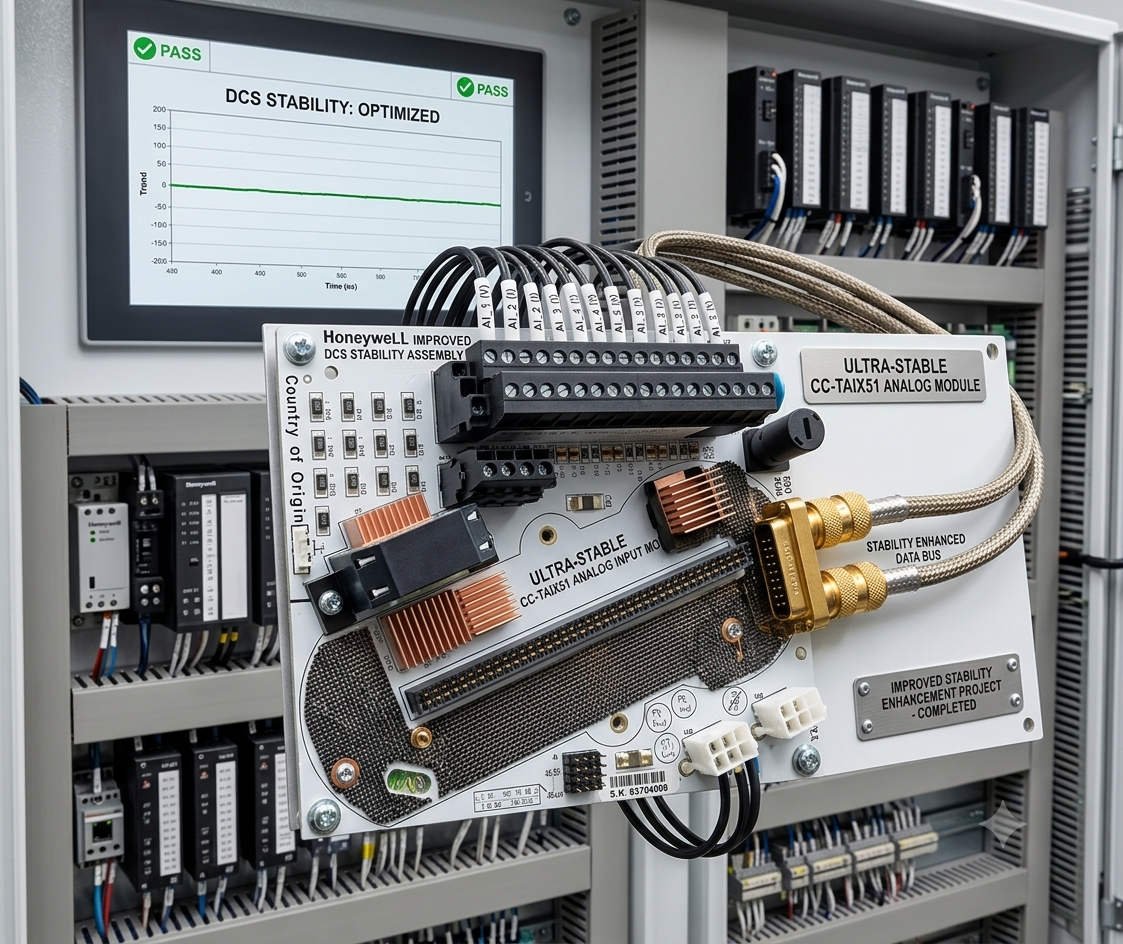
Honeywell CC-TAIX51 Guide: Solving Humidity-Induced Packet Loss

Reducing Packet Loss in Honeywell CC-TAIX51 Analog Input Modules

The Importance of Precision in Critical Process Industries

The Honeywell CC-TAIX51 analog input module provides high-precision signal acquisition for complex Distributed Control Systems (DCS). It serves vital sectors like oil & gas, pharmaceuticals, and chemical processing. However, high-humidity environments often trigger unexpected communication packet loss. This issue undermines system reliability and causes delayed control responses. Understanding these environmental triggers helps engineers prevent intermittent faults and maintain continuous production cycles.

How Micro-Condensation Disrupts Factory Automation Hardware

Standard industrial ratings often cover humidity levels up to 95% non-condensing. Nevertheless, rapid temperature shifts inside control cabinets create micro-condensation on PCB surfaces. Moisture forms conductive paths between sensitive communication traces. Consequently, this leads to signal distortion or transient short circuits. In fast PID control loops, even minor data acquisition delays can destabilize the entire process.

Maintaining Signal Integrity and Isolation Barriers

The CC-TAIX51 relies on high-impedance circuits to ensure accurate analog data. Humid conditions increase leakage current across these critical isolation barriers. As a result, insulation resistance drops and the signal-to-noise ratio (SNR) weakens. While analog values might only fluctuate slightly, the internal I/O link often suffers. This manifests as checksum failures and data retransmissions at the controller level.

Protecting High-Speed Backplane Communication Stability

These modules communicate with the DCS controller via high-speed backplane interfaces. Humidity and airborne contaminants quickly oxidize these metal connectors. Increased contact resistance introduces timing jitter or bit errors during data transfer. Therefore, communication drops occur more frequently under high system loads. Regular hardware inspection remains the best defense against these physical layer failures.

Optimizing Control Cabinet Climate Management

Field experience shows that climate control is more effective than simple sealing. We recommend installing anti-condensation heaters inside every critical cabinet. Technicians should maintain the internal temperature at least 5°C above the ambient dew point. Sealed IP-rated enclosures without thermal regulation often trap moisture inside. Proper airflow management ensures long-term reliability for all factory automation components.

Implementing Conformal Coating and Connector Care

For offshore or coastal installations, factory-applied conformal coating provides essential protection. Ensure all coatings comply with the IEC 61086 standard for industrial electronics. During maintenance shutdowns, use non-residue contact cleaners on backplane connectors. Re-seating modules restores proper contact pressure and clears oxidation. Powergear X Automation observers suggest that many “failed” modules only require professional cleaning to resume service.

Expert Analysis from Powergear X Automation

At Powergear X Automation, we believe environmental management defines hardware lifespan. The CC-TAIX51 is a robust component, but it cannot overcome poor cabinet design. Engineers should prioritize proactive thermal monitoring over reactive module replacement. Combining high-quality Honeywell hardware with rigorous maintenance standards significantly reduces total cost of ownership. Visit our website for more technical solutions and high-reliability automation hardware.

Technical Maintenance Checklist

  • 🔧 Install internal heaters to prevent micro-condensation.
  • 🔧 Maintain temperature 5°C above the local dew point.
  • 🔧 Use gold-plated or sealed connectors in high-corrosion zones.
  • 🔧 Verify firmware compatibility before swapping legacy modules.
  • 🔧 Schedule annual connector cleaning with non-residue agents.

Solution Scenario: Coastal Refinery Deployment

  • The Challenge: Intermittent “I/O Link Failure” alarms during morning temperature shifts.
  • The Discovery: Micro-condensation on the backplane due to high ambient salt-mist humidity.
  • The Fix: Installed regulated heaters and switched to conformal-coated CC-TAIX51 units.
  • The Result: Communication packet loss dropped to zero within the first 30 days.

Frequently Asked Questions

Q1: Why does my DCS report packet loss when the module seems powered on?
Communication requires much higher signal purity than simple power delivery. Humidity increases contact resistance, causing “bit-flip” errors that the DCS rejects as invalid packets. Powergear X recommends checking the backplane pins for discoloration first.

Q2: Is it better to replace an old module or improve cabinet cooling?
If the environment exceeds 95% humidity, a new module will eventually fail too. Improve the cabinet climate control first. However, if the old module shows visible corrosion on the gold fingers, replacement is necessary to prevent damaging the backplane.

Q3: How do I verify if my CC-TAIX51 is compatible with a legacy rack?
Always check the Honeywell hardware compatibility matrix for your specific firmware revision. Older racks may lack the modern shielding required for high-speed digital communication. In humid plants, consider upgrading the I/O base along with the module.

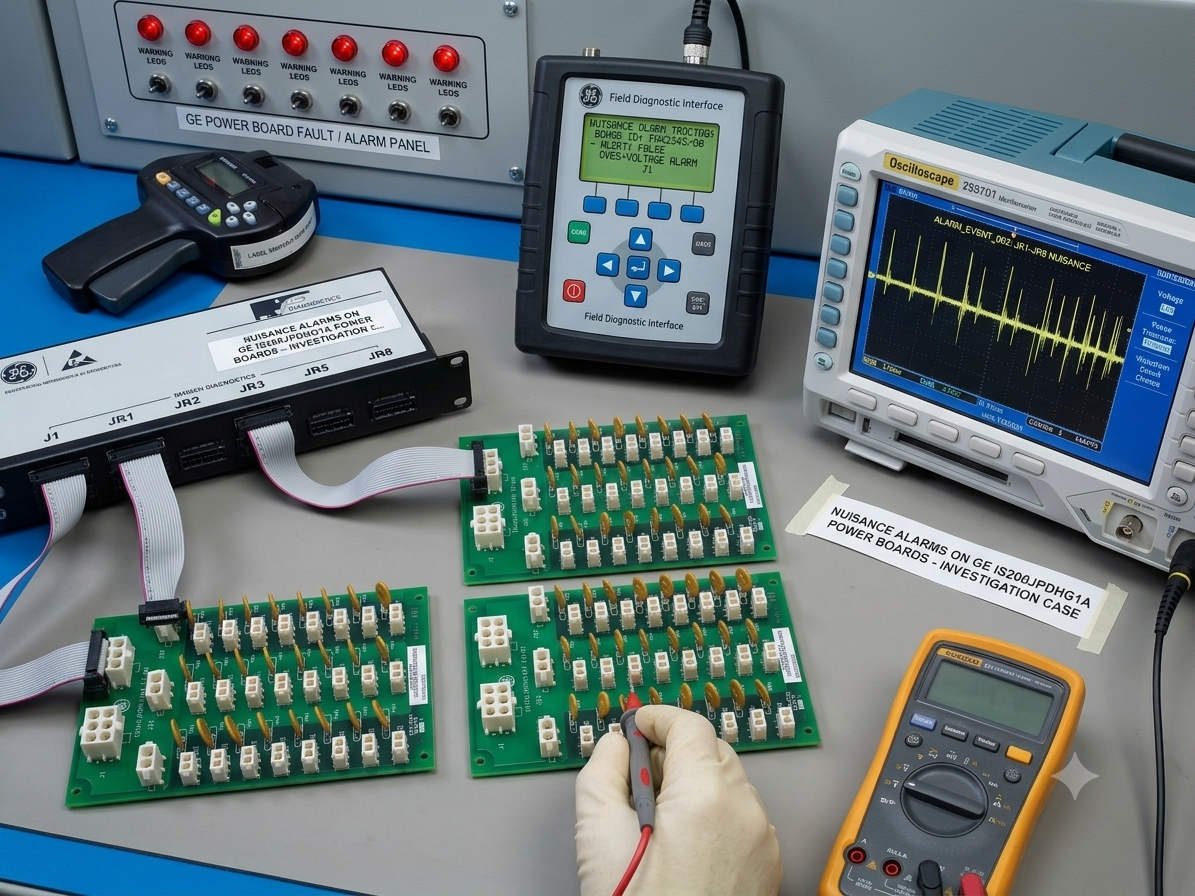
GE IS200JPDHG1A Troubleshooting: False Total Failure Alarms

Can Monitoring Circuit Drift on the GE IS200JPDHG1A Cause False System Trips?

In high-availability industrial automation, faulty diagnostic feedback can prove as damaging as actual physical hardware failures. The GE IS200JPDHG1A Power Distribution Board serves as the central power backbone within EX2100 excitation systems. Beyond distributing vital DC voltage rails, this board actively monitors subsystem health metrics. However, an isolated internal failure within its internal sensing loop can trick the main controller. Consequently, the DCS may generate an unwarranted “Power System Total Failure” critical alarm message.

The Functional Architecture of Power Supervision Circuitry

The IS200JPDHG1A integrates an intricate network of analog voltage dividers, operational amplifiers, and status signal comparators. These components constantly read feedback parameters across multiple incoming power feeds. After processing, the hardware forwards real-time status packets straight to the core turbine control systems. This architecture ensures that the controller can instantly identify sagging power lines. Therefore, the processing brain can protect downstream electronics before an absolute brownout disrupts plant operations.

How Internal Board Anomalies Generate Ghost Alarms

Component degradation can mimic a severe electrical blackout within the power distribution array. Over time, analog sensing channels can experience thermal resistance drift or comparator latch-up malfunctions. When this occurs, the diagnostic circuitry reports low or absent voltage despite a perfectly healthy DC bus. If the system lacks redundant cross-checking paths, a single sensor failure may trigger an immediate emergency trip. This false alarm unnecessarily isolates the entire generator excitation unit from the power grid.

Industry research indicates that up to 30% of power supply diagnostic alarms stem from feedback path errors. Pin oxidation on heavy backplane connectors can similarly attenuate the weak low-voltage telemetry signals. Moreover, old firmware configurations may misinterpret a single channel fault as an absolute power failure. Engineers must cross-reference actual physical bus bars before approving extensive control system module swaps.

Noise Immunity Vulnerabilities in Heavy Factory Automation

Turbine rooms host heavy electromagnetic fields generated by excitation transformers and massive variable frequency drives. The low-voltage supervisory lines on the IS200JPDHG1A remain susceptible to high-frequency induced noise. If cabinet grounding terminals loosen, common-mode noise can override the true analog feedback measurements. This electrical interference distorts waveform edges, leading to intermittent channel mismatch errors. Maintaining excellent shield continuity remains mandatory to protect signal tracking accuracy.

Evaluating Backward Compatibility and Selection Differences

Replacing an older power supervisor requires careful checking of part number suffix variations. While the base IS200JPDHG1A model handles standard distribution tasks, physical revision layers alter connector arrangements. Certain sub-versions feature specialized trace impedances designed to handle modern high-speed noise filtering tasks. Attempting to install an unverified board revision can introduce unintended parameter reading offsets. To avoid project delays, procure components from certified distributors like Powergear X Automation Limited.

Step-by-Step Diagnostic Verification Protocols

  • Physical Bus Measurement: Measure the true incoming DC control voltage directly using a calibrated digital multimeter.
  • ⚙️ Connector Inspection: Unplug and re-seat all communication cables while checking for immediate thermal pin discoloration.
  • 🔧 Chronological Log Analysis: Examine the ToolboxST event sequence to trace if channel faults preceded the total blackout alarm.

Strategic Maintenance Perspectives from Powergear X Automation Limited

At Powergear X Automation Limited, we emphasize that automatic hardware swapping often increases overall troubleshooting costs. When a total power failure indicator arises, blindly replacing the distribution block skips root-cause verification. Many issues resolve after cleaning oxidized edge contacts with manufacturer-approved chemical solvents. We suggest tracking sensing calibration trends during standard annual system turnarounds. To explore our comprehensive database of genuine GE components, visit our store at https://www.powergearx.com/.

Real-World Application Scenarios

During a baseline commissioning phase at a combined-cycle power station, operators reported a sudden, unexplained total power alarm. Physical tests confirmed that the main 125VDC auxiliary battery supply remained fully energized. Further analysis traced the error to an open-circuit feedback trace on the distribution board. Replacing the damaged module restored correct telemetry reporting, allowing the plant to achieve full production output without further delay.

Frequently Asked Questions (FAQ)

1. Why does a minor analog drift escalate to a complete total power system shutdown message?
If the controller code uses an unweighted “AND” condition across sensing channels, a single dead input simulates a total voltage loss. Updating your I/O block parameters to utilize voting logic solves this vulnerability.

2. Can I test the internal comparator circuitry of this board while the system runs online?
Online manual circuit tracing is highly discouraged due to short-circuit risks near the main power buses. Confine deep component-level validation to a static test bench during standard outage schedules.

3. How do I differentiate between a real input supply failure and a board-level telemetry fault?
A genuine supply failure simultaneously alters parallel monitoring systems, such as your main upstream switchgear breakers. If only the specific board reports zero volts while other metrics remain unchanged, suspect a telemetry issue.

Measure Switching Noise on GE IS2020RKPSG3A Module

Measure Switching Noise on GE IS2020RKPSG3A Module

Analyzing High-Frequency Switching Noise on the GE IS2020RKPSG3A Power Supply Bus

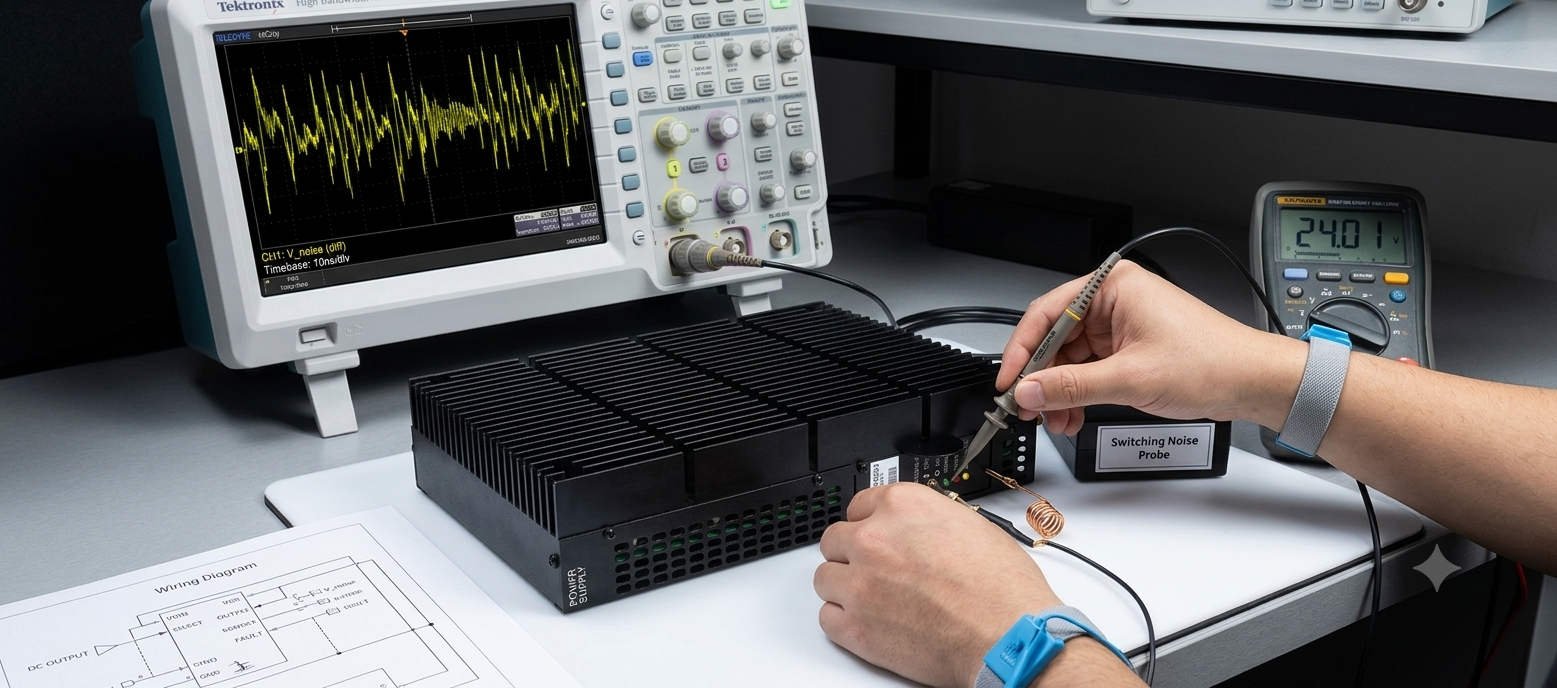
In heavy industrial automation, clean low-voltage DC power safeguards processor integrity. The GE IS2020RKPSG3A power supply module delivers critical 5VDC power to EX2100 excitation systems and Mark VI control racks. However, a standard digital multimeter cannot capture high-frequency switching anomalies on the bus. This technical article covers the exact oscilloscope methods required to analyze dangerous ripple voltages. As a result, engineers can protect vital control networks from unexpected trips.

Measure Switching Noise on GE IS2020RKPSG3A Module

Measure Switching Noise on GE IS2020RKPSG3A Module

The Core Function and Architecture of the Power Module

The IS2020RKPSG3A utilizes a high-efficiency switch-mode power conversion architecture. It regulates voltage for downstream processing boards and critical communication interfaces. In addition, the internal circuitry isolates the control logic from heavy grid surges. This regulation keeps processing environments functional during severe load fluctuations. However, the native switching frequency inevitably introduces high-frequency ripple components onto the distribution lines.

Operational Principles of Oscilloscope Ripple Diagnostics

Detecting power anomalies requires proper instrument bandwidth selection and specific input coupling. Maintenance teams must utilize an oscilloscope with a minimum bandwidth of 100 MHz. Furthermore, engineers should select AC coupling to strip away the dominant 5VDC component. This setting allows the instrument to isolate the underlying millivolt-level noise. Consequently, you can observe high-frequency spikes that cause CPU watchdog resets and network dropouts.

The Critical Nature of Correct Probe Grounding

Standard oscilloscope probes often include long ground leads with alligator clips. However, these long wires act as antennas in noisy power generation environments. They capture stray electromagnetic interference from surrounding high-current bus ducts. To avoid false readings, technicians must utilize a short spring ground accessory. This practice restricts the ground loop area to under two centimeters. Therefore, it ensures that observed waveform ringing stems from the power supply rather than external induction.

Incorrect grounding methods can artificially inflate peak-to-peak voltage readings by several hundred percent. This inflation frequently leads to the premature replacement of perfectly healthy modules. Experienced engineers always measure ripple directly across the distribution terminal blocks. This strategic placement provides an accurate view of the voltage quality reaching the control systems.

Evaluating Compatibility and Module Selection Variations

When executing system updates, procurement officers must review original factory hardware revisions. The IS2020RKPSG3A features specific mechanical connector footprints and thermal properties. Older power supply variations may look identical but lack advanced internal noise filtering. In addition, backplane interface configurations can vary slightly across different controller generations. Relying on verified suppliers like Powergear X Automation Limited prevents costly installation compatibility errors.

Online Measurement and Calibration Benchmarks

  • Instrument Setup: Activate the 20 MHz bandwidth limiter to eliminate irrelevant high-frequency ambient radiation.
  • ⚙️ Baseline Profiling: Record bus waveforms during steady-state operation and major process load transitions.
  • 🔧 Network Inspection: Verify terminal torque values and check downstream filtering capacitors for leakage.

Expert Market Commentary from Powergear X Automation Limited

At Powergear X Automation Limited, we monitor component lifecycle patterns across major power plants globally. We notice that many power supply faults trace back to aging capacitors on adjacent I/O modules. As these capacitors degrade, they no longer buffer the 5VDC bus effectively. Therefore, we highly recommend performing preventative oscilloscope health checks annually. To find certified replacement components and optimize your factory automation assets, visit our portal at https://www.powergearx.com/.

Industrial Application Scenarios

In offshore gas extraction facilities, turbine control stability directly influences production metrics. The IS2020RKPSG3A maintains steady core voltages for the central processors. By implementing routine ripple tracking, maintenance crews can detect supply degradation months before a terminal blowout occurs. This proactive strategy ensures continuous operation of the DCS during severe ambient temperature changes.

Frequently Asked Questions (FAQ)

1. What peak-to-peak millivolt threshold indicates a need to replace the module?
While minor ripple is normal, high-frequency switching noise exceeding 50mVpp warrants close observation. If spikes regularly surpass 100mVpp during load transitions, replace the unit to protect downstream processors.

2. Can I replace the module while the turbine control system is active?
Live replacement depends on your rack redundancy configuration. In non-redundant simplex setups, pulling the module causes an immediate controller crash. Always confirm system redundancy status before attempting live servicing.

3. Why does the 5VDC bus show high noise when the power module passes bench tests?
This discrepancy usually indicates external electromagnetic interference. Poor cabinet bonding or missing cable shields allow noise from neighboring VFD equipment to induce voltage spikes onto the DC distribution lines.

Fix GE IS200ERDDH1ABA Black Screen Fault With Flashing LED

Fix GE IS200ERDDH1ABA Black Screen Fault With Flashing LED

Solving the GE IS200ERDDH1ABA Black Screen Anomaly With Flashing Communication LEDs

In heavy-duty industrial automation, visual feedback remains essential for safe control operations. Field engineers using GE Mark VI and Mark VIe systems often face a confusing diagnostic scenario. The IS200ERDDH1ABA remote display board initializes with a completely black screen. However, the onboard communication LED continues to blink normally. This symptom indicates that lower-level data bus hardware remains functional. Nevertheless, the independent video rendering or backlight path has failed entirely.

Fix GE IS200ERDDH1ABA Black Screen Fault With Flashing LED

Fix GE IS200ERDDH1ABA Black Screen Fault With Flashing LED

The Operational Function of the Remote Display Module

The IS200ERDDH1ABA provides critical real-time status data directly from the turbine core. It translates complex internal data streams into actionable graphics for on-site maintenance crews. In power generation and petrochemical sectors, this interface reduces dependency on central control rooms. The module features integrated serial transceivers and dedicated memory chips to manage local screen refreshes. Consequently, it maintains local monitoring capabilities even during heavy DCS network loading events.

The Principle of Dual Path Initialization Failures

Understanding this fault requires analyzing the separate power supply routing on the processor board. The communication microprocessor operates on low-voltage logic thresholds, typically around 3.3VDC. Therefore, it can initialize and flash its status LED during marginal voltage sags. In contrast, the liquid crystal array and backlight driver demand stable, higher-tolerance power rails. If the incoming power supply degrades, the communication circuits boot up while the screen remains dead.

Investigating Firmware Incompatibility and Graphic Renders

A blinking indicator proves that the display board exchanges data packets with the controller backplane. However, successful data receipt does not guarantee that the local graphics processor can render images. During phased plant upgrades, engineers often install newer controller code while leaving legacy display software unchanged. This variation causes a severe firmware handshake mismatch upon system boot-up. The module receives information successfully but cannot map the variables to the older display library.

Mechanical Stress and High-Vibration Environment Risks

Turbine enclosures expose sensitive control systems to continuous mechanical vibrations and intense heat cycles. Over years of service, these forces weaken internal connections between the PCB and the glass panel. High contact resistance frequently develops along the microscopic copper traces of flexible ribbon cables. Moreover, airborne contaminants accelerate oxidation on terminal header pins inside the cabinet. These subtle physical defects can cut off video signals while leaving robust communication lines intact.

A Comprehensive Selection and Procurement Guide

When sourcing replacement components, procurement managers must match exact suffix variations. The IS200ERDDH1ABA features specific revision characteristics tailored for standard Mark VI configurations. Substituting it with older revisions can introduce physical shape conflicts or terminal layout changes. In addition, ensure the replacement board contains the correct pre-loaded bootloader firmware. Relying on specialized distributors like Powergear X Automation Limited prevents costly engineering delays.

Field Maintenance Routines for Display Interfaces

  • Flashlight Inspection: Shine a bright light at an angle across the black screen to reveal hidden text.
  • ⚙️ Dynamic Voltage Audit: Measure the terminal power rail under full startup load to capture temporary drops.
  • 🔧 Ribbon Seating: Clean header contacts with certified solvent and secure ribbon cables using locking clips.

Industry Commentary from Powergear X Automation Limited

At Powergear X Automation Limited, we emphasize that field symptoms are rarely clear-cut in factory automation. A flashing LED often creates a false sense of security regarding hardware health. We advise technicians to execute cross-swaps with functional matching terminals during planned maintenance outages. This method quickly isolates software bugs from physical hardware component failures. To explore our comprehensive catalog of verified GE modules, check out our site at https://www.powergearx.com/.

Real-World Application Scenarios

During a peak-load startup at a natural gas power facility, a critical turbine display suddenly went dark. While the network interface indicators continued flashing, operators could not confirm auxiliary pump parameters locally. Using a structured diagnostic framework, technicians identified a 500-millivolt drop on the local 24VDC feeder loop. Replacing the worn terminal power supply immediately restored the screen graphics. This approach averted an expensive emergency shutdown sequence.

Frequently Asked Questions (FAQ)

1. What does it mean if faint images are visible under a flashlight during a black-screen event?
This indicates that the graphic logic and communication circuits are functioning perfectly. The failure rests entirely inside the backlight inverter circuit or the high-intensity LED array itself.

2. How do I upgrade the internal display software if the terminal remains completely black?
You must establish a direct serial connection via the dedicated maintenance port using ToolboxST. This bypasses the corrupted primary runtime database and forces a clean firmware overwrite sequence.

3. Can external electrical surges cause this specific flashing-LED black-screen state?
Yes. High-voltage transients often slip past primary cabinet barriers and strike the sensitive analog drivers of the display panel. Meanwhile, the digitally isolated communication transceivers survive the surge unscathed.

Fix Ground Loop Alarms on GE IS200EPSM Excitation Modules

Fix Ground Loop Alarms on GE IS200EPSM Excitation Modules

How Ground Potential Differences Impact the Stability of the GE IS200EPSM Module

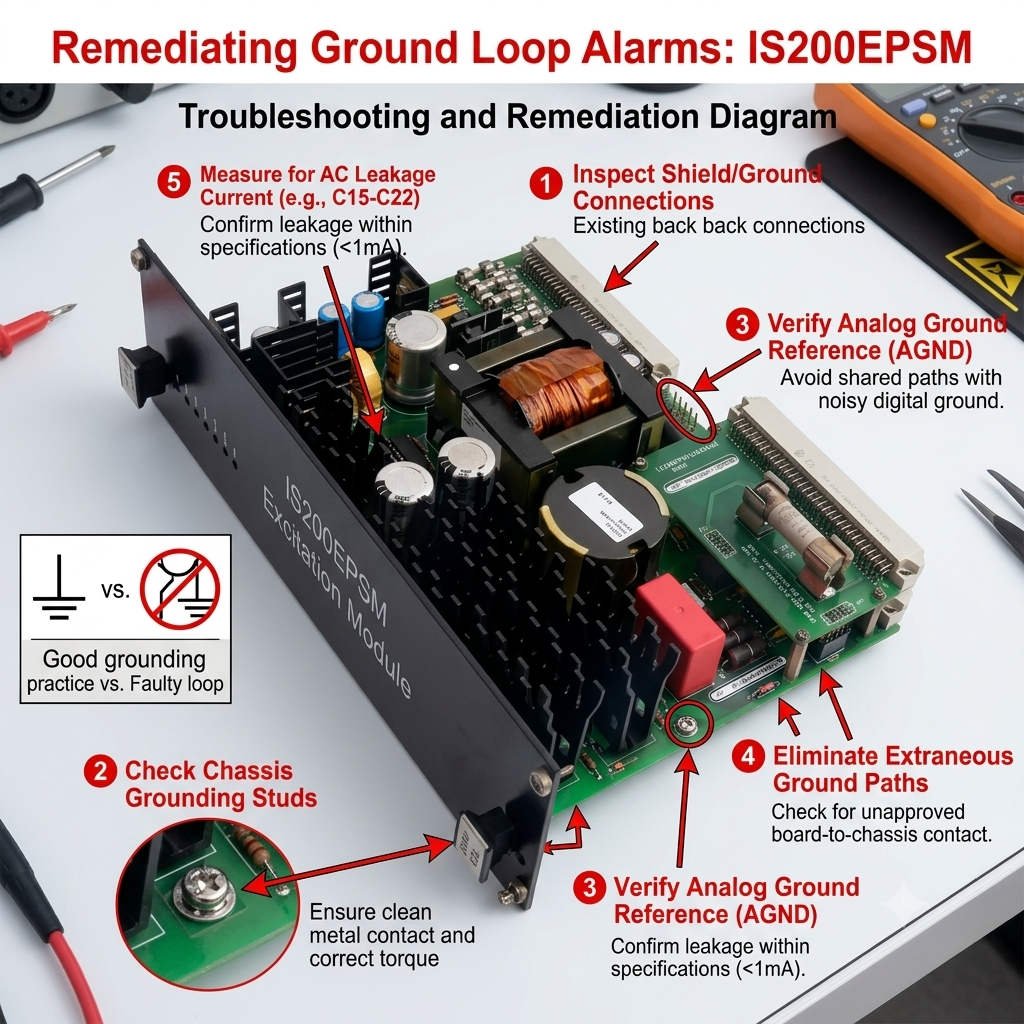
In high-power industrial automation, proper grounding topology is just as vital as input voltage quality. The GE IS200EPSM power supply module acts as a primary energy source within the EX2100 excitation platform. However, voltage potential differences between the DCS electronic ground and Protective Earth (PE) frequently degrade system stability. This technical review explores how ground loops introduce common-mode noise and compromise critical processor power networks.

Fix Ground Loop Alarms on GE IS200EPSM Excitation Modules

Fix Ground Loop Alarms on GE IS200EPSM Excitation Modules

The Architecture and Functional Value of the IS200EPSM

The IS200EPSM provides highly regulated low-voltage DC outputs directly to internal control electronics and sensitive I/O pathways. Its advanced power-conversion circuitry depends heavily on a clean, consistent reference potential to maintain tight regulation parameters. In continuous-process plants, this stability remains paramount for safeguarding against turbine trips and operational asset dropouts. Therefore, the module functions as the foundational electrical backbone for the wider system logic controller.

The Mechanics of Common-Mode Noise and Reference Drift

A significant voltage potential difference often arises when control cabinets lie far apart from primary substations. When the electronic ground shifts relative to PE, dangerous currents flow backward through data cable shields. Consequently, this circulating common-mode current generates electromagnetic interference that shifts the zero-volt baseline reference. As a result, processors misinterpret logic thresholds, triggering intermittent data packet losses, false high alarms, or random watchdog time-outs.

Field data indicates that grounding anomalies account for over 35% of unexplained controller resets in legacy systems. The internal filtering networks of the IS200EPSM can clamp minor transient currents effectively. However, continuous common-mode voltage stress above one volt exceeds the dampening limits of standard isolation transformers. This ongoing stress forces sensitive multi-layered boards to process high-frequency noise instead of clean power variables.

Surge Tolerance Limits and Semiconductor Degradation

Equipotential bonding directly influences how a power module handles lightning transients and massive motor switching events. If the control infrastructure lacks an integrated ground path, surge energy seeks alternative routes through internal semiconductor elements. This diverted energy creates severe thermal strain inside the module’s primary switching transistors and smoothing capacitors. Over time, this stress drastically reduces the mean time between failures (MTBF) for the power supply hardware.

Selecting and Validating the Correct Hardware Revision

When engineering system retrofits, maintenance teams must carefully match original bill-of-materials (BOM) part numbers. The IS200EPSM line incorporates distinct internal grounding configurations across different manufacturing series. Older system revisions may utilize isolated ground returns that conflict directly with modern, interconnected backplane frameworks. Procurement managers should cross-reference compatibility metrics through expert distributors like Powergear X Automation Limited to avoid startup logic faults.

Field Procedures for Grounding Diagnostics and Audits

  • Pre-Commissioning Test: Measure both AC and DC voltage between the electronic ground busbar and the cabinet PE frame.
  • ⚙️ Single-Point Alignment: Verify that the control system connects to the main facility grounding grid at exactly one point.
  • 🔧 Shield Termination Audit: Ensure instrument cable shields terminate strictly according to manufacturer instructions to avoid parallel paths.

Expert Implementation Analysis from Powergear X Automation Limited

At Powergear X Automation Limited, we emphasize that replacing a module rarely resolves structural grounding defects. In our field experience, many recurring “hardware failures” disappear entirely once engineers correct high-impedance bonding joints. We recommend maintaining strict compliance with IEEE 1100 and IEC 60364 industrial control system standards during turnarounds. To explore our full catalog of certified components and access specialized technical advice, visit us at https://www.powergearx.com/.

Application Scenario: Gas Turbine Excitation Retrofit

During a major petrochemical refinery modernization project, technicians installed a new IS200EPSM power card. Soon after, the system experienced recurring, unexplained communication drops between the controller and the I/O racks. Diagnostic tracking revealed a 4.8V potential difference between the remote panel ground and the main plant grid. By establishing an equipotential bonding network across the platforms, the engineering team stabilized the communication links instantly.

Frequently Asked Questions (FAQ)

1. What maximum voltage between electronic ground and PE is acceptable for stable operation?
For optimal stability, the voltage difference should remain below 0.5VAC and 1.0VDC. Any steady-state reading exceeding 1.0V requires immediate investigation, as it can cause analog signal drift and logic errors.

2. Can an existing ground loop slowly damage internal components without triggering an immediate alarm?
Yes, ground loops generate continuous high-frequency noise that forces internal filtering components to operate much hotter. This extra thermal load accelerates the dry-out process of electrolytic smoothing capacitors, causing premature module failure months later.

3. Should I ground the instrument cable shield at both ends when using this module?
No, grounding a signal shield at both ends creates a physical parallel path for ground currents to circulate. Always ground the shield at one designated reference point—typically the marshalling cabinet side—to avoid corrupting the 4-20mA loop values.

Back to Top
Product has been added to your cart