How Ground Potential Differences Impact the Stability of the GE IS200EPSM Module
In high-power industrial automation, proper grounding topology is just as vital as input voltage quality. The GE IS200EPSM power supply module acts as a primary energy source within the EX2100 excitation platform. However, voltage potential differences between the DCS electronic ground and Protective Earth (PE) frequently degrade system stability. This technical review explores how ground loops introduce common-mode noise and compromise critical processor power networks.

Fix Ground Loop Alarms on GE IS200EPSM Excitation Modules
The Architecture and Functional Value of the IS200EPSM
The IS200EPSM provides highly regulated low-voltage DC outputs directly to internal control electronics and sensitive I/O pathways. Its advanced power-conversion circuitry depends heavily on a clean, consistent reference potential to maintain tight regulation parameters. In continuous-process plants, this stability remains paramount for safeguarding against turbine trips and operational asset dropouts. Therefore, the module functions as the foundational electrical backbone for the wider system logic controller.
The Mechanics of Common-Mode Noise and Reference Drift
A significant voltage potential difference often arises when control cabinets lie far apart from primary substations. When the electronic ground shifts relative to PE, dangerous currents flow backward through data cable shields. Consequently, this circulating common-mode current generates electromagnetic interference that shifts the zero-volt baseline reference. As a result, processors misinterpret logic thresholds, triggering intermittent data packet losses, false high alarms, or random watchdog time-outs.
Field data indicates that grounding anomalies account for over 35% of unexplained controller resets in legacy systems. The internal filtering networks of the IS200EPSM can clamp minor transient currents effectively. However, continuous common-mode voltage stress above one volt exceeds the dampening limits of standard isolation transformers. This ongoing stress forces sensitive multi-layered boards to process high-frequency noise instead of clean power variables.
Surge Tolerance Limits and Semiconductor Degradation
Equipotential bonding directly influences how a power module handles lightning transients and massive motor switching events. If the control infrastructure lacks an integrated ground path, surge energy seeks alternative routes through internal semiconductor elements. This diverted energy creates severe thermal strain inside the module’s primary switching transistors and smoothing capacitors. Over time, this stress drastically reduces the mean time between failures (MTBF) for the power supply hardware.
Selecting and Validating the Correct Hardware Revision
When engineering system retrofits, maintenance teams must carefully match original bill-of-materials (BOM) part numbers. The IS200EPSM line incorporates distinct internal grounding configurations across different manufacturing series. Older system revisions may utilize isolated ground returns that conflict directly with modern, interconnected backplane frameworks. Procurement managers should cross-reference compatibility metrics through expert distributors like Powergear X Automation Limited to avoid startup logic faults.
Field Procedures for Grounding Diagnostics and Audits
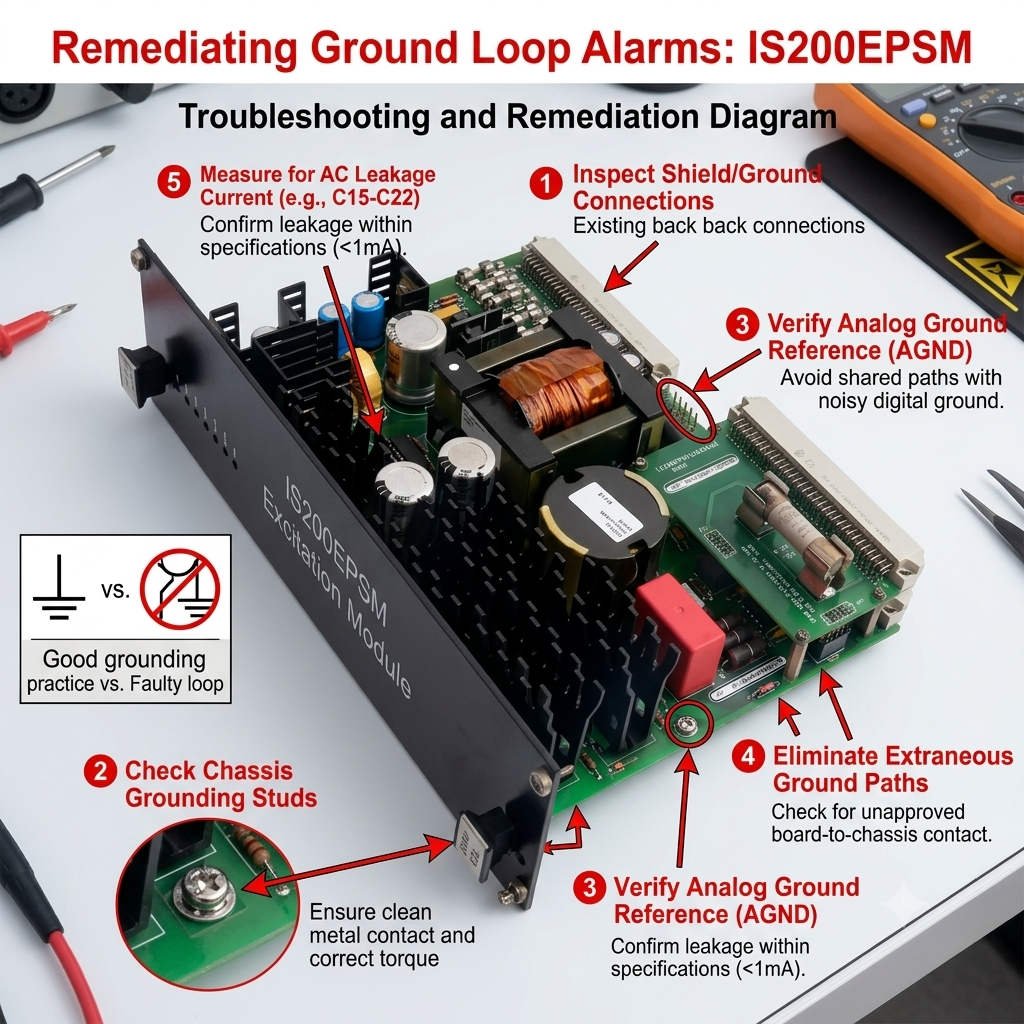
- ✅ Pre-Commissioning Test: Measure both AC and DC voltage between the electronic ground busbar and the cabinet PE frame.
- ⚙️ Single-Point Alignment: Verify that the control system connects to the main facility grounding grid at exactly one point.
- 🔧 Shield Termination Audit: Ensure instrument cable shields terminate strictly according to manufacturer instructions to avoid parallel paths.
Expert Implementation Analysis from Powergear X Automation Limited
At Powergear X Automation Limited, we emphasize that replacing a module rarely resolves structural grounding defects. In our field experience, many recurring “hardware failures” disappear entirely once engineers correct high-impedance bonding joints. We recommend maintaining strict compliance with IEEE 1100 and IEC 60364 industrial control system standards during turnarounds. To explore our full catalog of certified components and access specialized technical advice, visit us at https://www.powergearx.com/.
Application Scenario: Gas Turbine Excitation Retrofit
During a major petrochemical refinery modernization project, technicians installed a new IS200EPSM power card. Soon after, the system experienced recurring, unexplained communication drops between the controller and the I/O racks. Diagnostic tracking revealed a 4.8V potential difference between the remote panel ground and the main plant grid. By establishing an equipotential bonding network across the platforms, the engineering team stabilized the communication links instantly.
Frequently Asked Questions (FAQ)
1. What maximum voltage between electronic ground and PE is acceptable for stable operation?
For optimal stability, the voltage difference should remain below 0.5VAC and 1.0VDC. Any steady-state reading exceeding 1.0V requires immediate investigation, as it can cause analog signal drift and logic errors.
2. Can an existing ground loop slowly damage internal components without triggering an immediate alarm?
Yes, ground loops generate continuous high-frequency noise that forces internal filtering components to operate much hotter. This extra thermal load accelerates the dry-out process of electrolytic smoothing capacitors, causing premature module failure months later.
3. Should I ground the instrument cable shield at both ends when using this module?
No, grounding a signal shield at both ends creates a physical parallel path for ground currents to circulate. Always ground the shield at one designated reference point—typically the marshalling cabinet side—to avoid corrupting the 4-20mA loop values.