
Over 50,000 hot-selling automation module components.
FC-TSDI-1624 Module: Enhancing SIL Reliability in Process Safety

FC-TSDI-1624 Module: Enhancing SIL Reliability in Process Safety

Optimizing Functional Safety: The Critical Role of the FC-TSDI-1624 in Modern Industrial Architectures

In the high-stakes world of industrial automation, maintaining Safety Integrity Levels (SIL) requires hardware that excels under extreme conditions. The Honeywell FC-TSDI-1624 stands as a cornerstone for Safety Manager and FSC systems. This remote-mounted Safe Digital Input module bridges the gap between field instrumentation and central logic solvers. By acquiring signals from hazardous areas, it ensures process uptime while protecting human life and environmental assets.

FC-TSDI-1624 Module: Enhancing SIL Reliability in Process Safety

FC-TSDI-1624 Module: Enhancing SIL Reliability in Process Safety

The Core Functionality of the FC-TSDI-1624 Module

The FC-TSDI-1624 serves as a high-integrity interface for digital field devices such as emergency stop buttons, pressure switches, and flame detectors. Unlike standard PLC inputs, this module features internal self-diagnostics to detect “stuck-at” faults or cross-talk. It processes 24VDC signals and communicates status updates directly to the safety controller backplane. This architecture allows engineers to monitor critical inputs with millisecond precision, ensuring rapid response during a shutdown event.

Technical Principles: Managing Signal Integrity Across Distances

Remote mounting offers flexibility but introduces physical challenges like voltage drop and electromagnetic interference (EMI). The module utilizes filtered input circuits to mitigate high-frequency noise from nearby equipment. However, loop resistance remains a primary constraint for copper-based installations. When distances exceed standard cabinet boundaries, signal distortion can lead to nuisance trips. Therefore, maintaining a strict grounding topology is essential to prevent common-mode noise from corrupting digital states. Expert teams at Powergear X Automation Limited often emphasize that the quality of the cable shield termination is as vital as the module itself.

EMC Tolerance and Safety Availability in Harsh Environments

Industrial facilities often house Variable Frequency Drives (VFDs) and high-power motors that generate significant electrical noise. The FC-TSDI-1624 is engineered with robust EMC shielding to operate reliably in these “noisy” environments. Despite its high tolerance, poor installation practices can compromise safety availability. For instance, routing signal cables parallel to high-voltage power lines often induces transient voltages. These transients may trigger false Sequence of Events (SOE) logs, complicating post-incident analysis. Proper segregation of cable trays ensures the module maintains its certified diagnostic coverage without interruption.

Strategic Engineering Insights from Powergear X Automation Limited

At Powergear X Automation Limited, we have observed that many system failures stem from “hidden” communication instabilities during brownfield expansions. While the FC-TSDI-1624 is highly versatile, extending its reach via standard copper interconnects beyond recommended limits is risky. We suggest that for distances exceeding 50 meters, users should consider fiber-optic remote I/O nodes. This approach eliminates grounding potential differences between buildings. Our experience suggests that a proactive EMC survey during the Front-End Engineering Design (FEED) stage saves significant costs during the commissioning phase.

Key Technical Maintenance Best Practices

  • Use Shielded Twisted Pairs: Always utilize individually shielded cables to minimize cross-channel interference.
  • Single-Point Grounding: Terminate shields at a designated reference point to avoid destructive ground loops.
  • Vibration Resistance: Secure all wiring mechanically in high-vibration areas like turbine or compressor skids.
  • Surge Protection: Install external lightning arrestors for any signal lines originating from outdoor tank farms.
  • Firmware Alignment: Ensure the module revision matches the Safety Manager controller version to prevent diagnostic mismatches.

Comparative Analysis: Choosing the Right Installation Strategy

When selecting the FC-TSDI-1624, buyers must distinguish between local mounting and remote-node deployment. Local mounting is cost-effective for small-scale skids where the controller is nearby. Conversely, remote-mounted configurations are superior for sprawling refineries as they reduce the “marshalling footprint.” However, remote mounting requires more rigorous documentation for SIL validation. If your project involves heavy VFD usage or multiple grounding zones, the existing wiring infrastructure may require a complete redesign to support modern safety standards.

Application Scenarios and Solutions

The FC-TSDI-1624 is widely deployed in offshore oil platforms where space is a premium. In these environments, the module is placed in specialized explosion-proof enclosures near the wellhead. Another common application is in pharmaceutical batch processing, where frequent cleaning and high humidity require robust I/O protection. By placing the FC-TSDI-1624 closer to the process, plants reduce the volume of cabling returning to the main control room, significantly lowering fire load and installation costs.

For more technical specifications or to secure genuine Honeywell safety components, visit the official Powergear X Automation Limited website for expert assistance.

Frequently Asked Questions (FAQ)

1. Why am I seeing intermittent SOE alarms even though the field switch is stable?
This is often caused by electromagnetic induction or poor shield grounding. If the signal cable runs parallel to a VFD output, the “noise” can mimic a digital transition. Verify your cable segregation and ensure the shield is grounded at only one end.

2. Can I swap an older TSDI module with the FC-TSDI-1624 without software changes?
While they may be mechanically compatible, safety systems require firmware verification. You must check the “Approved Interoperability List” for your specific Safety Manager version. Failure to do so could invalidate your SIL certification.

3. How does distance affect the SIS proof-testing process?
Longer distances increase the complexity of loop resistance testing and diagnostic verification. Properly segmented remote I/O nodes allow technicians to test smaller sections of the loop independently, which speeds up the turnaround schedule significantly.

Protecting Safety Systems with HIMA X-AO1601 Isolation

HIMA X-AO1601 Analog Output Module Technical Guide & Specs

Maximizing Safety System Integrity with the HIMA X-AO1601 Analog Output Module

The Role of HIMA X-AO1601 in Safety-Critical Control Systems

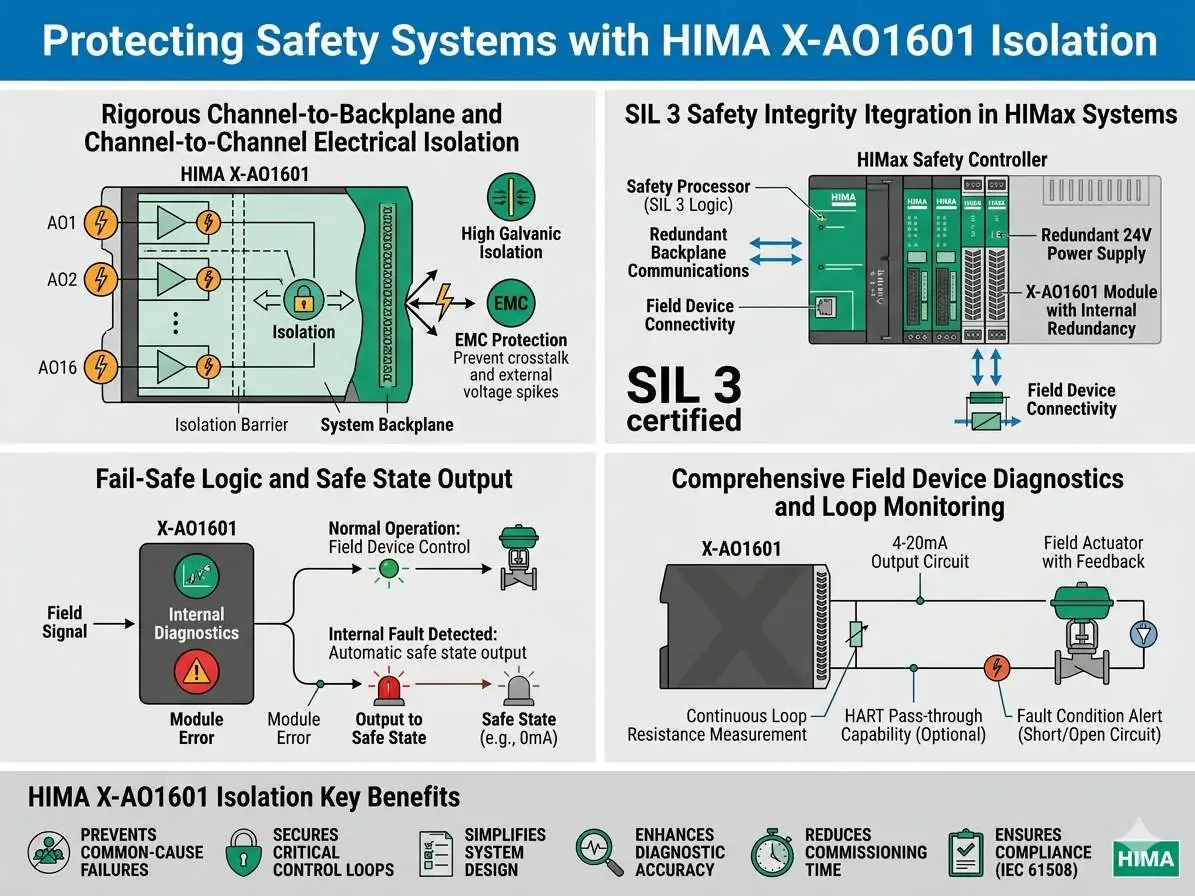
The HIMA X-AO1601 analog output module plays a vital role in modern industrial automation. It supports high-integrity processes in oil and gas, chemical processing, and pharmaceutical sectors. This module ensures stable signal transmission while preventing electrical faults from spreading throughout the system. Consequently, it maintains operational continuity even in demanding environments. Engineers prioritize this model for its ability to handle sensitive control loops with extreme reliability.

Protecting Safety Systems with HIMA X-AO1601 Isolation

Protecting Safety Systems with HIMA X-AO1601 Isolation

Understanding Channel Isolation Architecture and Signal Integrity

The X-AO1601 features advanced galvanic isolation between individual channels and the backplane. This design choice effectively eliminates ground loops in large distributed control systems (DCS). Moreover, it ensures that noise on one loop does not interfere with adjacent signals. In multi-loop PID systems, this isolation prevents oscillations often misidentified as tuning errors. Therefore, it provides the precise analog control necessary for valve positioning and dosing applications.

Technical Realities of Short-Circuit Protection Limits

While the module demonstrates high resilience, it does not include full active short-circuit protection for every channel. A hard short on the output may cause a channel shutdown or degraded performance levels. As a result, repetitive faults could shorten the operational lifespan of the hardware. We recommend adding external current-limiting resistors for applications involving long field cables. Additionally, combining the module with intrinsically safe barriers is essential in hazardous locations.

Ensuring Output Stability for High-Precision Applications

This module consistently delivers high-resolution 4–20 mA signals across broad industrial temperature ranges. High stability directly improves control precision in pressure regulation and flow dosing systems. Furthermore, it reduces signal drift over time, which lowers the frequency of required manual recalibrations. In pharmaceutical batch processing, even minor signal deviations can lead to production waste. The X-AO1601 mitigates these risks through superior hardware engineering and thermal management.

Installation Strategies for Long-Term Maintenance Reliability

Field experience shows that most electrical faults occur at terminal boxes rather than inside cabinets. Therefore, following strict installation protocols is necessary to protect the HIMA X-AO1601 module. Consider the following maintenance best practices:

  • ✅ Use fused terminal blocks to provide an extra layer of protection against field shorts.
  • ✅ Route analog cables separately from high-power lines to minimize electromagnetic interference.
  • ✅ Implement a single-point grounding scheme to prevent potential differences between cabinets.
  • ✅ Use spring-clamp terminals in high-vibration environments like offshore platforms or compressors.

Expert Commentary from Powergear X Automation Limited

At Powergear X Automation Limited, we believe the X-AO1601 represents a benchmark for safety-rated analog outputs. However, users must not mistake internal isolation for total circuit immunity. In our experience, many system failures stem from over-reliance on internal module protections. To achieve true SIL-rated reliability, you must integrate external surge protection. We advise all technical teams to verify firmware compatibility before upgrading legacy HIMA racks to ensure seamless integration.

Practical Solution Scenarios and Application Cases

  • Refinery Valve Control: Provides isolated feedback loops to ensure safe valve positioning during emergency shutdowns.
  • Chemical Dosing Systems: Delivers precise 4-20mA signals to maintain strict chemical ratios in continuous processes.
  • Pharmaceutical Manufacturing: Ensures signal accuracy for temperature-sensitive batch reactions to comply with FDA standards.

Industrial Automation Frequently Asked Questions

Q: Does the X-AO1601 remove the need for external surge arrestors in outdoor wiring?
No, external protection remains necessary. While the module is robust, long-distance outdoor cables are susceptible to lightning and transients that exceed internal isolation limits.

Q: How do I handle a channel shutdown caused by an accidental short circuit?
First, clear the field fault and check the loop resistance. You may need to cycle the power or reset the module firmware depending on your specific HIMA system configuration.

Q: Can I mix different load types on the same X-AO1601 module?
Yes, the channel-to-channel isolation allows for different loads. However, ensure that each loop stays within the module’s total power dissipation specifications to prevent overheating.

To optimize your control system with authentic HIMA components and professional support, please visit the Powergear X Automation Limited official website today.

Reliable Safety Communication with HIMA X-COM01 Modules

HIMA X-COM01 Guide: Bridging SafeEthernet and Modbus TCP

Enhancing Functional Safety and Interoperability with the HIMA X-COM01 Communication Module

The Vital Role of X-COM01 in Modern Safety Architectures

The HIMA X-COM01 communication module serves as a critical bridge in high-integrity industrial environments. It connects safety-critical control systems with standard industrial networks without compromising functional safety. In sectors like oil and gas or pharmaceutical manufacturing, maintaining SIL-rated architectures is essential. This module enables deterministic data exchange while supporting both SafeEthernet and Modbus TCP protocols. As a result, engineers can achieve seamless integration between safety PLCs and higher-level monitoring systems.

Reliable Safety Communication with HIMA X-COM01 Modules

Reliable Safety Communication with HIMA X-COM01 Modules

Dual-Protocol Mastery: Balancing Safety and Openness

The X-COM01 handles SafeEthernet and Modbus TCP simultaneously to provide maximum flexibility. SafeEthernet ensures certified safety communication between HIMA controllers using advanced redundancy and CRC mechanisms. These features are vital for Emergency Shutdown (ESD) systems where data integrity is mandatory. Conversely, Modbus TCP offers interoperability with SCADA, DCS, and third-party hardware. This dual capability eliminates the need for external protocol gateways. Consequently, it reduces latency and removes potential points of failure in the network.

Optimizing Communication Latency and Determinism

In the world of factory automation, predictable response time outweighs raw transmission speed. The X-COM01 is specifically engineered for deterministic data exchange. It ensures that critical safety signals, such as trip commands, reach their destination within strict time windows. According to industry research from organizations like ARC Advisory Group, unstable latency is a leading cause of nuisance trips. Therefore, the X-COM01 provides the stability needed to maintain high plant availability and safety compliance.

Strategic Network Redundancy and Reliability

Reliability in continuous-process industries directly impacts the bottom line by preventing unplanned downtime. The X-COM01 module supports redundant communication paths within the SafeEthernet architecture. If one network path fails, the system continues to operate without interruption. However, achieving this level of reliability requires precise configuration. Misconfigured ring or star topologies often cause commissioning issues in complex control systems. Therefore, proper network design remains a prerequisite for leveraging the module’s full potential.

Professional Installation and Maintenance Best Practices

Maintaining a robust safety network requires adherence to strict engineering standards. Powergear X Automation Limited recommends the following field-proven strategies:

  • Implement Logical Segmentation: Use VLANs or dedicated switches to separate safety traffic from non-safety Modbus data.
  • Verify Shielding Integrity: Always use shielded industrial Ethernet cables in high-EMI environments to prevent intermittent faults.
  • Validate Redundancy: Physically disconnect network paths during Factory Acceptance Testing (FAT) to confirm seamless failover.
  • Monitor Environmental Factors: Ensure the control cabinet maintains proper cooling to prevent thermal stress on communication components.

Expert Analysis from Powergear X Automation Limited

At Powergear X Automation Limited, we see a clear trend toward “Safety-Integrated Openness.” The X-COM01 embodies this by allowing safety data to coexist with diagnostic monitoring. However, we believe users must remain vigilant about network security. As safety systems become more connected, robust cybersecurity measures must accompany physical hardware like the X-COM01. We recommend this module for users who need to modernize their DCS integration while maintaining strict adherence to IEC 61508 standards.

Application Scenarios and Solutions

  • Chemical Processing: Integrating reactor ESD systems with a centralized SCADA for real-time diagnostic visibility.
  • Offshore Platforms: Ensuring redundant communication between fire and gas (F&G) systems across long distances.
  • Pharmaceutical Plants: Maintaining batch traceability and safety integrity in highly regulated GAMP environments.

Frequently Asked Questions (FAQ)

Q: Can I use the X-COM01 for safety-related control of third-party VFDs via Modbus TCP?
No, Modbus TCP is not a safety-certified protocol on the X-COM01. For safety-related control (such as STO), you must use SafeEthernet between compatible HIMA devices or hardwired safety I/O for third-party hardware.

Q: What is the most common cause of “Communication Loss” alarms in new X-COM01 installations?
In our experience, most issues stem from IP address conflicts or incorrect subnet masks within the Modbus configuration. Ensure that your safety network range does not overlap with the plant-wide office network.

Q: Does the X-COM01 require special software for configuration?
Yes, configuration is typically handled through HIMA’s engineering tool (like SILworX). You must ensure your software version supports the specific firmware revision of the X-COM01 module to enable all SafeEthernet features.

To find the most reliable safety components and technical support for your next project, visit the Powergear X Automation Limited website today.

Back to Top
Product has been added to your cart