Understanding Remote Safety I/O: Honeywell FC-RUSIO-3224 Features
Optimizing Safety Systems with the Honeywell FC-RUSIO-3224 Universal I/O Module
Understanding the Engineering Interface and Connectivity Requirements
The Honeywell FC-RUSIO-3224 stands as a sophisticated remote universal safety I/O module. Many technicians often ask if this unit requires a dedicated, standalone programming cable. Unlike traditional PLCs that utilize serial or USB leads, this module integrates directly into the Honeywell Experion PKS architecture. Engineers typically perform configuration through centralized workstations and Fault Tolerant Ethernet (FTE) networks. Consequently, physical direct-connect cables are rarely necessary for routine software deployment.

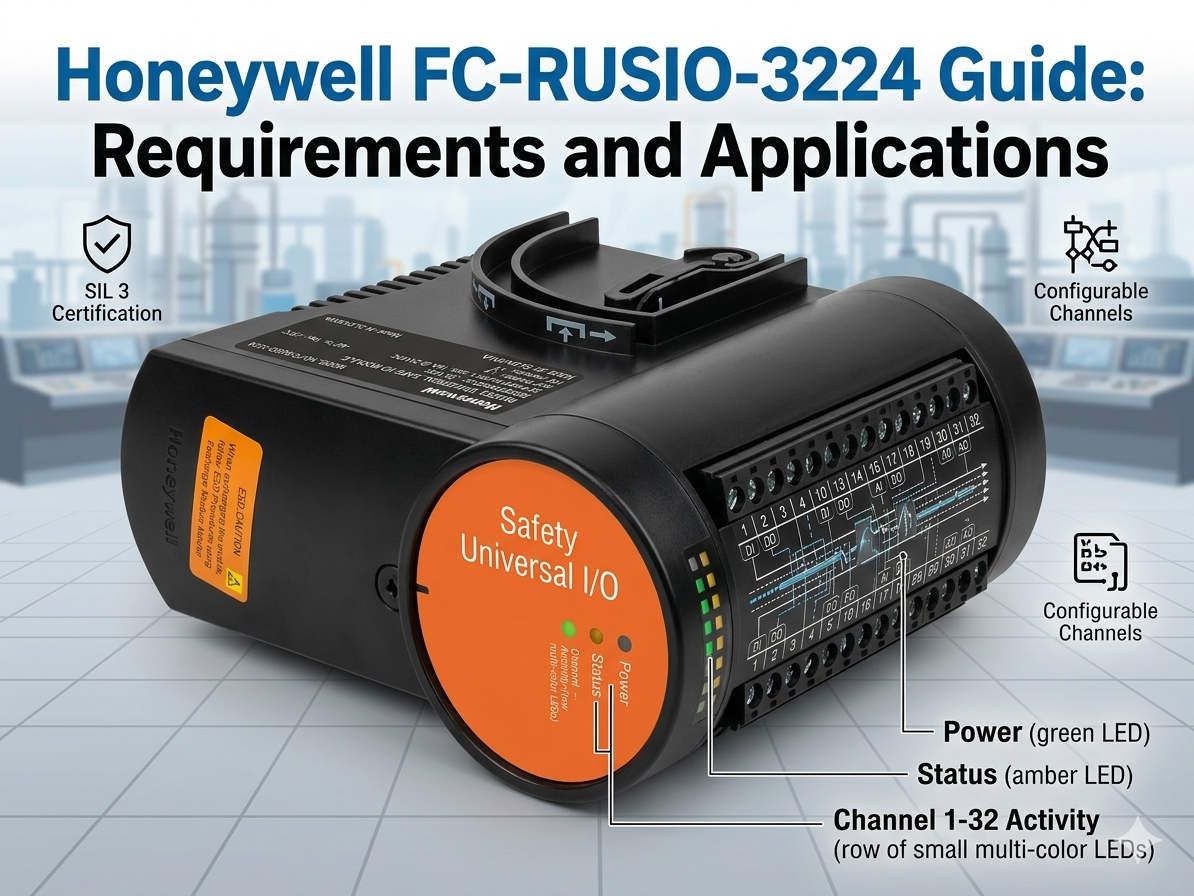
Honeywell FC-RUSIO-3224 Guide Requirements and Applications
Core Application Value in Process-Critical Environments
Modern industrial automation demands high reliability in petrochemical, refinery, and chemical processing sectors. The FC-RUSIO-3224 excels by reducing field wiring complexity and enhancing signal integrity. By deploying distributed I/O closer to field devices, plants can significantly lower cabinet density. Moreover, this architecture simplifies brownfield modernization projects where existing conduit space is limited. Reducing the total cable load also minimizes potential points of failure within the control infrastructure.
Technical Insights into Communication and Network Topology
The communication path for the FC-RUSIO-3224 represents a shift from legacy serial protocols to high-speed networking. These modules rely on safety controller communication and dedicated configuration tools within the Honeywell environment. Therefore, installation teams must prioritize network routing and firmware alignment before hardware commissioning. In our experience at Powergear X Automation Limited, mismatched firmware revisions often cause more downtime than actual hardware defects. Ensuring software-side validation remains the most critical step for successful integration.
Environmental Reliability and Advanced Cabinet Design
Thermal management is a frequent concern in harsh refinery applications. Remote I/O modules housed in poorly ventilated enclosures often suffer from intermittent communication faults. To ensure stability, maintain consistent airflow and follow strict IEC industrial EMC grounding practices. Additionally, keep high-power VFD wiring isolated from sensitive I/O signal paths. Field data suggests that extreme temperature cycling can loosen mechanical connections, particularly in offshore or high-vibration settings.
System Compatibility and Strategic Lifecycle Management
Before procuring replacement modules, users must verify the specific system generation and firmware revision levels. Assumption of “plug-and-play” interchangeability is a common mistake in complex DCS environments. Even physically identical units may fail system validation if the database configuration does not align. In regulated industries like LNG production, documenting module substitutions is vital for audit compliance. Powergear X Automation Limited recommends keeping a detailed log of hardware revisions to streamline future maintenance windows.
Installation and Maintenance Best Practices
- ✅ Validate Access: Confirm engineering workstation connectivity before energizing the cabinet.
- ✅ Shielded Wiring: Use shielded twisted-pair cables in high-noise environments like turbine areas.
- ✅ Surge Protection: Install external surge arrestors for modules connected to outdoor field instruments.
- ✅ Grounding Protocols: Follow single-point grounding rules to prevent ground loops in communication paths.
Strategic Buyer’s Guide for Procurement Teams
Procurement departments should recognize that the FC-RUSIO-3224 is a component of a larger safety ecosystem. While a proprietary handheld cable is not standard, specific maintenance adapters may be required for deep diagnostics. Buyers should always check the existing Honeywell lifecycle support status before initiating large-scale replacements. For those seeking reliable inventory and technical support, we invite you to explore the solutions at Powergear X Automation Limited, where we specialize in high-demand industrial hardware.
Industrial Application Scenarios
- Petrochemical Refineries: Managing safety-instrumented functions (SIF) with high-density universal I/O.
- Chemical Processing: Reducing wiring costs in modular “skid” based manufacturing units.
- Oil & Gas Wellheads: Providing ruggedized remote monitoring in geographically exposed locations.
Frequently Asked Questions (FAQ)
Q: Can the FC-RUSIO-3224 be configured without the Honeywell Experion software?
No, this module is an integrated component of the Honeywell safety environment. It requires the authorized engineering tools and system database to define channel types and safety parameters.
Q: How does this module handle different signal types like AI, DI, or DO?
The “Universal” designation means each of the 32 channels is software-configurable. This flexibility allows one hardware part number to support various field devices, simplifying spare parts inventory.
Q: What is the most common cause of communication failure on these modules?
In my professional experience, network switch configuration and improper shield grounding are the primary culprits. Always ensure the FTE network is properly segmented and that shielding is only grounded at the designated control end.
For high-quality industrial components and expert guidance, visit the Powergear X Automation Limited website today.