
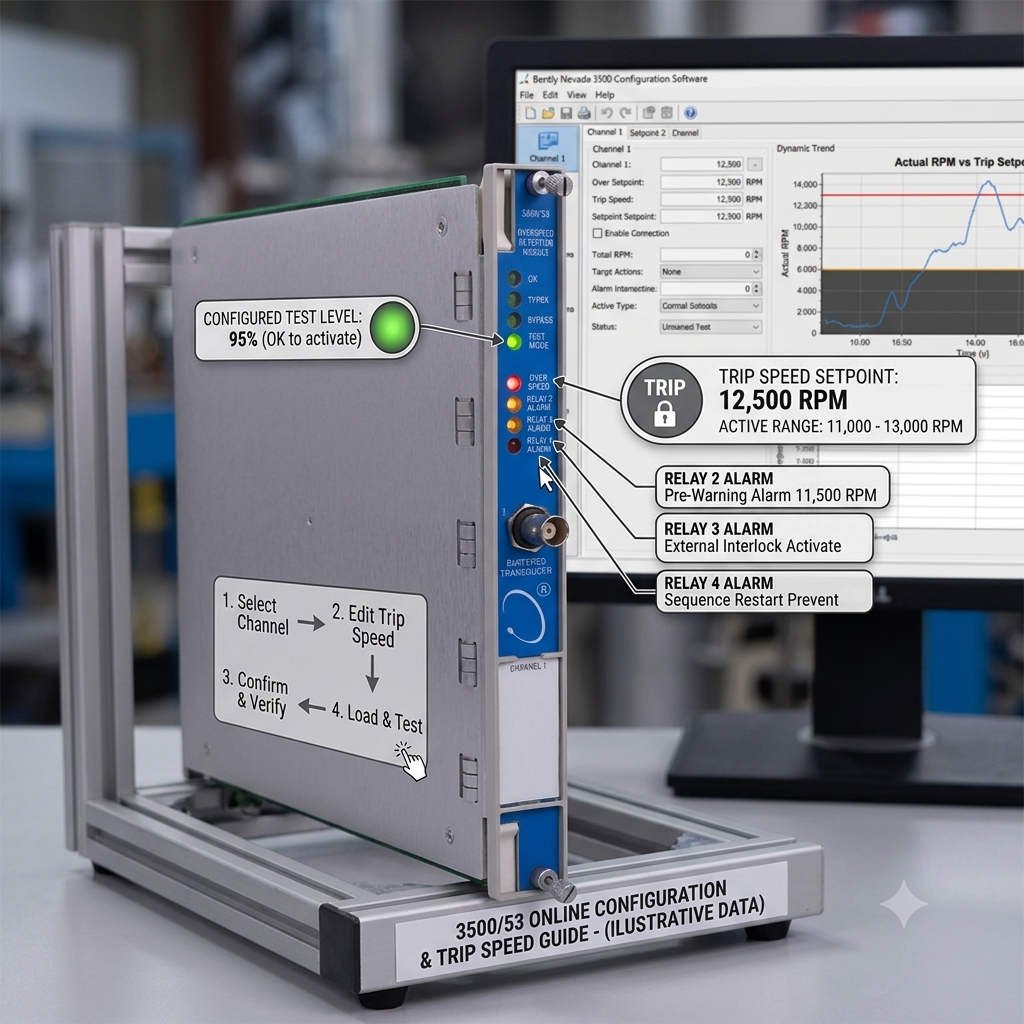
Bently Nevada 3500/53 Online Configuration & Trip Speed Guide
Can You Modify Bently Nevada 3500/53 Trip Speed Online? Safety Logic and Risks Explained
Modifying safety parameters in a machinery protection system requires deep technical caution. In the industrial automation sector, the Bently Nevada 3500/53 Electronic Overspeed Detection System safeguards critical rotating machinery. However, field engineers often debate whether the 3500 Rack Configuration Software allows users to modify the Trip Speed parameter while the turbine is running. The short answer depends on your system configuration, firmware version, and active safety protocols.
The Real Risks of Online Trip Speed Modifications
According to API 670 standards for machinery protection systems, operators should never alter safety-critical setpoints during machine operation. However, the Bently Nevada software environment does not always enforce a hard block on online changes. Depending on your specific system setup, an online download of a modified overspeed setpoint typically triggers one of two technical behaviors.
Scenario 1: Pending Activation Status
In newer firmware versions, the software accepts the configuration download but places the new Trip Speed into a “Pending” state. The module continues to use the old setpoint until the hardware undergoes a manual reset or a power cycle. Field engineers must remember that a “Download Successful” message does not mean the new overspeed protection value is live.
In contrast, older legacy systems or racks with relaxed security permissions might allow immediate execution. In this scenario, the overspeed setpoint changes in real time. If a technician accidentally inputs an incorrect value, the machine could lose its safety margin instantly, risking catastrophic mechanical failure during a transient surge.
Why Independent Overspeed Protection Matters in DCS and PLC Environments
The Bently Nevada 3500/53 module does not serve as a standard speed transmitter. Instead, it operates as an independent safety layer separate from the primary Distributed Control System (DCS) or Programmable Logic Controller (PLC). In factory automation plants, control systems can experience communication lag or processor overruns.
Therefore, the 3500/53 system must act autonomously. If the primary governor control fails, this module executes an emergency trip within milliseconds. This rapid response prevents rotor destruction in high-stakes applications like refinery compressors, steam turbine generators, and LNG expansion trains.
Technical Insights: Voting Logic and Configuration Security
To deliver maximum reliability, the 3500/53 module utilizes advanced voting logic, typically configured in a 2oo3 (Two Out of Three) architecture. Three independent proximity probes measure the shaft speed simultaneously. The system triggers a trip output only when at least two channels confirm an overspeed condition.
If you attempt an online configuration modification and cause a parameter mismatch between channels, you risk disrupting this voting logic. To eliminate this vulnerability, facility managers must enforce strict hardware-based security:
- Keep the physical rack keyswitch turned to the RUN Position to block unauthorized software writes.
- Enable software-level configuration locks and password hierarchies.
- Enforce a strict Management of Change (MOC) policy before connecting any configuration PC.
Installation and Maintenance Best Practices for Field Engineers
Experienced automation professionals follow rigid guidelines when maintaining speed detection hardware. To ensure plant safety, always apply the following field rules:
- Execute Changes Only During Shutdown: Schedule all overspeed adjustments during planned maintenance windows when the rotor is completely stationary.
- Verify Measurement Units Carefully: Always double-check your units before hitting download. Mistaking Hertz (Hz) for Revolutions Per Minute (RPM), or entering an incorrect gear tooth count, will corrupt the safety calculation.
- Audit the System Event Logs: After any configuration upload, review the System Event List to confirm that the hardware accepted the parameters without generating a channel fault.
Powergear X Automation Insight: Hardware Lifecycle Strategy
Our Perspective: At Powergear X Automation, we observe that many industrial sites run Bently Nevada 3500 racks that have been in continuous operation for over a decade. While these systems are remarkably durable, running obsolete firmware creates unnecessary operational risks. Firmware mismatches between old hardware modules and newer PC configuration software frequently cause corrupt downloads or false diagnostics.
We recommend conducting a comprehensive audit of your machinery protection assets every five years. Upgrading your modules ensures full compliance with modern safety standards and guarantees clean integration with your broader plant control systems.
Industrial Application Scenario: Petrochemical Compressor Protection
Consider a large-scale centrifugal compressor driven by a steam turbine in a petrochemical plant. The plant utilizes a Rockwell Automation Allen-Bradley ControlLogix PLC for process sequencing and a Honeywell Experion DCS for continuous loop control. However, the critical overspeed trip logic resides solely in a Bently Nevada 3500 rack equipped with a 3500/53 module configured in 2oo3 voting logic.
During an annual turnaround, engineers needed to update the turbine trip speed from 4,200 RPM to 4,150 RPM based on new OEM design limits. Instead of performing an unapproved online modification while idling, the team utilized the plant’s outage window. They switched the physical rack keyswitch to PROGRAM, verified the tooth-to-frequency scaling factors, uploaded the new configuration, switched the key back to RUN, and simulated a speed signal to validate the trip relays before startup. This disciplined approach prevented accidental trips and ensured complete compliance with insurance and safety regulations.
Frequently Asked Questions
Q1: What happens if a 3500/53 channel experiences a sensor fault during operation?
In a standard 2oo3 configuration, if one proximity probe fails or loses its signal, the module flags a channel fault error but does not trip the machine. The voting logic automatically degrades to a 1oo2 (One Out of Two) safety structure, allowing the plant to continue running safely while maintenance teams replace the faulty sensor.
Q2: Can I mix old firmware modules with new software versions?
While Bently Nevada software provides backward compatibility, severe gaps between old module firmware and modern software versions can block specific parameter changes or cause communication timeouts. Always check the official compatibility matrix before attempting to modify parameters.
Q3: Is the 3500/53 module interchangeable with standard 3500/50 tachometer modules?
No, they serve different purposes. The 3500/50 is a standard tachometer designed for speed measurement, reverse rotation detection, and zero-speed tracking. The 3500/53 is a highly specialized, fast-response safety module dedicated solely to emergency overspeed protection and complies with rigorous international safety standards.
Looking to replace obsolete modules, source certified spare parts, or optimize your industrial control systems? Discover reliable hardware solutions and technical support by visiting Powergear X Automation today.