Over 50,000 hot-selling automation module components.

Bently Nevada 3300 XL Cable Terminal: Specialized Tools Guide

Bently Nevada 3300 XL Click-Loc Termination: Do You Need Specialized Tools?

The Critical Role of Click-Loc Connectors in Asset Protection

In factory automation and machinery protection, the Bently Nevada 3500 Monitoring System stands as the industry standard for rotating equipment. The 3300 XL series extension cable links the proximity probe directly to the proximitor sensor. At the heart of this sensor loop lies the Click-Loc connector. This high-frequency connection point secures the vital millivolt signals that detect microscopic shaft movements. Standard wiring methods often fail here because this loop handles RF carrier waves rather than simple DC power. Consequently, field engineers must prioritize termination quality to ensure total plant safety.

Technical Insights: Why Standard Strippers Degrade High-Frequency Signals

The 3300 XL eddy current measurement system operates on high-frequency radio networks to map real-time vibration displacement. The Click-Loc connector maintains a precise characteristic impedance across the coaxial network. Regular commercial wire strippers frequently nick the outer jacket or slice the delicate shielding mesh. As a result, this physical damage alters the loop capacitance and introduces electromagnetic interference (EMI). Field experience shows that hand-stripped cables often pass basic static continuity tests during commissioning. However, they regularly trigger ghost alarms and intermittent channel faults once the turbine spins up to full operating speed.

The Crimp Height Factor: Preventing Vibration Signal Drift

Engineers must achieve an exact crimp height and uniform compression when processing specialized coaxial terminals. Standard aviation or network crimping tools cannot deliver the specific mechanical retention force that Bently Nevada hardware demands. Over-crimping crushes the inner Teflon dielectric layer, which directly shorts out the signal. Conversely, under-crimping creates a loose connection that oxidizes rapidly under harsh refinery conditions. According to Electric Power Research Institute (EPRI) maintenance data, faulty cable terminations rank among the top causes of false trips in industrial control systems. Therefore, investing in calibrated, factory-matched crimping tools remains non-negotiable for critical machinery.

Powergear X Automation Expert Commentary: Balancing Upfront Costs and Long-Term Reliability

At Powergear X Automation, we consistently witness maintenance teams attempting to bypass specialized tooling costs by utilizing universal tools. While a universal tool lowers short-term procurement expenses, it exponentially multiplies operational risks on the plant floor. In critical process industries like oil and gas or power generation, a single false trip can cost thousands of dollars per minute in lost production. We strongly recommend that reliability managers treat specialized termination toolkits as a mandatory asset protection investment rather than an optional accessory.

Field Installation and Best Practices Guide

To ensure maximum signal integrity and avoid premature cable wear, field technicians should follow this structured deployment workflow:

  • ✅ Verify Component Matching: Ensure your extension cable model matches the specific 8mm or 5mm proximity probe system requirements.
  • 🔍 Inspect Mechanical Health: Check the cable jacket for tight bend radiuses, severe kinks, or oily residues prior to cutting.
  • 🔧 Deploy Specialized Tooling: Utilize a dedicated coaxial stripping tool configured to the exact multi-step dimensions of the Click-Loc connector.
  • ⚙️ Execute Controlled Crimping: Apply pressure using a ratcheting crimp tool that only releases once it reaches the correct compression threshold.
  • 📦 Secure the Assembly: Anchor the completed connection inside a conduit box to prevent the cable from whipping or shaking during operation.

Real-World Application Scenario: Petrochemical Compressor Overhaul

During a recent centrifugal compressor retrofitting project at a major petrochemical facility, the contractor used generic tools to terminate thirty new 3300 XL extension lines. Within three weeks of startup, three critical channels reported random vibration spikes that threatened to trigger an automatic emergency shutdown. A specialized diagnostic team traced the issue back to erratic contact resistance inside the hand-crimped Click-Loc heads. After the team replaced the lines using a calibrated factory termination kit, the signal noise dropped by 18 decibels, and the channels achieved perfect operational stability.

Frequently Asked Questions (FAQ)

Q1: Can I use an aviation-grade terminal crimper for Click-Loc connectors?
No. While aviation tools look similar, their die profiles and pressure ratings do not match the exact outer diameter tolerances of Bently Nevada hardware, leading to poor signal shielding.

Q2: What happens if oil or moisture enters the Click-Loc joint?
Moisture creates an unwanted parallel resistance path that dampens the RF signal, which the DCS or PLC system typically misinterprets as low vibration or a sensor failure.

Q3: Is it better to buy pre-terminated cables or make them in the field?
For standard distances, pre-terminated original cables offer the highest reliability. However, if you must route cables through tight conduits, field termination using specialized tools is required.

Optimize Your Monitoring Systems with Certified Hardware

Achieving flawless machine monitoring requires genuine, industrial-grade components that stand up to the most demanding environments. Discover our full selection of high-performance hardware, cables, and instrumentation accessories designed for modern control architectures.

Explore premium automation solutions today by visiting Powergear X Automation to upgrade your plant infrastructure.
Bently Nevada 176449 Rear IO Module Selection Guide_

3500 System Machinery Protection: 176449 I/O Modules

Decoding Bently Nevada 176449 Series Rear I/O Modules for 3500 Machinery Protection Systems

In high-stakes industrial automation, continuous condition monitoring safeguards multimillion-dollar rotating assets. The Bently Nevada 3500 system relies heavily on specialized backplane connectivity to process field sensor data. Specifically, the 176449 series Rear I/O modules provide critical electrical termination and signal routing. Choosing the wrong dash-number option can compromise your entire machinery protection strategy. This comprehensive guide breaks down the variations, technical principles, and installation rules for these critical components.

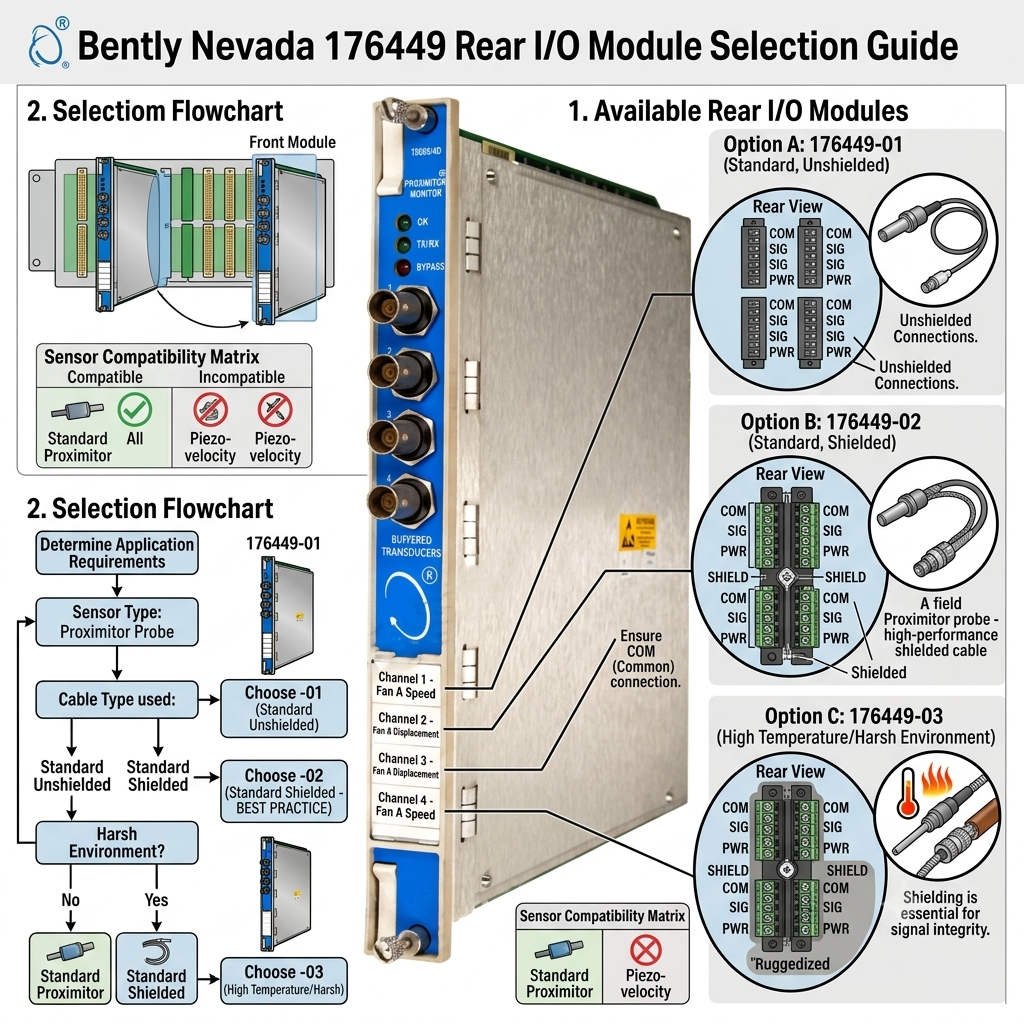
Bently Nevada 176449 Rear IO Module Selection Guide_

Bently Nevada 176449 Rear IO Module Selection Guide_

The Functional Architecture of 176449 Rear Interface Boards

The 176449 family acts as the physical interface between field-mounted transducers and front-end monitor cards. Each module routes raw analog voltages from proximity probes, accelerometers, or pressure sensors safely into the rack. Moreover, the internal circuitry isolates delicate processing microprocessors from unpredictable field surges. This isolation maintains signal stability in noisy environments near massive turbomachinery. Therefore, these rear boards form the foundation of any reliable API 670 protection loop.

Understanding Core Model Variances and Monitor Pairings

Rear I/O Part NumberAssociated Monitor CardPrimary Target Application
176449-013500/40M ProximitorShaft vibration and dynamic radial position monitoring
176449-023500/42M Proximitor/SeismicCombined velocity, acceleration, and case expansion tracking
176449-043500/45 PositionThrust position, differential expansion, and valve metrics
176449-073500/77M Recip PressureReal-time reciprocating compressor cylinder diagnostics

Signal Conditioning and Channel Topology Principles

Each variations within the 176449 family utilizes distinct input resistance paths and grounding layouts. For instance, the 176449-01 matches the negative voltage modulation typical of eddy-current proximity probes. In contrast, the 176449-07 handles rapid transient pressure spikes inside combustion or compression chambers. Consequently, mixing these cards up causes severe scaling errors or complete signal dropouts. The front processor card simply cannot normalize a signal conditioned by an incompatible rear board.

The API 670 Standard and System Interlocking Integrity

In power generation and petrochemical refining, machinery protection systems operate under strict API 670 compliance rules. This standard mandates that component failures must not prevent an emergency trip from executing properly. A degraded terminal block or a loose jumper on the Rear I/O card can mask dangerous shaft deflections. As a result, the DCS might receive faulty baseline data, delaying automated shutdown procedures. Proactive maintenance teams always treat rear hardware with the same care as front-facing processing modules.

Best Practices for Field Commissioning and Maintenance

  • Verification First: Double-check the precise dash-number configurations before sliding any module into the rack chassis.
  • ⚙️ Torque Optimization: Secure terminal strip screws tightly to eliminate intermittent signal noise caused by cabinet vibration.
  • 🔧 Shield Management: Drain cable shields strictly according to the Bently Nevada manual to prevent dangerous grounding loops.

Strategic Sourcing Commentary from Powergear X Automation Limited

At Powergear X Automation Limited, we observe widespread issues stemming from the use of unchecked surplus parts. Many plants buy replacement modules from unverified brokers without cross-referencing their specific revision histories. A physical board might fit perfectly into a 3500 slot while remaining electronically incompatible with your sensor software setup. We recommend auditing your entire spare parts inventory every year to ensure exact compatibility. For certified, high-performance machinery protection hardware, explore our validated listings at https://www.powergearx.com/.

Real-World Deployment and Solutions

During a recent gas terminal overhaul, engineers faced recurring channel errors on a critical centrifugal compressor. While the 3500/42M monitor tested perfectly on the bench, it threw persistent faults when installed in the rack. The troubleshooting team eventually tracked the issue to an old 176449-02 board suffering from micro-fractures along its backplane connector pins. Replacing the worn rear module instantly restored full diagnostic visibility, preventing an expensive forced outage during plant startup.

Frequently Asked Questions (FAQ)

1. Why does my 3500 software report a configuration mismatch when the front monitor matches the sensor?
This error usually indicates that the installed rear terminal module does not match the channel profile expected by the monitor. The 3500 rack verifies the ID of both the front and rear modules before allowing communication to initialize.

2. Can I use a 176449-02 card to pull dynamic signals into a standalone diagnostic data collector?
Yes. The 176449-02 provides buffered output terminals on the rear face for easy analyzer connection. This configuration allows technicians to connect diagnostic instruments without disturbing active safety trip loops.

3. What environmental factors cause the highest rate of failure on these specific rear cards?
Corrosive gas exposure, particularly hydrogen sulfide (H2S) in refinery settings, accelerates the oxidation of the exposed terminal contacts. Always ensure your marshalling enclosures maintain positive pressure and active chemical air filtering.

Back to Top
Product has been added to your cart