How IC695CPE330 Handles Network Storms: Dual-Core Architecture and PLC Resilience Guide
In modern industrial automation, Ethernet connectivity plays a critical role in high-speed data exchange. Engineers frequently debate whether a severe broadcast storm will crash an Emerson PACSystems RX3i controller. However, claiming that network overload always leads to a CPU system crash is technically inaccurate. The IC695CPE330 CPU features an advanced dual-core processor design that separates core control logic from network communication tasks. Powergear X Automation presents this technical analysis to examine how the IC695CPE330 manages extreme network traffic and maintains system stability.

Understanding the Dual-Core Processing Architecture in Advanced Control Systems
The IC695CPE330 controller utilizes two distinct processing cores to maximize operational stability. One dedicated core processes ladder logic execution and I/O scanning functions. Meanwhile, the second core manages Ethernet protocol handling and external communications. Furthermore, independent Network Interface Controllers (NICs) manage LAN1 and LAN2 separately. This physical isolation prevents high TCP or broadcast traffic from freezing the main control loop. Therefore, a heavy network storm typically causes temporary communication drops rather than a complete PLC logic failure.
Evaluating Ethernet Traffic Thresholds in Factory Automation Networks
Gigabit Ethernet capacity provides high data throughput for modern DCS and PLC architectures. However, operating at 1 Gbps does not make the controller immune to excessive multicast or broadcast packets. Heavy protocol traffic, such as SRTP or Ethernet Global Data (EGD), requires continuous packet processing. As a result, extreme network storms can overload the internal network stack. While the PLC remains in RUN mode, HMI screens may freeze and SCADA monitoring might disconnect temporarily.
Implementing Network Segmentation Using Dual Independent LAN Ports
The IC695CPE330 provides two independent Ethernet LAN interfaces that must operate on different IP subnets. Engineers should never bridge LAN1 and LAN2 into the same broadcast domain. Connecting LAN1 to the enterprise IT layer and LAN2 to the local control network creates a logical security barrier. Consequently, broadcast traffic generated on office computers cannot enter the local PLC I/O network. Proper subnetting remains the most effective defense against network-induced downtime.
Field Guidelines for Preventing Network Loops and Packet Duplication
Unintended Layer-2 loops cause severe packet duplication and rapid network degradation. According to industrial networking standards, Ethernet switches should follow structured tree topologies unless configuring managed ring redundancy. When network storms occur, field engineers must follow a systematic diagnostic sequence:
- Check Physical Topologies: Inspect the switch cabling to verify that redundant links have Spanning Tree Protocol (STP) enabled.
- Identify MAC Flapping: Monitor managed switch logs for rapid MAC address swapping across switch ports.
- Inspect Broadcast Statistics: Use switch diagnostics to measure current broadcast and multicast packet rates.
- Verify Subnet Configurations: Ensure LAN1 and LAN2 IP addresses do not overlap with adjacent subnets.
Diagnostic Methods for Differentiating Network Dropping from CPU Crashes
Troubleshooting requires distinguishing between a communication timeout and a true CPU hardware fault. If the PLC continues executing its logic loop while HMI communications fail, the CPU core is functioning normally. Engineers should execute the following steps during network anomalies:
- Preserve System Logs: Collect the CPU fault table and Ethernet exception logs before rebooting the controller.
- Isolate Network Segments: Temporarily disconnect the enterprise uplink cable from the LAN1 port.
- Monitor Scan Times: Check whether the controller logic scan time remains stable during high network traffic.
- Verify LED Diagnostics: Confirm that the CPU RUN LED stays solid green while analyzing port activity lights.
B2B Sourcing and Hardware Compatibility Insights
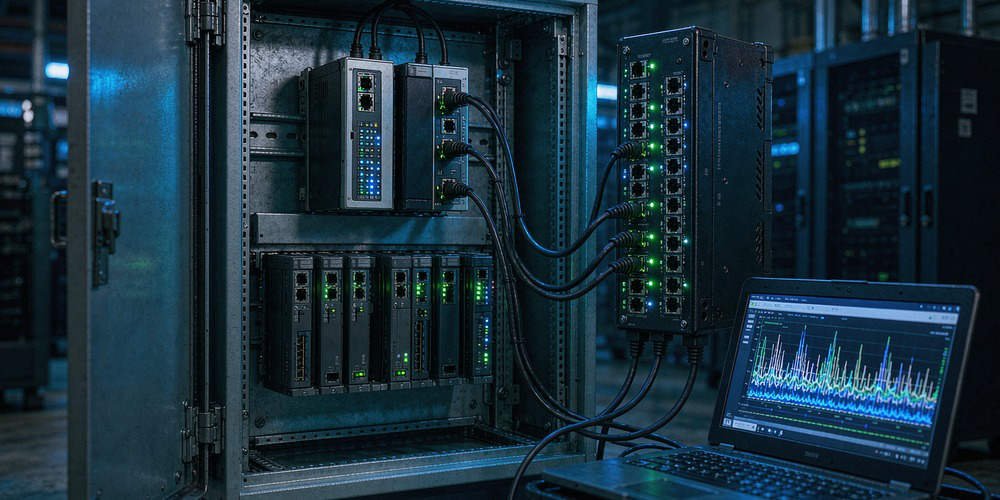
System integrators must evaluate total network architecture when upgrading RX3i control systems. Procuring advanced CPUs like the IC695CPE330 ensures high processing capacity for complex machinery. However, long-term reliability depends heavily on using industrial managed switches equipped with Storm Control and IGMP Snooping features. Procurement managers should source genuine hardware components to ensure full firmware compatibility across all Ethernet modules.
Application Scenario: Automotive Assembly Line Communication Isolation
An automotive manufacturing plant experienced frequent SCADA disconnections when an office video stream saturated the main network. The plant utilized an IC695CPE330 CPU connected to a flat enterprise network. Heavy broadcast traffic overwhelmed the Ethernet stack, causing SRTP communication timeouts across the assembly line.
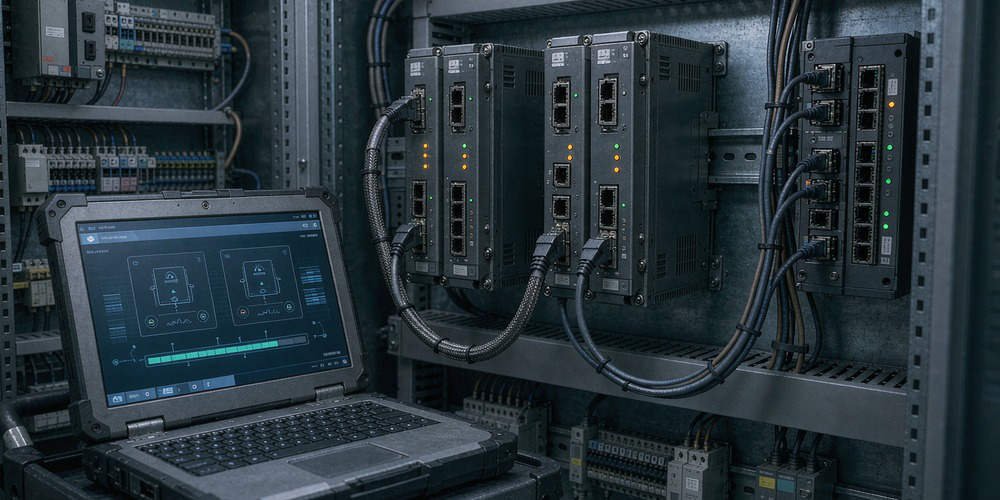
Engineers resolved the issue by implementing strict network segmentation. They reconfigured the IC695CPE330 to route enterprise SCADA traffic through LAN1 on a dedicated VLAN. Meanwhile, local I/O drops and HMI panels were isolated on LAN2 using a managed industrial switch with active Storm Control. This dual-subnet strategy eliminated communication losses completely without requiring CPU hardware replacements.
To upgrade your industrial network infrastructure with high-performance controllers and automation components, visit Powergear X Automation for expert technical support and genuine module sourcing.
Frequently Asked Questions (FAQ)
Q1: Will a network storm cause the IC695CPE330 CPU to go into STOP mode?
No, a standard network storm rarely causes the CPU to stop. The dual-core architecture isolates logic execution from communication tasks, keeping the PLC in RUN mode during network overloads.
Q2: Can I assign the same IP subnet to both LAN1 and LAN2 ports?
No, LAN1 and LAN2 must use distinct IP subnets. Overlapping IP ranges can cause routing errors, intermittent communications, or complete network interface failure.
Q3: What switch features best protect the IC695CPE330 from broadcast storms?
Managed industrial switches with Storm Control, VLAN segmentation, and IGMP Snooping provide the best protection against broadcast and multicast network storms.




Leave a Comment
Your email address will not be published. Required fields are marked *