

Integrating ABB S800 and S900 I/O: The Strategic Role of the CI856 Interface
Modern industrial automation demands flexibility across diverse process environments. The ABB CI856 Communication Interface stands as a robust bridge for the AC 800M controller. It enables seamless communication between high-density standard I/O and intrinsically safe remote modules. By acting as a PROFIBUS DP master, the CI856 streamlines complex system architectures. This article explores how this module integrates different I/O generations while maintaining high operational reliability.
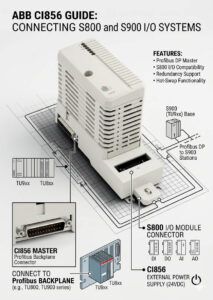
ABB CI856 Guide Connecting S800 and S900 IO Systems
Functional Overview of the CI856 PROFIBUS Master
The CI856 serves as a specialized PROFIBUS DP-V1 master interface for the ABB 800xA system. It connects the AC 800M controller to distributed I/O stations over a digital bus. This module handles cyclic data exchange for real-time control and acyclic data for advanced diagnostics. Consequently, engineers can monitor the health of field devices without interrupting the main process loop. Its hardware design supports high-speed transmission, which is vital for fast-acting control systems.
Bridging S800 and S900 I/O Systems
One major advantage of the CI856 is its ability to host both S800 and S900 I/O simultaneously. S800 I/O typically serves standard process areas with high-density requirements. In contrast, S900 I/O provides intrinsic safety for hazardous zones like refineries. The CI856 allows these two distinct systems to coexist on a single PROFIBUS segment. Therefore, plants can manage centralized control logic while meeting varied safety and protection standards.
Technical Principles of PROFIBUS DP-V1 Integration
Effective integration relies on the PROFIBUS DP-V1 protocol and standardized GSD files. The CI856 manages the communication timing and node addressing for all connected slaves. However, mixed topologies require careful consideration of segment loading and signal termination. Engineers must ensure that the total node count stays within ABB’s recommended limits. Furthermore, firmware alignment between the master and slave modules remains critical for diagnostic transparency. Improper GSD configuration often leads to “missing slave” errors during commissioning.
Hazardous Area Deployment and Intrinsic Safety
The synergy between the CI856 and S900 I/O is crucial for factory automation in explosive atmospheres. S900 modules are specifically designed for Zone 1 and Zone 2 applications. The CI856 transmits data from these hazardous areas back to the safe-area controller. This setup eliminates the need for expensive, bulky traditional safety barriers. As a result, the overall system footprint decreases while maintaining compliance with international ATEX and IECEx standards.
Selection Criteria and Key Differences
When choosing between S800 and S900 I/O for a CI856 segment, the environment is the primary factor. S800 modules offer modularity and cost-efficiency for non-hazardous indoor utility rooms. Meanwhile, S900 modules offer ruggedized protection and galvanic isolation for outdoor or chemical process skids. Additionally, engineers must evaluate the communication cycle time requirements. High node counts on a single CI856 may increase latency, affecting high-speed PID loops.
Best Practices for Installation and Maintenance
- ✅ Segment Testing: Validate PROFIBUS voltage levels before connecting all remote stations.
- ⚙️ Firmware Alignment: Ensure GSD files and module firmware are consistent across the network.
- 🔧 Grounding Control: Ground cable shields only at designated points to prevent ground loops.
- 📏 Bending Radius: Maintain proper cable curves at cabinet entries to avoid signal reflection.
Expert Implementation Insights from Powergear X Automation Limited
At Powergear X Automation Limited, we have observed that shielding issues cause 60% of field bus failures. We recommend using industrial-grade PROFIBUS connectors with integrated termination switches. Furthermore, maintenance teams should avoid routing communication cables parallel to high-power VFD lines. For brownfield upgrades, always verify that your CI856 firmware supports the specific revisions of your legacy S800 stations. For more technical support and genuine ABB parts, explore our solutions at https://www.powergearx.com/.
Real-World Application Scenarios
- Refinery Modernization: Integrating old S800 racks with new S900 intrinsically safe islands for tank farm expansion.
- Pharmaceutical Production: Managing standard HVAC control (S800) and solvent dosing (S900) under one AC 800M controller.
- Offshore Platforms: Utilizing S900 I/O for compact, remote process skids connected via the CI856 to reduce cabling weight.
Frequently Asked Questions (FAQ)
1. Can a single CI856 segment support a mix of standard and hazardous area I/O?
Yes, but the physical segments usually require a DP/IS coupler or barrier to maintain the electrical isolation required for S900 intrinsically safe nodes.
2. What is the most common cause of “Slave Missing” alarms on CI856?
Most failures stem from incorrect termination or damaged PROFIBUS cables. Using a bus analyzer can quickly pinpoint reflections or low signal voltage.
3. Is the CI856 compatible with non-ABB PROFIBUS DP slaves?
Generally, yes. Since it follows the standard PROFIBUS DP-V1 protocol, it can communicate with third-party devices if the correct GSD files are imported into the ABB 800xA engineering tool.