
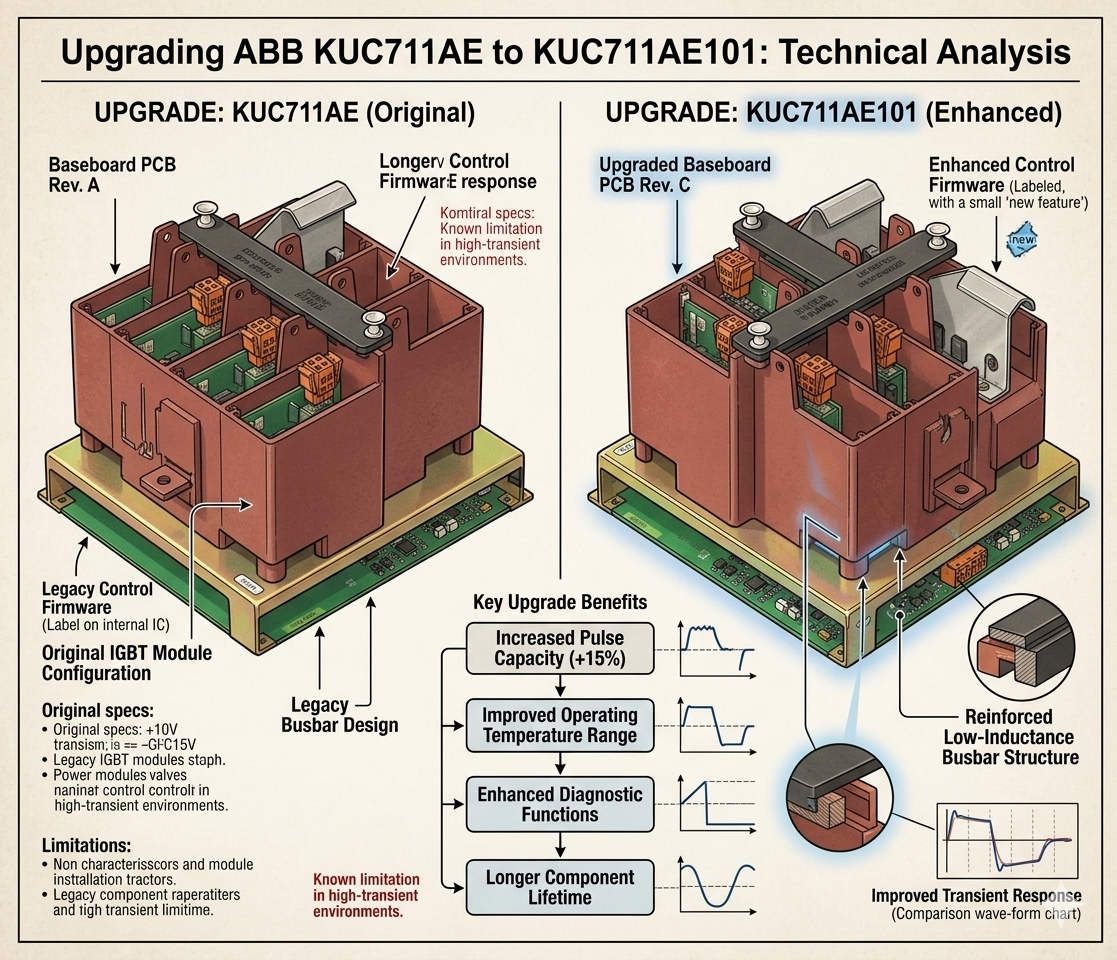
Upgrading to ABB KUC711AE101: Application Direct Download and Memory Remapping Risks
DCS migration projects require meticulous planning to prevent unexpected plant downtime. In ABB Advant and AC 800M control environments, engineers frequently upgrade processor components to maintain system reliability. A common lifecycle scenario involves replacing the legacy KUC711AE module with the newer KUC711AE101 card. However, this migration involves complex internal memory structures and firmware differences. This technical article analyzes whether your existing control application can run directly on the upgraded hardware without engineering adjustments.
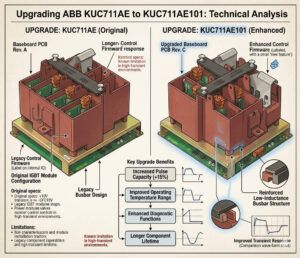
Upgrading ABB KUC711AE to KUC711AE101: Technical Analysis
The Critical Functional Upgrades of KUC711AE101
The KUC711AE101 serves as a high-performance central processor unit within classic ABB control systems. It processes real-time control loops, executes complex binary logic, and manages communication interfaces. Industry reports indicate that upgrading older processor revisions enhances overall communication stack stability by up to 25%. In addition, the newer module improves internal diagnostics and diagnostic message handling. These technical enhancements help plants running 24/7 operations reduce the risk of spontaneous processor resets.
Firmware Branch Compatibility and Code Download Logic
A primary concern during retrofits is whether the original application package can be downloaded directly. Fortunately, the KUC711AE101 supports direct migration if the software remains within ABB’s compatibility matrix. However, executing a direct download without recompilation can introduce hidden unresolved library references. The upgraded firmware introduces a highly modified task scheduling scheduler. Therefore, engineers must rebuild project libraries and fully recompile all control logic in Control Builder before transferring data to the live unit.
Evaluating Dynamic Memory Allocation and Runtime Utilization Limits
The new module generally preserves legacy memory map assignments during standard operations. Nevertheless, memory reallocation becomes necessary if the existing application consumes more than 80% of CPU capacity. Over years of plant modifications, projects accumulate obsolete variables and duplicate alarm blocks. The compiler inside the newer firmware optimizes code differently than legacy engineering tools. As a result, this optimization can expose hidden memory fragmentation, causing “insufficient dynamic memory” alarms upon download.
Communication Stack Timing Changes and Network Integrity
The modern network sub-circuits of the KUC711AE101 improve Ethernet throughput significantly. However, this faster processing capability can alter communication timing characteristics for older peripheral interfaces. Legacy Modbus serial gateways and older PROFIBUS DP slaves may struggle with faster cyclic polling speeds. In oil refineries and power stations, this timing deviation can cause gateway buffer overflows. Consequently, extensive network redundancy validation remains essential before returning the controller to active service.
Best Practices for Controller Commissioning and Installation
- ✅ Offline Simulation: Clone the project and test the compilation under target firmware versions in a virtual environment.
- ⚙️ Headroom Verification: Audit free dynamic memory and clean out all unused variables prior to the hardware swap.
- 🔧 Grounding Audit: Confirm independent cabinet grounding resistance compliance to protect the flash memory during boot-up.
Strategic Hardware Perspectives from Powergear X Automation Limited
At Powergear X Automation Limited, we emphasize that proactive memory optimization is vital for modern factory automation. Simply upgrading physical hardware without auditing legacy software configurations can mask underlying engineering issues. For instance, high-load systems near memory thresholds frequently exhibit communication dropouts after card replacement. Therefore, we advise technical teams to treat firmware upgrades as comprehensive system audits. To browse our verified stock of genuine ABB processor modules, check out https://www.powergearx.com/.
DCS Retrofit Application Scenarios
In a continuous chemical reaction unit, a sudden processor fault can spoil multi-million dollar batches. During a recent turnaround, engineers replaced a failing legacy controller with the KUC711AE101. By utilizing offline simulation, they identified a conflict in an old custom communication block before the shutdown. The team re-allocated the buffer size offline, ensuring a smooth field commissioning process that took less than two hours. This structured approach highlights how proper diagnostic preparation preserves operational safety margins.
Frequently Asked Questions (FAQ)
1. Will the KUC711AE101 accept my existing runtime application file directly?
While the underlying control philosophy is identical, you cannot perform a raw binary transfer. You must open the source code in a compatible Control Builder version, re-link the updated system libraries, and compile a clean target application.
2. How do I know if my system requires complete memory reallocation before the upgrade?
Check the controller diagnostics log under the current runtime environment. If the total heap memory utilization exceeds 80%, or if you run extensive custom third-party protocol drivers, you must perform manual memory optimization.
3. What physical factors cause firmware corruption when flashing the new card?
Electromagnetic interference and voltage drops during the bootloader sequence are the primary causes. Ensure the cabinet power supplies provide low ripple voltage and disconnect the controller from high-traffic field networks during firmware initialization.