Over 50,000 hot-selling automation module components.
Siemens vs. Rockwell PLC: Selecting the Right Automation System

Siemens vs. Rockwell PLC: Selecting the Right Automation System

Strategic Comparison: Siemens vs. Rockwell PLC Systems in Industrial Automation

The Core Value of Leading Control Systems

Siemens excels in complex scenarios requiring high system integration, such as automotive and chemical manufacturing. Its TIA Portal architecture significantly reduces cross-system debugging costs for large-scale projects. Conversely, Rockwell (Allen-Bradley) dominates the North American market and discrete manufacturing sectors. Rockwell offers a more intuitive learning path for beginners entering the PLC programming field. Therefore, Siemens provides global versatility, while Rockwell ensures rapid deployment for standardized production lines.
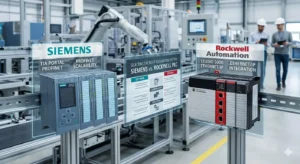
Siemens vs. Rockwell PLC: Selecting the Right Automation System

Programming Environments: TIA Portal vs. Studio 5000

The Siemens TIA Portal integrates PLC, HMI, and drives into a single unified platform. This integration eliminates frequent software switching and boosts overall engineering efficiency. Rockwell utilizes a modular approach with Studio 5000 and FactoryTalk separated into different packages. This separation helps beginners master individual functions but increases complexity during full system integration. Based on our field experience, Siemens allows direct variable linking, whereas Rockwell often requires manual tag configuration.

Optimizing Scan Time and System Response

Siemens S7-1200 and S7-1500 controllers maintain exceptional stability under heavy program loads. Rockwell CompactLogix systems provide highly responsive performance for smaller, high-speed applications. Precise scan times are vital for accurate motion control in packaging and robotics. However, improper task priority configuration in Rockwell systems can lead to cycle jitter. Siemens employs a default cyclic structure that is often more forgiving for less experienced programmers.

Industrial Communication Protocol Compatibility

Siemens natively supports PROFINET and Profibus, featuring mature OPC UA integration for Industry 4.0. Rockwell relies on EtherNet/IP, ensuring seamless compatibility with North American equipment ecosystems. Protocol selection dictates your future expansion costs and device hardware choices. Note that interfacing Siemens with EtherNet/IP devices usually requires an external gateway. Similarly, Rockwell systems need additional modules to communicate over PROFINET networks.

Field Installation and Maintenance Standards

Siemens hardware requires strict grounding practices, particularly for sensitive analog signal modules. Rockwell systems offer slightly higher tolerance for grounding variances under North American standards. We recommend single-point grounding to prevent circulating currents in your control cabinet. In high-vibration environments like mining, Siemens spring terminals offer superior reliability. Regular maintenance must include tightening Rockwell screw terminals to prevent intermittent I/O loss.

Powergear X Automation: Expert Engineering Perspective

At Powergear X Automation, we believe the choice depends on your regional ecosystem. Siemens offers the best flexibility for multi-brand integration in European and Asian markets. However, Rockwell remains the undisputed leader for projects based in the United States. Beyond the brand name, true engineering value lies in understanding electrical specifications and communication logic. We advise engineers to focus on mastering troubleshooting skills rather than just software syntax.

Technical Implementation Checklist

  • ✅ Match the PLC brand to the regional technical support network.
  • ✅ Use shielded twisted pair cables for all analog I/O.
  • ✅ Install external surge protection for outdoor control equipment.
  • ✅ Implement UPS backup for mission-critical automation controllers.
  • ✅ Verify communication gateway requirements for multi-protocol systems.
  • ✅ Optimize task priorities to prevent scan time fluctuations.

Strategic Industry Scenarios

  • High-Speed Packaging: Rockwell CompactLogix for intuitive motion control and local support.
  • Large Chemical Plants: Siemens S7-1500 with TIA Portal for massive system integration.
  • North American Retrofits: Allen-Bradley ControlLogix for compatibility with existing plant standards.

Frequently Asked Questions (FAQ)

Q1: Should I prioritize Siemens or Rockwell for a new international project?

Consider the project location and the local spare parts supply chain. Siemens is the better choice for Asian and European sites due to its vast ecosystem. For North American sites, Rockwell ensures easier access to technicians and replacement hardware.

Q2: Is it difficult to migrate legacy code to new PLC platforms?

Siemens provides robust migration tools for S7-300 to S7-1500 transitions. However, older Rockwell systems like SLC500 may require significant manual re-coding. Always budget extra time for I/O address mapping and communication verification during upgrades.

Q3: Which platform handles third-party device integration more efficiently?

Siemens TIA Portal generally offers better multi-vendor integration tools through standardized GSD files. Rockwell is highly efficient within its own “Premier Integration” ecosystem. For a mix of brands, Siemens typically reduces the total engineering hours required.

Rockwell vs Siemens The Guide to Factory Automation PLCs

Allen-Bradley vs Siemens PLC: Choosing Your Industrial Control System

Two titans dominate the industrial automation landscape: Allen-Bradley (Rockwell Automation) and Siemens.

They both offer robust, scalable, and highly durable control systems that reliably power complex manufacturing plants globally. The real challenge is not about performance—it is determining which ecosystem best aligns with your long-term operational needs. This guide offers a deep dive beyond mere specification lists, providing practical, experience-based insights for real-world plant environments.

The Critical Ecosystem Choice: Why Your PLC Brand Matters

The selection of a core PLC brand dictates your entire factory automation ecosystem. Allen-Bradley (AB) enjoys immense popularity across North America. Many facilities standardized on Rockwell tools decades ago. Consequently, local maintenance teams already know the Studio 5000 environment, which guarantees faster adoption and troubleshooting. Conversely, Siemens stands as a global powerhouse, often the default choice for international Original Equipment Manufacturers (OEMs), particularly in Europe and Asia.

Expert Insight (Powergear X Automation): Choosing a PLC brand commits your facility to that vendor’s software, motor drives, Human-Machine Interfaces (HMIs), technical support, and spare parts supply for the next 10 to 15 years. Therefore, selecting a platform that contradicts your existing installed base or local talent pool will certainly inflate lifecycle costs and dramatically slow issue resolution during critical downtime.

Rockwell vs Siemens The Guide to Factory Automation PLCs

Engineering Software Battle: Studio 5000 vs. TIA Portal

The engineering software defines the user experience and development speed.

Allen-Bradley (Studio 5000 / RSLogix 5000): This platform emphasizes ladder logic (LD) and function block diagram (FBD) programming. These are programming languages very familiar to US-based technicians. Moreover, Studio 5000 integrates seamlessly with Rockwell’s FactoryTalk suite for Supervisory Control and Data Acquisition (SCADA), alarming, and data historization. If you currently use PanelView HMIs or FactoryTalk View, maintaining the AB stack avoids toolchain incompatibility.

Siemens (Totally Integrated Automation – TIA Portal): TIA Portal’s key strength is unifying PLCs, safety controllers, drives, and HMIs into one cohesive engineering environment. This platform excels using Structured Text (SCL), and it provides advanced, system-wide diagnostics. As a result, teams managing diverse assets under a single architecture benefit from TIA’s reduction in context-switching and its simplified version control across all devices.

✅ Guidance:
Choose AB if your priority is familiar programming, fast North American onboarding, and leveraging existing Rockwell infrastructure.
Choose Siemens if your team can access the expertise and you require a unified engineering platform for all your control systems components.

Hardware Scale and Network Standards: Matching the Right Controller

Both companies offer scalable hardware that meets various operational needs.

Allen-Bradley: The CompactLogix is a mid-range controller perfect for machine-level control, such as small production lines or standalone packaging cells. The ControlLogix represents the high-end, modular platform designed for plant-wide automation, large I/O counts, and high-speed applications. AB uses native EtherNet/IP, which integrates straightforwardly into common US facility networks.

Siemens: The S7-1200 offers an entry-to-mid-range option, providing a cost-effective choice for OEMs and compact system builds. The S7-1500 is the high-performance, modular PLC, featuring extremely fast processing and comprehensive diagnostics, making it prevalent in the automotive and process industries. Siemens leverages native PROFINET and PROFIBUS, which align well with European-sourced equipment and industrial networks.

Example Application: A small robotic pick-and-place station requires a CompactLogix or an S7-1200. Conversely, a multi-zone assembly line involving complex motion control and integrated safety demands a ControlLogix or an S7-1500 DCS equivalent.

Availability and Lifecycle: The Hidden Cost of Downtime

Component availability is often the most significant factor impacting emergency downtime costs.

Allen-Bradley: In the United States, obtaining AB spare parts quickly is usually easier. This is critical when production downtime costs easily reach thousands of dollars per hour. Resellers consistently stock both legacy and current CompactLogix and ControlLogix units for same-day or next-day shipping.

Siemens: Siemens enjoys broader global availability. However, quickly sourcing older S7-300/400 modules on short notice within North America can sometimes be slow. If your equipment fleet primarily uses European OEMs, Siemens may offer smoother long-term global support, even if a US-based spot-replacement takes longer.

🔧 Practical Recommendation: If minimizing downtime through rapid parts replacement in North America is mission-critical, AB often holds the advantage. If your business operates globally or relies heavily on European machine builders, Siemens provides smoother long-haul global integration.

Cost Analysis: Upfront Price vs. Total Lifecycle Expenditure

It is a common error to focus solely on the initial Purchase Price.

Allen-Bradley: Initial hardware prices are often higher. However, this cost is frequently offset by the extensive local expertise, a robust distributor network, and the faster, well-established US replacement pathways.

Siemens: Siemens hardware often carries a lower initial price tag. Any potential long-term savings, however, heavily depend on your team’s existing skillset and regional parts availability. Retraining costs or slower emergency sourcing can quickly erode any initial hardware savings.

Powergear X Automation advises evaluating the Total Lifecycle Cost (TLC). This calculation must include software licenses, staff training time, inventory for spares, the risk profile of downtime, and vendor response times—not just the CPU unit price.

Quick Comparison: Allen-Bradley vs. Siemens PLCs

FeatureAllen-BradleySiemens
Engineering SoftwareStudio 5000 (US familiar)TIA Portal (Unified platform)
Mid-Range PLCCompactLogixS7-1200
High-End PLCControlLogixS7-1500
Primary NetworkingEtherNet/IPPROFINET/PROFIBUS
StrengthNorth American support, fast onboardingGlobal standardization, unified tooling
Watch-OutsHigher initial price, potential OEM lead timesUS learning curve, legacy NA spare part sourcing

Solutions Scenarios: Which PLC Fits Your Project?

Scenario 1: High-Speed Packaging Line (North America)
Choice: Allen-Bradley ControlLogix or CompactLogix.
Reasoning: Leverage existing local training, use native EtherNet/IP for easier integration with peripherals, and guarantee fast spare part availability to minimize potential $10,000/hour downtime risk.

Scenario 2: New Production Facility (Global Standard)
Choice: Siemens S7-1500 with TIA Portal.
Reasoning: Maintain a global standard across multiple international plants, leverage the unified TIA Portal for engineering consistency across PLCs and drives, and simplify management of complex European-sourced machinery.

Frequently Asked Questions (FAQ) with Experience

  • Q1: Will mixing AB and Siemens controllers save money?
    A: Mixing brands rarely saves money in the long run. While you might save on the initial hardware cost of one unit, you introduce complexity into the support chain. You double your required software licenses, increase training costs for technicians, and complicate your spare parts inventory. The added engineering time and troubleshooting complexity often outweigh any initial savings.
  • Q2: My facility uses an old AB platform (PLC-5). Should I upgrade to AB or switch to Siemens?
    A: If your team is only familiar with legacy Rockwell platforms, upgrading to the ControlLogix/Studio 5000 ecosystem provides the fastest path to modernization. The transition, while significant, is much easier for an experienced technician than switching to an entirely new platform like TIA Portal. The quickest adoption will be with the brand your team already knows.
  • Q3: Is the networking standard (EtherNet/IP vs. PROFINET) a major factor?
    A: Yes, it is a significant factor. While both are modern Ethernet protocols, your choice will influence how easily you connect with other components. If your plant has invested heavily in EtherNet/IP-compatible smart devices (like motor starters or remote I/O), switching to PROFINET will require network gateways, adding a potential point of failure. Conversely, many advanced European robotic and motion systems are optimized for PROFINET. Stick with the network that dominates your facility’s existing infrastructure.

For in-depth analysis of these industrial automation systems and to discover solutions tailored to your specific operational needs, we encourage you to visit the expert platform at Powergear X Automation.

Our team can provide guidance on current in-stock options and safe substitution strategies for critical components.

Back to Top
Product has been added to your cart