
Over 50,000 hot-selling automation module components.
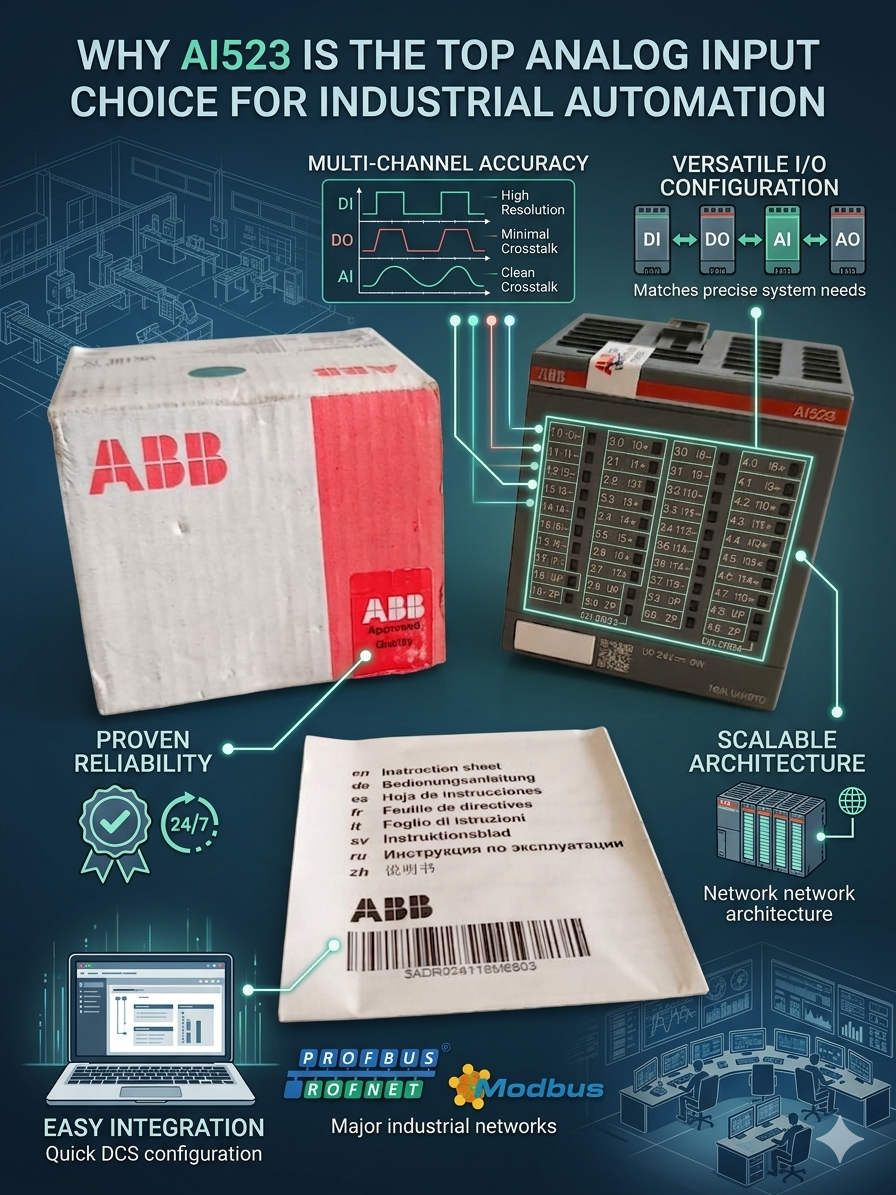
Why AI523 is the Top Analog Input Choice for Industrial Automation

Why AI523 is the Top Analog Input Choice for Industrial Automation

Is the AI523 the Most Versatile Analog Module in the AC500 Series?

In many industrial automation projects, the analog I/O layer often becomes a hidden bottleneck. Signal instability and poor channel isolation can cause significant delays during commissioning. The ABB AI523 analog input module addresses these practical integration challenges effectively. It eliminates the need for complex external signal conditioning hardware. Consequently, process industries such as chemical plants and water treatment facilities prioritize this module for its reliability and flexibility.

    Why AI523 is the Top Analog Input Choice for Industrial AutomationWhy AI523 is the Top Analog Input Choice for Industrial Automation

Multi-Signal Compatibility in Modern Control Systems

The AI523 stands out because it supports multiple industrial signal standards simultaneously. It handles both current and voltage-based instrumentation within a single architecture. In retrofit projects, this flexibility proves invaluable. Engineers often encounter mixed field devices, ranging from legacy 0–10 V sensors to modern 4–20 mA transmitters. Using the AI523 reduces the need for additional converters. Therefore, it simplifies cabinet design and minimizes potential failure points.

Signal Stability and Noise Immunity Technical Principles

Analog signal quality directly impacts the stability of any DCS or PLC system. In motor-heavy environments, electromagnetic interference often triggers false alarms. The AI523 utilizes advanced filtering and channel isolation to improve long-term reliability. This technical design is crucial when Variable Frequency Drives (VFDs) operate near I/O cabinets. Stable acquisition prevents PID oscillation and ensures accurate batch dosing. As a result, operators avoid chasing “ghost” faults caused by electrical noise.

Environmental Reliability for Factory Automation

Industrial environments subject hardware to heat, vibration, and humidity. The AI523 features a robust terminal structure designed for long operational cycles. Loose wiring often causes intermittent signal loss in high-vibration areas like compressor stations. This module provides secure connections that reduce unplanned maintenance. Furthermore, its thermal management allows for dense cabinet installations without compromising performance. Investing in durable hardware lowers the total cost of ownership over the plant’s lifecycle.

Strategic Maintenance and Installation Guidelines

  • Shielding Protocols: Ground analog cable shielding at one side only to prevent ground loops.
  • ⚙️ Mechanical Integrity: Use ferrules on stranded conductors to ensure maximum terminal contact.
  • 🔧 Surge Protection: Install dedicated surge protectors for any analog loops connected to outdoor instrumentation.

Authoritative Insight from Powergear X Automation Limited

At Powergear X Automation Limited, we believe that standardization is key to operational excellence. Standardizing on a universal module like the AI523 simplifies spare parts inventory. It also shortens the learning curve for maintenance technicians. We often see projects where inferior modules lead to hidden costs through intermittent downtime. Choosing the right interface is a strategic decision for any factory automation project. For a comprehensive range of ABB AC500 components, please visit our website at https://www.powergearx.com/.

Application Case: Pharmaceutical Process Skids

A recent pharmaceutical project required precise pressure and temperature monitoring across several skids. The engineers used the AI523 to integrate both legacy PT100 sensors and new HART-enabled transmitters. This approach allowed for a phased migration without halting production. The high-resolution acquisition ensured batch consistency and met strict regulatory standards. This case highlights how versatile I/O modules bridge the gap between different technology generations.

Frequently Asked Questions (FAQ)

1. How does the AI523 handle mixed active and passive current loops?
The module is adaptable, but you must plan your wiring carefully. We recommend verifying the power source for each loop. Proper distribution planning prevents overcurrent issues on the module’s backplane.

2. Can the AI523 be used in high-altitude energy facilities?
Yes, the AC500 series generally supports extended environmental ratings. However, check the derating curves for temperature and voltage isolation if your facility is above 2,000 meters.

3. What is the most common cause of “Input Overflow” errors on this module?
Overflow errors typically stem from a broken shield or an ungrounded signal reference. This causes common-mode voltage to drift beyond the module’s detectable range, even if the actual signal is correct.

Emerson 8mm to Bently Nevada Integration

Emerson 8mm to Bently Nevada Integration: Guide for 3300 & 3500 Systems

Understanding the Integration Challenge in Industrial Automation

Integrating diverse components forms the backbone of modern industrial automation. Engineers frequently face the challenge of connecting third-party sensors to legacy or proprietary monitoring systems. This scenario often arises when merging Emerson’s reliable 8mm proximity sensors with the ubiquitous Bently Nevada 3300 and 3500 machinery protection systems. Successful integration is critical for effective machine health monitoring. A smooth connection ensures reliable data flow for predictive maintenance. Therefore, careful planning and technical understanding become essential.

Emerson 8mm to Bently Nevada Integration

The Role of Proximity Sensors in Machinery Protection

Proximity sensors, like the Emerson 8mm series, play a vital role in measuring shaft position, vibration, and speed. These non-contact sensors generate a voltage output proportional to the gap distance. The Bently Nevada control systems, specifically the 3300 and 3500 rack monitors, require a specific signal input. However, direct electrical compatibility between brands may not exist. The sensor and the monitor must meet specific requirements for sensitivity (mV/mil), linearity, and range. This standardization ensures data accuracy for critical machinery.

Technical Specifications: Bridging the System Gap

Proper connection requires matching the key technical specifications of both systems. Emerson 8mm sensors typically use an external power supply and a coaxial cable for signal transmission. The Bently Nevada 3300 and 3500 series expect a buffered, conditioned signal. In addition, the system’s power requirements must align. Using an interface or conditioning module often solves potential electrical discrepancies. Experienced technicians confirm signal integrity across the entire operating range. Consequently, the selection of a suitable signal conditioner is paramount.

Emerson 8mm to Bently Nevada Integration

Practical Steps for a Seamless PLC/DCS Integration

  1. Verify the sensor’s power supply and current draw.
  2. Confirm the required gap voltage for the Bently Nevada input card.
  3. Use an interface module to translate the signal to the monitor’s expected format.
  4. Calibrate the entire measuring chain end-to-end.
  5. Update documentation and wiring schematics in the DCS or PLC records.

This diligence maintains system reliability and compliance.

Author’s Insight: Enhancing System Trustworthiness

Based on my experience, never compromise on cable quality or shielding. Noise interference significantly affects proximity sensor readings. Using specialized junction boxes with proper grounding improves system trustworthiness. Furthermore, consider future expansion or upgrades. Selecting a configurable interface module allows for easier scaling. The Bently Nevada 3500 offers greater flexibility, but the fundamental signal conditioning principle remains the same. Investing in quality components reduces long-term maintenance costs.

Emerson 8mm to Bently Nevada Integration

Application Scenario: Turbo-machinery Monitoring

Imagine a large industrial facility using turbo-machinery. Continuous, accurate shaft vibration data prevents catastrophic failures. Emerson 8mm sensors monitor the shaft displacement. The Bently Nevada 3500 system provides continuous, real-time protection and alarming. This blended solution leverages the strengths of both brands. The interface module acts as the crucial link, ensuring reliable data delivery to the central control systems. This successful integration minimizes downtime and maximizes asset utilization.

Need the right components for your integration?

Powergear X Automation Limited offers specialized interface solutions to perfectly match Emerson 8mm sensors with Bently Nevada systems. Click the product links below for detailed specifications and to compare models.

Product Comparison Guide

Product ModelKey FeatureApplication Focus
EZ1081-03-00-010High-speed data throughputCritical Turbomachinery
EZ1080-12-00-010Extended temperature rangeHarsh environments
EZ1080-18-08-010Integrated signal filteringHigh-noise applications

Product Selection Details

EZ1081-03-00-010: This model focuses on rapid data acquisition, ideal for high-speed machinery where minimal latency is critical. It ensures quick response in protection scenarios.

EZ1080-12-00-010: Designed for resilience, this unit operates reliably in extreme temperatures, making it suitable for unconditioned industrial spaces or outdoor applications.

EZ1080-18-08-010: With built-in noise reduction capabilities, this model is the superior choice for electrically noisy areas, guaranteeing clean, accurate signal transmission to the Bently Nevada monitor.

Achieving High Accuracy with RX3i Analog Modules: Calibration, Compensation, and Signal Conditioning Essentials

Introduction

As a seasoned industrial control engineer, I understand the critical role accurate analog signals play in industrial processes. The GE RX3i platform is robust, but getting the most out of its analog modules requires more than just plug-and-play. It demands a thoughtful approach to calibration, compensation, and signal conditioning.

This guide will share insights I’ve gathered over years in the field, helping you achieve high accuracy with your RX3i analog modules. My goal is to provide practical, actionable advice that goes beyond the manual, ensuring your control systems operate with unmatched precision.

Achieving High Accuracy with RX3i Analog Modules

Understanding the Foundation: Why Accuracy Matters

In industrial automation, even small errors in analog readings can lead to significant issues. Think about temperature control, pressure monitoring, or flow measurement. Inaccurate data can result in:

  • Process inefficiencies and wasted resources.
  • Compromised product quality.
  • Safety hazards due to incorrect readings.
  • Increased downtime for troubleshooting.

The RX3i analog modules are designed for high performance, but their true potential is unlocked only when properly integrated and maintained within your system. This starts with a deep understanding of the factors that influence accuracy.

Calibration: Your First Line of Defense

Calibration is fundamental. It’s the process of adjusting your module to provide accurate readings compared to a known standard. Neglecting regular calibration is like driving with an uncalibrated speedometer – you might think you’re going the right speed, but you’re probably not.

Achieving High Accuracy with RX3i Analog Modules

Here are my key takeaways for RX3i analog module calibration:

  • Use Certified Standards: Always use calibration equipment with a known, traceable accuracy. Don’t cut corners here.
  • Follow Manufacturer Guidelines (But Think Beyond): The GE manuals provide excellent calibration procedures. However, consider your specific environment. High vibration or extreme temperature swings might require more frequent calibration.
  • Document Everything: Keep meticulous records of your calibration dates, the equipment used, and the “as found” and “as left” conditions. This data is invaluable for trending performance and troubleshooting.
  • In-Situ vs. Bench Calibration: Where possible, perform in-situ (on-site) calibration. This accounts for the actual wiring, cable lengths, and electrical noise present in your operational environment, which can sometimes differ from a bench test.

Compensation: Mitigating Environmental Impacts

Even perfectly calibrated modules can be affected by environmental factors. This is where compensation comes in. It’s about correcting for variables that can drift over time or due to changing conditions.

My unique insights on compensation for RX3i analog modules include:

  • Temperature Drift: Analog modules, like all electronics, are sensitive to temperature changes. While RX3i modules are robust, significant temperature swings can cause readings to drift. Consider using modules with built-in cold junction compensation for thermocouples, or implement software-based temperature compensation algorithms if your process demands extreme precision. I’ve seen situations where a small temperature change in the control cabinet caused significant process deviations simply because compensation wasn’t adequately considered.
  • Lead Wire Resistance: Especially with RTDs, the resistance of the lead wires can introduce errors. Always use the proper wiring configuration (e.g., 3-wire or 4-wire RTD connections) to minimize or eliminate the impact of lead wire resistance. If you’re stuck with a 2-wire setup, you might need to empirically measure and compensate for the lead resistance in your PLC code.
  • Load Variations: For current outputs, ensure your receiving device’s impedance is within the specified range for the RX3i module. An incorrect load can lead to non-linear responses.

Signal Conditioning: Cleaning Up the Noise

Industrial environments are inherently noisy. Electrical interference, ground loops, and transient spikes can all corrupt analog signals, leading to inaccurate readings and erratic control. Signal conditioning is the art of preparing your signal for the analog module so it’s clean and reliable.

My recommendations for effective signal conditioning with RX3i modules:

  • Proper Shielding and Grounding: This is non-negotiable. Use shielded cables and ensure proper grounding practices throughout your system. Incorrect grounding is a leading cause of signal integrity issues. I often see ground loops causing phantom readings or unstable signals; a common mode choke can be a lifesaver in such scenarios.
  • Filtering: Implement appropriate filtering to remove high-frequency noise. This can be done with external filters, or often, the RX3i modules have configurable digital filters you can leverage. Don’t over-filter, though, as it can slow down your signal response.
  • Isolation: Use isolation barriers for signals coming from different ground potentials to prevent ground loops and protect your modules from surges. This is especially crucial when connecting to field devices that might have their own power supplies.
  • Cable Selection and Routing: Choose the right type of cable for your signal (e.g., twisted pair for differential signals) and route power and signal cables separately to minimize electromagnetic interference (EMI).
  • Impedance Matching: Ensure the impedance of your sensor, cable, and analog input module are properly matched to maximize signal transfer and minimize reflections.

Achieving High Accuracy with RX3i Analog Modules

My Unique Perspective: Beyond the Basics

Having spent years troubleshooting complex industrial systems, I’ve learned that true accuracy comes from a holistic view. It’s not just about one perfect component, but how all components interact.

  • The “Hidden” Software Compensation: Many engineers focus only on hardware. But leveraging the processing power of the RX3i PLC for software-based compensation is a game-changer. For example, creating a lookup table in your PLC code to correct for sensor non-linearity, or implementing a Kalman filter for noisy signals, can significantly improve accuracy without additional hardware. I’ve successfully applied these techniques to extract high precision from standard analog inputs in demanding applications.
  • Predictive Maintenance for Accuracy: Don’t wait for failures. Monitor your analog signal trends. A gradually drifting signal might indicate a failing sensor, module degradation, or increasing environmental interference. Early detection saves significant downtime.
  • Training Your Team: The best practices are useless if your maintenance team isn’t aware of them. Invest in training your personnel on proper calibration techniques and troubleshooting analog signals.

Achieving high accuracy with RX3i analog modules is an ongoing commitment, not a one-time task. By meticulously addressing calibration, implementing smart compensation strategies, and ensuring robust signal conditioning, you can unlock the full potential of your GE RX3i system.

For high-quality industrial automation solutions, including GE RX3i products and expert support, please visit Powergear X Automation Limited.

ModelTitleLink
IC695ALG112GE Fanuc RX3i Isolated Analog ModuleLearn More
IC695ALG306GE Fanuc Isolated Thermocouple Input ModuleLearn More
IC695ALG616GE PACSystems RX3i Analog Input ModuleLearn More
IC695ALG728GE Fanuc RX3i PACSystem Analog Input ModuleLearn More
IC695ALG608GE Fanuc PACSystems RX3i Analog Input ModuleLearn More
Back to Top
Product has been added to your cart