Over 50,000 hot-selling automation module components.
Optimizing Load Sharing with FC-PSU-UNI2450U Power Modules

Optimizing Load Sharing with FC-PSU-UNI2450U Power Modules

Optimizing Reliability via FC-PSU-UNI2450U Parallel Power Architecture

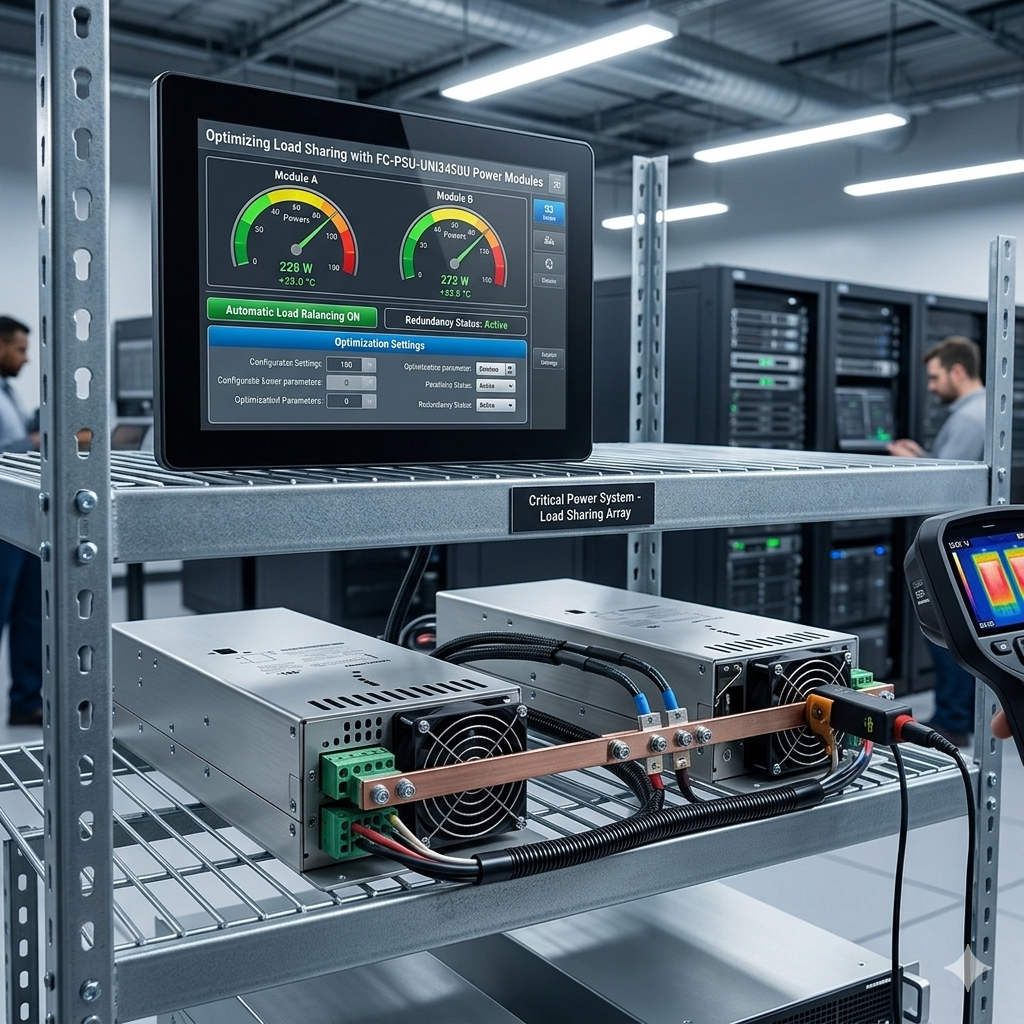
Modern industrial plants require high-capacity DC power that stays operational 24/7. While paralleling multiple FC-PSU-UNI2450U modules increases total output, the real challenge lies in balanced current distribution. Uneven loads force a single module to work at peak capacity while others remain idle. This imbalance accelerates thermal stress and degrades critical internal components like electrolytic capacitors. Consequently, systems without proper balancing face unexpected shutdowns during transient voltage spikes in PLC or DCS environments.
Optimizing Load Sharing with FC-PSU-UNI2450U Power Modules

Optimizing Load Sharing with FC-PSU-UNI2450U Power Modules

Active Current Sharing vs. Passive Matching

The FC-PSU-UNI2450U excels because it utilizes active current-sharing control circuitry. Unlike passive systems that rely on voltage matching, active control maintains precision during dynamic load shifts. In passive setups, a minor deviation of 50mV can cause significant current hogging. This lead module often experiences rapid temperature rises and premature failure. Therefore, active balancing is essential for remote I/O racks and Honeywell controllers, especially when ambient temperatures exceed 40°C.

Addressing Cable Impedance in Multi-Module Arrays

Hidden resistance in wiring often disrupts even the best power configurations. Identical power supplies may still show a 5% to 8% current imbalance due to inconsistent cable lengths. To mitigate this, engineers should use identical conductor cross-sections and star-distribution topologies. Moreover, avoiding mixed copper and aluminum terminals prevents oxidation-related resistance. Following IEC 60364 guidelines ensures that voltage drops remain within limits during peak startup currents in refinery MCC cabinets.

Thermal Management and System Derating

Total system capacity does not always scale linearly when adding more modules. Enclosure airflow and ambient heat dictate the actual sustainable output. For instance, two 50A modules might not safely deliver a continuous 100A in a sealed cabinet. We recommend maintaining at least 50mm of vertical ventilation clearance. Furthermore, separate exhaust paths prevent hot-air recirculation. Thermal imaging during commissioning helps verify that each module in the parallel group dissipates heat evenly.

Advanced Installation and Surge Protection Strategies

Reliability in oil and gas or water treatment facilities requires robust protection. External Surge Protection Devices (SPD) are vital for both AC inputs and DC outputs. Without coordinated Type II SPDs, transient events can permanently damage rectifier stages. Additionally, we advise against daisy-chaining outputs. A common DC busbar minimizes branch impedance differences. Always verify that ground resistance stays below plant engineering limits to reduce transient impedance during faults.

Selection Logic: Redundancy vs. Maximum Capacity

Choosing the right number of FC-PSU-UNI2450U modules depends on your specific uptime requirements. In high-availability DCS environments, N+1 redundancy is the gold standard. This setup ensures that if one module fails, the remaining units carry the full load without interruption. However, mixing different hardware revisions is generally discouraged. Always validate mixed-generation operation through on-site load testing to prevent circulating currents and chronic overload alarms.

Expert Insights from Powergear X Automation Limited

At Powergear X Automation Limited, we observe that the transition to smarter, active-sharing modules marks a shift toward predictive maintenance. Traditional power supplies were “fit and forget,” but the FC-PSU-UNI2450U allows for better integration into modern diagnostic frameworks. We believe that focusing on thermal symmetry today prevents costly downtime tomorrow. For more technical specifications or procurement support, visit our official site at Powergear X Automation Limited.

Industrial Solution Scenarios

  • Petrochemical Plants: Ensuring 24/7 stability for redundant Honeywell Safety Manager systems.
  • Offshore Platforms: Utilizing thermal derating strategies to maintain power in high-salt, high-heat environments.
  • Pharmaceutical Lines: Implementing N+1 architecture to prevent batch loss during power module maintenance.

Technical Summary Checklist

  • Active Balancing: Precision current sharing for dynamic PLC/DCS loads.
  • ⚙️ Wiring Topology: Use star-topology to equalize branch impedance.
  • 🔧 Protection: Type II SPD integration for remote or outdoor field stations.
  • 🌬️ Airflow: Mandatory 50mm vertical clearance for natural convection.
  • 📏 Validation: Commissioning verification with ±10% current deviation limits.


Frequently Asked Questions (FAQ)

1. Why does one module in my parallel set run significantly hotter than the others?
This is typically caused by unequal branch resistance rather than a PSU defect. If the cable to one module is shorter or the terminal is tighter, it offers a path of least resistance, forcing that module to carry more current. Checking terminal torque and cable lengths usually resolves this based on our field experience.

2. Can I mix the FC-PSU-UNI2450U with older legacy power modules?
While theoretically possible if voltages match, it is risky. Older generations often lack active sharing logic. The newer module might “fight” the older one, leading to circulating currents. We recommend a full system upgrade or rigorous load-bank testing before permanent integration.

3. What is the most common failure point in parallel power installations?
Beyond thermal exhaustion, terminal oxidation is a frequent culprit. In humid or corrosive industrial environments, high-resistance connections at the DC busbar create imbalances that trigger nuisance alarms or premature capacitor aging. Regular infrared thermography is the best preventative measure.

Allen-Bradley 1769-OW16 Guide: Features & Industrial Applications

Allen-Bradley 1769-OW16 Guide: Features & Industrial Applications

Optimizing Industrial Control with the Allen-Bradley 1769-OW16 Relay Output Module

The 1769-OW16 stands as a cornerstone in the Allen-Bradley CompactLogix family. It bridges the gap between digital logic and high-power field devices. This 16-point electromechanical relay module offers unparalleled versatility for modern control systems. Engineers frequently choose this module for its ability to switch diverse load types across isolated circuits. Consequently, it remains a preferred choice in factory automation and complex process control environments.

Allen-Bradley 1769-OW16 Guide: Features & Industrial Applications

Core Functional Principles and Galvanic Isolation

The 1769-OW16 operates on the principle of electromagnetic induction to physically open or close mechanical contacts. Each output provides galvanic isolation, which effectively shields the PLC backplane from volatile field-side electrical noise. This physical separation allows the module to manage a mix of 24V DC and 120/240V AC loads simultaneously. Furthermore, the robust design ensures that a failure in a single field device does not compromise the entire controller rack.

Technical Specifications and Performance Constraints

Understanding the switching dynamics of the 1769-OW16 is critical for system reliability. Unlike solid-state alternatives, these mechanical relays have a typical propagation delay of 10 milliseconds. While this speed is sufficient for most industrial valves and starters, it is inadequate for high-speed motion control. According to industry benchmarks from organizations like the IEEE, mechanical wear is the primary failure mode for such devices. Under a full rated resistive load, users should anticipate an electrical life between 100,000 and 500,000 cycles.

  • Mechanical Endurance: Approximately 10 million no-load operations.
  • Voltage Range: Supports 5V to 265V AC and 5V to 125V DC.
  • Current Rating: Typically 2.5A per point (continuous).
  • Power Consumption: Higher backplane draw compared to transistor modules due to coil energization.

Strategic Application Scenarios in Modern Industry

The 1769-OW16 excels in environments where “clean” switching and high voltage flexibility are paramount. In chemical processing plants, it often controls heavy-duty solenoids and motor starters. In packaging lines, it serves as a reliable interface for pilot lights and signaling towers. However, for applications requiring high-frequency switching (exceeding 1 Hz), our experts at Powergear X Automation Limited recommend transitioning to transistor-based modules to avoid premature mechanical fatigue.

Expert Selection Guide: Relay vs. Transistor Outputs

Selecting the right output module requires balancing durability against application speed. The 1769-OW16 is the “Swiss Army Knife” of outputs, but it is not universal. If your system requires Pulse Width Modulation (PWM) or rapid counting, the mechanical latency of a relay will cause timing errors. Conversely, for retrofit projects where you must interface with legacy AC contactors and modern DC sensors on the same rail, the 1769-OW16 is technically superior and more cost-effective.

Installation Best Practices and Field Experience

In our extensive field experience at Powergear X Automation Limited, we have observed that 80% of relay failures stem from improper surge suppression. Inductive loads generate massive back-EMF (electromotive force) during turn-off, which causes arcing across the contacts. To extend the module’s lifespan by up to 300%, we strictly advise the following technical safeguards:

  • For DC Loads: Always install a flyback diode (e.g., 1N4004) in parallel with the load.
  • For AC Loads: Utilize an RC snubber or a Metal Oxide Varistor (MOV) to suppress voltage spikes.
  • Thermal Management: Ensure at least 50mm of clearance around the CompactLogix rack to dissipate coil heat.
  • Wiring Integrity: Periodically check terminal torque in high-vibration mining or milling applications.

For high-quality components and expert technical support, we invite you to explore the full range of solutions at Powergear X Automation Limited, your trusted partner in industrial efficiency.

Frequently Asked Questions (FAQ)

Q1: Why is my 1769-OW16 failing after only a few months of operation?
This is usually caused by “contact welding” or excessive arcing. If you are switching inductive loads like large contactors without external surge suppressors, the electrical arc degrades the contact surface rapidly. Implementing RC snubbers often resolves this issue immediately.

Q2: Can I mix different voltages on the same 1769-OW16 module?
Yes, but with caution. The module is organized into groups. While the module provides isolation between the logic and the field, you must ensure that the wiring layout maintains physical separation between high-voltage AC and low-voltage DC to prevent crosstalk or safety hazards.

Q3: How do I know when it is time to replace the module preventatively?
We recommend monitoring the “cycle count” via PLC logic. Once an output exceeds 400,000 operations under significant load, it enters the “wear-out” phase. Replacing the module during scheduled downtime is far more cost-effective than dealing with an emergency line stoppage.

Application Case Study: Water Treatment Facility

In a recent project, a municipal water plant utilized the 1769-OW16 to manage chemical dosing pumps and motorized valves. By using the relay’s dry contacts, the engineers avoided the need for 16 individual interposing relays, reducing the control panel footprint by 30%. By following Powergear X Automation Limited‘s guidelines on surge suppression, the facility has maintained zero output failures over three years of continuous operation.

Back to Top
Product has been added to your cart