

ABB PPC322BE Battery Low Alarm: Technical Risks & Solutions
ABB PPC322BE Controller: Mitigating Operational Risks of Battery Low Alarms in Excitation Control Systems
In modern industrial automation, the reliability of generator excitation control systems hinges on tiny components. The ABB PPC322BE controller stands as a critical processing unit within advanced Automatic Voltage Regulator (AVR) frameworks. However, field engineers frequently misinterpret the critical “Battery Low” alarm on this specific platform. This article explores the technical functions, risk vectors, and strategic maintenance protocols necessary to safeguard continuous manufacturing and power generation infrastructure.
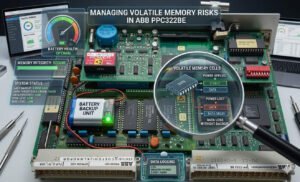
Managing Volatile Memory Risks in ABB PPC322BE Controllers
The Vital Role of SRAM Volatile Memory Retention
The PPC322BE controller utilizes a specialized internal backup battery to sustain its static random-access memory (SRAM) chipsets. This battery continuously preserves crucial operational parameters, including PID excitation tuning values, AVR regulator setpoints, and historical fault data. Moreover, it maintains communication configurations and real-time clock synchronization vital for Distributed Control Systems (DCS) diagnostics. While the factory automation system remains fully energized, the primary DC power supply runs the control board logic seamlessly.
Consequently, operators often dismiss the low battery warning because the excitation system maintains normal output levels. However, our technical specialists at Powergear X Automation Limited frequently observe severe parameter corruption when systems undergo subsequent power cycling. Industry statistics indicate that over 30% of unexpected restart delays during planned plant outages stem directly from unaddressed controller battery depletion.
Quantifying the Real Risks of Control Power Disruption
The operational danger of a weak battery rarely manifests during steady-state manufacturing conditions. Instead, the vulnerability exposes itself during unexpected DC control power loss, planned maintenance shutdowns, or critical black-start operations. When the external power supply drops, an insufficient battery voltage immediately triggers a complete reset of the volatile memory layers. As a result, calibration tables invalidate instantly, and the entire controller initialization loop fails upon power restoration.
In redundant excitation setups, missing memory data prevents dual-channel controllers from synchronizing their operational references properly. Therefore, turbine generators cannot build up voltage safely, causing immediate startup failures on the factory floor. According to Electrical Power Research Institute (EPRI) guidelines, maintaining backup power integrity is vital for system recovery times during black-start contingencies.
Executing Safe Online Battery Replacement Procedures
Fortunately, the engineering architecture of the ABB PPC322BE module supports hot-swapping or online replacement procedures. Maintenance teams can change the battery cell without shutting down the active excitation process, provided the controller remains powered. This capability offers massive financial advantages for continuous-process industries, such as refinery compressor trains and captive power generation facilities.
Nevertheless, online replacement demands meticulous technical execution because accidental board contact can short-circuit delicate electronic traces. If the main control voltage fluctuates during manual extraction, memory loss can still occur in milliseconds. Technicians must strictly follow precise, field-tested sequences to eliminate structural risk during live panel maintenance.
- System Verification: Confirm that the excitation system runs in a stable, automatic control loop without active faults.
- Data Backup: Download all current AVR parameters and communication settings using engineering software tools before touching hardware.
- ESD Protection: Wear grounded electrostatic discharge wrist straps to protect adjacent integrated circuits from static failure.
- Rapid Swap: Extract and insert the approved replacement cell swiftly, utilizing non-conductive tools to protect structural clips.
- Status Confirmation: Verify the immediate clearance of the low-voltage error register on the local Human Machine Interface (HMI).
Environmental Degradation and Technical Selection Criteria
Thermal management directly dictates the lifecycle efficiency of lithium-based backup cells inside control cabinets. Standard manufacturer datasheets often project a nominal 5-year battery lifespan under perfect laboratory conditions. However, actual excitation enclosures are usually located near high-temperature turbine decks or heat-generating rectifier bridges. When ambient cabinet temperatures exceed 40°C regularly, chemical degradation inside the cell accelerates drastically.
Field records show that high humidity levels and intense thermal cycling cut actual battery lifespan down to 2–3 years. Furthermore, severe electromagnetic interference (EMI) in IEC 61000 industrial environments requires robust grounding configurations. Poorly grounded cabinets expose the controller to voltage spikes during the battery replacement process, jeopardizing data integrity.
Compatibility and Firmware Challenges in Retrofit Projects
When engineering facility upgrades, matching the exact iteration of the PPC322BE controller is vital for system compatibility. Newer controller revisions frequently feature updated EEPROM structures that change how parameter memory blocks align. Therefore, combining mismatched firmware generations without verifying memory behavior can cause hidden startup issues after power cycling. Engineers must evaluate the existing UNITROL or Symphony Plus architecture carefully before installing replacement hardware components.
| Technical Variable | Legacy ABB Implementations | Modern PPC322BE Platforms |
|---|---|---|
| Memory Architecture | Basic volatile SRAM arrays | Advanced high-speed synchronized SRAM |
| Battery Lifespan (45°C) | Approximately 1.5 to 2 years | Optimized chemistry lasting 2 to 3 years |
| DCS Communication | Proprietary slow serial links | Integrated high-speed fieldbus interfaces |
Solutions and Application Scenarios
To maximize operational availability, heavy industries must transition from reactive troubleshooting to structured predictive maintenance schedules. Our engineering group strongly recommends measuring battery terminal voltages during annual diagnostic shutdowns. For comprehensive assistance with hardware sourcing, component testing, and technical upgrades, please explore the specialized support solutions at Powergear X Automation Limited.
In massive offshore electrical systems and continuous cement kiln operations, proactive battery replacement eliminates multi-million-dollar downtime risks. Integrating these simple components into your main asset management workflow ensures long-term operational continuity and rapid black-start recovery capabilities.
Frequently Asked Questions
Q1: Why does a new backup battery sometimes fail to clear the error code immediately?
A1: This issue typically occurs due to microscopic oxidation layers forming on the silver-plated terminal clips of the holder. Technicians should gently clean the contacts with an approved electronics cleaner and verify the actual terminal voltage using a digital multimeter.
Q2: Can we use standard consumer-grade lithium cells of identical size for an emergency fix?
A2: Absolutely not. Industrial controllers require industrial-grade cells built to withstand high-temperature derating and continuous thermal vibrations. Consumer batteries will degrade rapidly under intense cabinet heat, leading to premature memory loss within months.
Q3: What happens if a dual-channel redundant system suffers simultaneous battery failure during a shutdown?
A3: Both channels will lose their synchronized parameter baselines and revert entirely to unconfigured factory states. Consequently, the entire excitation system will block startup sequences until an engineer manually reloads the original backup profiles.