ABB AI931S vs AI931N: Why Chemical Plants Prefer AI931S
Comparison Guide: Why ABB AI931S Outperforms AI931N in Chemical Industry DCS Applications
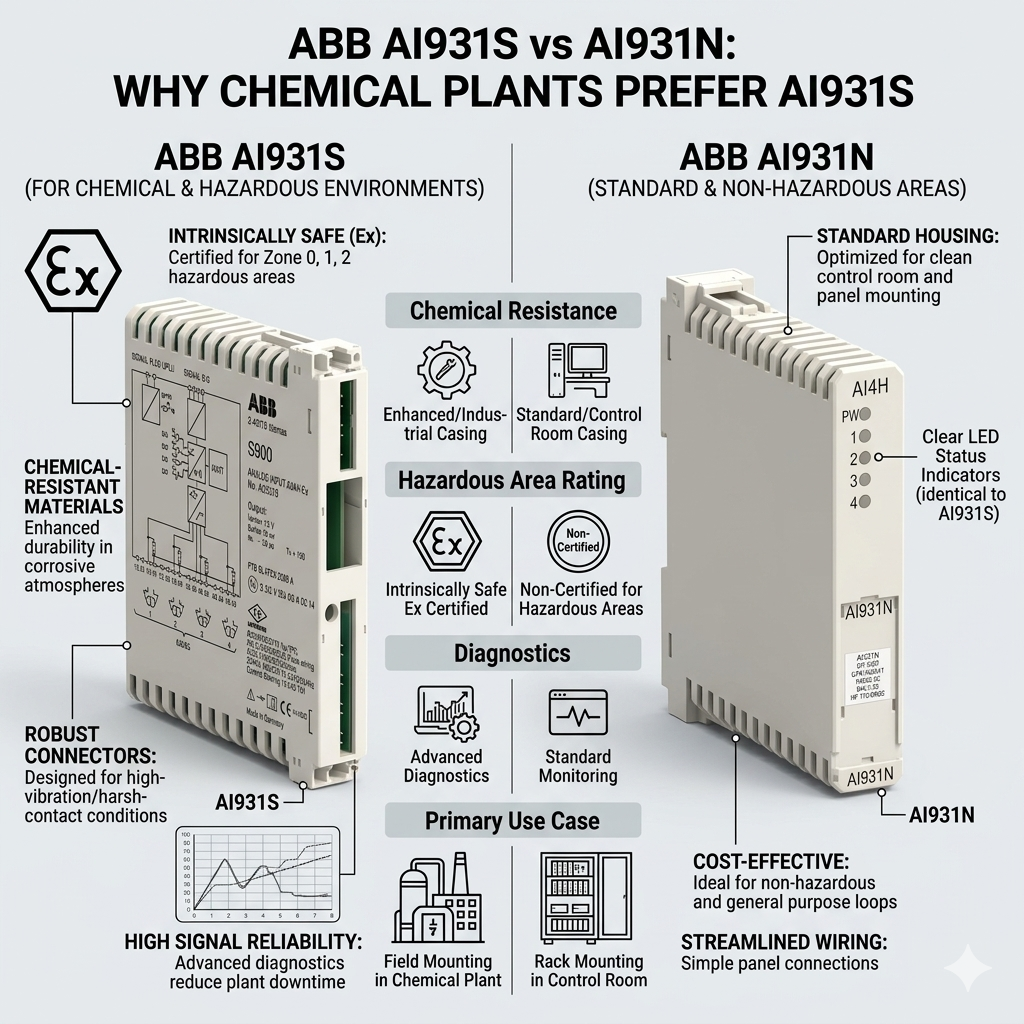
In the demanding environment of industrial automation, analog signal integrity determines the success of process control. The ABB Symphony series utilizes the AI931 series for critical data acquisition. Engineers frequently choose the AI931S over its sibling, the AI931N. This preference stems from the module’s superior ability to handle corrosive atmospheres and electrical noise. While both capture 4–20 mA signals, the “S” variant offers technical advantages that ensure long-term plant uptime.
ABB AI931S vs AI931N: Why Chemical Plants Prefer AI931S
Superior EMC Resistance for Stable Control Systems
Chemical plants operate massive motors and variable frequency drives (VFDs) that generate significant electromagnetic interference. Standard analog modules often suffer from signal drifting or intermittent spikes in these zones. However, the AI931S features enhanced Electromagnetic Compatibility (EMC) immunity. It effectively filters transient noise during heavy machinery switching events. Consequently, PID loops remain stable, and operators avoid the “ghost alarms” that plague lower-spec hardware. Tighter signal control directly reduces the risk of off-spec chemical batches.
Operational Principles and Signal Acquisition Accuracy
The core function of the AI931 series involves converting field transmitter currents into digital values for the DCS. The AI931S employs high-resolution conversion circuits designed for modern, high-precision transmitters. It maintains accuracy even when instrumentation loops span long distances across a facility. Moreover, the internal isolation of the “S” model prevents ground loops from corrupting sensitive measurements. This technical design ensures that pH, pressure, and flow data remain reliable for critical safety interlocks.
Environmental Durability in Corrosive Factory Automation Zones
Chemical facilities expose control systems to corrosive vapors, high humidity, and temperature fluctuations. The AI931S is engineered with better environmental tolerance than the AI931N. It withstands moisture-heavy environments common in distillation and solvent handling areas. Furthermore, the module’s internal components resist the slow degradation caused by conductive dust. Investing in the “S” version reduces the frequency of unexpected I/O dropouts. As a result, maintenance teams spend less time on card replacements during emergency repairs.
Selecting Between AI931S and AI931N: Key Differences
The choice between these modules depends largely on the installation site’s electrical “cleanliness.” For indoor utility rooms with isolated wiring, the AI931N may suffice for basic monitoring. Conversely, the AI931S is the industry standard for outdoor marshalling cabinets or reactor areas. The price difference between the two is negligible compared to the cost of a single unplanned shutdown. Therefore, most DCS engineers prioritize the AI931S for its resilience. It provides a “fit and forget” solution for high-stakes chemical production.
Implementation Guidelines and Expert Recommendations
- ✅ Cable Segregation: Keep analog signal wires at least 300mm away from high-power VFD feeders.
- ⚙️ Grounding Protocols: Always terminate cable shields at the module side to eliminate dangerous ground loops.
- 🔧 Environmental Control: Use anti-condensation heaters in outdoor cabinets to prevent terminal oxidation.
Perspective from Powergear X Automation Limited
At Powergear X Automation Limited, we believe that the trend toward “Smart” chemical plants requires higher hardware standards. As plants integrate more HART-enabled precision devices, the underlying I/O module must keep pace. We have observed that facilities upgrading to AI931S report a significant drop in intermittent signal faults. This shift reflects a broader industry move toward E-E-A-T (Expertise, Experience, Authoritativeness, and Trustworthiness) in hardware selection. To explore our full range of ABB Symphony components, please visit https://www.powergearx.com/ for reliable automation solutions.
Real-World Application Scenarios
In a large-scale ethylene reactor project, signal stability is non-negotiable. Using the AI931S for temperature acquisition ensures that the PID loop controlling the cooling jacket responds to real changes, not electrical noise. Similarly, in pharmaceutical batching, the high resolution of the AI931S allows for precise dosing of expensive ingredients. These scenarios demonstrate that selecting the right DCS module is as much about risk management as it is about electrical engineering.
Frequently Asked Questions (FAQ)
1. Can I mix AI931S and AI931N modules in the same ABB rack?
Yes, they are generally compatible within the same architecture. However, ensure your controller firmware is updated to recognize the specific diagnostic capabilities of the AI931S to maximize its value.
2. How does AI931S handle signal drift compared to older versions?
The AI931S uses advanced temperature compensation and better-shielded internal circuits. This design minimizes the thermal drift that often causes 4-20mA signals to deviate during seasonal weather changes.
3. What is the most common mistake when installing these modules?
The most frequent error is improper shielding. If the shield is grounded at both the transmitter and the AI931S module, it creates a ground loop that can negate the module’s built-in EMC protections.