
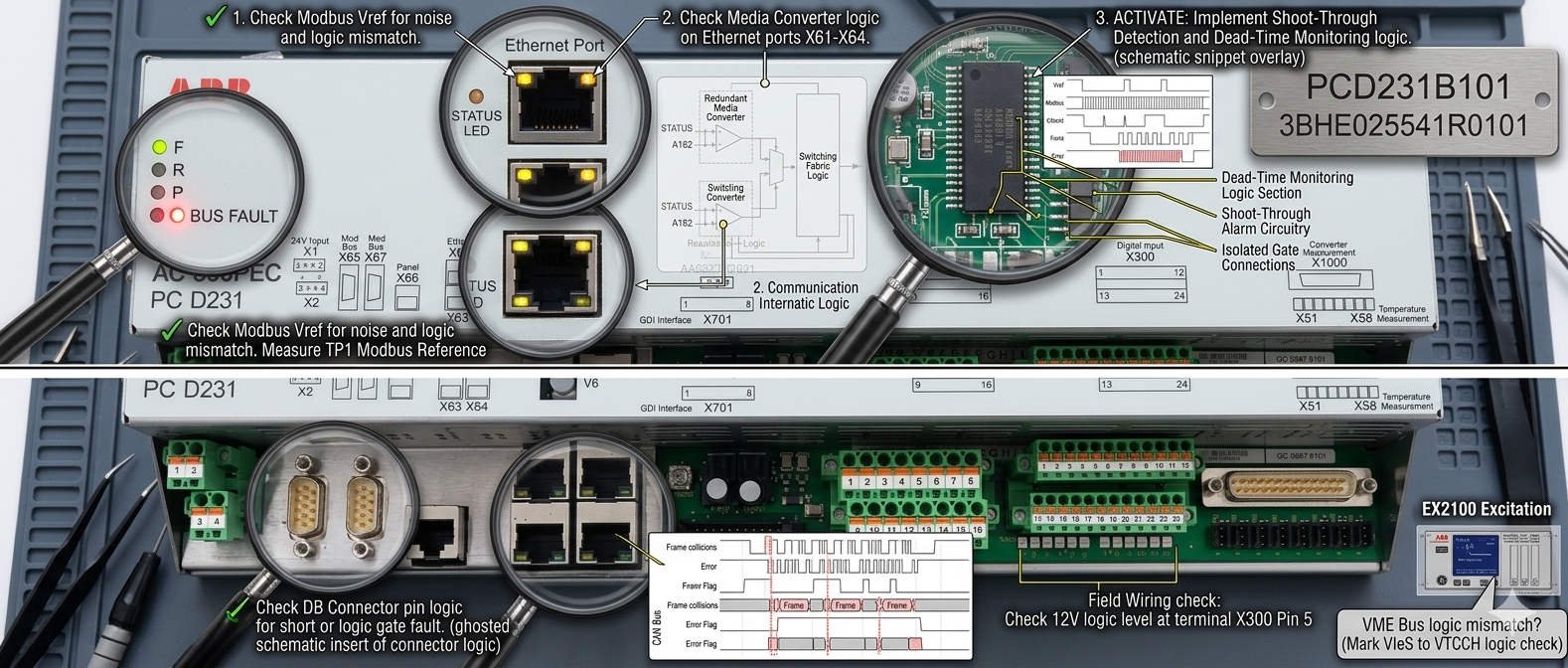
Troubleshooting PCD231B101 3BHE025541R0101 Bus Faults
PCD231B101 3BHE025541R0101 Address Switch Misconfiguration: Diagnosing Resulting Bus Faults
In high-availability **industrial automation**, precise node identification prevents costly unexpected operational downtime. The ABB PCD231B101 3BHE025541R0101 communication interface board manages vital data exchange. However, engineers frequently misconfigure its physical DIP address switches during routine maintenance. Instead of triggering a straightforward hardware alarm, this mistake introduces complex communication-layer bus faults. This technical article analyzes the specific system errors, underlying principles, and corrective measures for this scenario.

Troubleshooting PCD231B101 3BHE025541R0101 Bus Faults_
The Functional Role of the PCD231B101 Interface Board
The PCD231B101 3BHE025541R0101 acts as a high-speed communication link inside specialized ABB control architectures. It facilitates deterministic data traffic between central control processors, I/O networks, and excitation subsystems. Consequently, the board ensures real-time variable processing for large-scale power generation and **factory automation** applications. Its core electronics rely on steady hardware node addressing to execute synchronous data schedules flawlessly. Therefore, any compromise in address validity disrupts the entire communication sub-network architecture.
Principles of Bus Arbitration and Node Collision
The on-board DIP switches establish the logical binary identity of the interface module on the backplane. When a technician sets identical node addresses on two separate boards, a bus collision occurs immediately. The master **DCS** or controller cannot distinguish between the data streams during cyclic arbitration periods. As a result, the control system registers token-passing failures and communication link errors. This node conflict often causes the processor to isolate the entire local communication rack to protect process safety.
Typical System Alarms and Operational Consequences
Address misconfigurations generate diverse error signatures across different generations of ABB software utilities. Technicians routinely observe “Node Address Conflict” or “CIU Bus Fault” alerts on operator workstations. Moreover, these addressing errors frequently block proper fieldbus startup sequence completion during cold system boots. In redundant setups, incorrect switch positioning halts CPU synchronization entirely, disabling vital backup channels. The following structural matrix outlines the typical error profiles recorded during field troubleshooting operations:
| Fault Type | Typical System Indication | Operational Impact |
|---|---|---|
| Address Conflict | “Node Address Conflict” | Communication instability |
| Bus Timeout | “Communication Timeout” | Cyclic data interruption |
| Missing Node | “Slave/Node Not Responding” | I/O data loss |
| Bus Init Failure | “Fieldbus Startup Failed” | System startup blocked |
| Redundancy Error | “Redundant Link Failure” | Backup channel unavailable |
Impact on Long-Term Communication Loop Stability
A misplaced DIP toggle does not always cause an immediate total hardware shutdown sequence. Instead, marginal binary settings create intermittent signal degradation that remains hidden during normal baseline operations. The communication network constantly retries failed packets, which spikes the overall processor bus load dramatically. Consequently, operator screens experience sluggish update rates, and high-speed turbine excitation loops display transient instability. Over time, these continuous re-initialization cycles strain the module microprocessor components, shortening physical lifecycle expectations.
Key Differences and Hardware Selection Criteria
When engineering a network expansion, users must differentiate between firmware-dependent variants of the PCD231B101. Newer production revisions support broader address ranges and advanced telemetry diagnostics within unified **control systems**. Older legacy iterations, however, lack sophisticated packet filtering, rendering them vulnerable to adjacent node electrical noise. Buyers must cross-reference exact hardware revision suffixes against existing system topology sheets before ordering. Choosing mismatched revisions often causes initialization failures, even if the physical switch positions match perfectly.
Rigorous Field Testing and Maintenance Protocols
- ✅ Orientation Audit: Always verify the physical LSB/MSB direction against the official hardware schematic manual.
- ⚙️ Pre-Power Validation: Photograph and document the switch array layout prior to inserting new spare modules.
- 🔧 Segment Isolation: Avoid inserting modules with factory-default parameters directly onto an active, running control bus.
Strategic Perspectives from Powergear X Automation Limited
At Powergear X Automation Limited, our field engineering data confirms that human error drives most communication failures. Approximately 35% of post-turnaround bus alarms arise from incorrect physical configuration settings on hardware interfaces like the PCD231B101 3BHE025541R0101. We strongly recommend implementing formal check-sheets dedicated exclusively to DIP switch verification before rack power-up. If you require genuine, fully tested replacement components or expert technical integration advice, connect with us at https://www.powergearx.com/.
Industrial Application and Solution Scenario
In a thermal power plant, a sudden watchdog timeout on a turbine generator excitation system can trigger an immediate emergency shutdown. During a recent maintenance turnaround, a team inadvertently installed a replacement board with its address offset by one bit position. This error immediately caused intermittent packet dropping across the critical control network. By following a structured isolation protocol, engineers traced the issue directly to the physical hardware switches on the module. Correcting the binary sequence quickly restored full redundancy synchronization without further hardware investment.
Frequently Asked Questions (FAQ)
1. Why does a misconfigured board pass bench tests but fail inside the main control cabinet?
Bench test fixtures usually run isolated, single-node routines that do not check for node collisions. Once you place the module into a complex production network, conflicting target addresses immediately trigger arbitration errors.
2. Can high electrical noise mimic a physical DIP switch malfunction?
Yes. Severe electromagnetic interference around large motor enclosures can distort the address lines on the backplane carrier. This distortion causes the main controller to read corrupted address values intermittently.
3. How can I clear a persistent address fault after fixing the physical switch settings?
Most communication modules read their hardware address switches only during initial startup. Therefore, you must perform a complete power cycle on the module rack to force the board to register the updated configuration.