
ABB KUC711AE101 Watchdog Reset Diagnosis | Powergear X
Resolving ABB KUC711AE101 Watchdog Resets in Critical DCS Environments
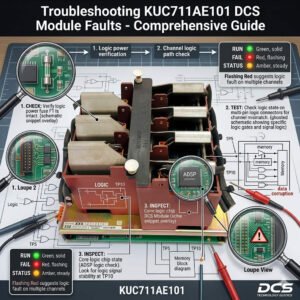
Repeated watchdog reset events on the ABB KUC711AE101 processor module rarely indicate a simple hardware failure. In actual factory automation environments, these faults stem from underlying system instability. For instance, severe backplane communication noise, abnormal power supply ripples, or cyclic task overloads often trigger the integrated watchdog mechanism. In continuous-process industries like petrochemical and thermal power plants, uncontrolled resets disrupt critical operations. Therefore, automation engineers must capture the system log error chain before the system overwrites the reboot history.
Troubleshooting KUC711AE101 DCS Module Faults_
Understanding the Watchdog Mechanism and Core Value
The KUC711AE101 module functions within high-availability distributed control systems (DCS) that require strictly deterministic task execution. Its internal watchdog circuit continuously monitors software health to prevent firmware deadlocks and cyclic execution overruns. When a software loop hangs or a task freezes, the watchdog timer expires and forces a hardware reset. This action protects the overall control systems from unpredictable behavior. However, blind module replacement without log verification usually fails to solve the root problem.
Decoding Watchdog Timeout Event Codes
The first diagnostic priority requires isolating the exact software timeout signature within the system buffer. Engineers must scan the error logs specifically for the following technical indicators:
- WDOG_TIMEOUT: Confirms the hardware watchdog timer expired before receiving a software clear signal.
- TASK_OVERRUN: Indicates a cyclic execution loop failed to complete within its allocated time slice.
- CPU EXECUTION TIMEOUT: Points to a high-priority firmware routine blocking the operating system scheduler.
- KERNEL PANIC / RTOS SCHEDULER ERROR: Signals a fatal crash within the real-time operating system kernel.
At Powergear X Automation Limited, our field data indicates that excessive Modbus polling frequencies or sudden OPC server traffic bursts typically cause these overruns. If the total cyclic scan load exceeds 80% for extended periods, the operating system inevitably drops lower-priority maintenance tasks and triggers a safety reset.
Analyzing Backplane and Communication Errors
Communication-layer instability frequently forces the processor into prolonged fault-handling routines that look like CPU failures. During troubleshooting, engineers must look for specific communication codes such as BACKPLANE BUS ERROR, I/O BUS TIMEOUT, and DMA ACCESS ERROR. In aging industrial automation cabinets, contact oxidation or constant machine vibration creates microsecond-level connection breaks. Consequently, the controller firmware consumes vital processing cycles trying to re-establish the connection, which ultimately causes a watchdog timeout.
Identifying Power Supply and Firmware Integrity Flaws
Transient power quality issues represent another major cause of unexpected processor resets. Industrial facilities operating large variable frequency drives (VFDs) often introduce severe voltage distortions into the 24 VDC distribution lines. Standard multimeters cannot capture these ultra-fast power drops, yet they easily corrupt local memory operations. If the system log records POWER FAIL DETECTED, FLASH CHECKSUM ERROR, or MEMORY PARITY ERROR, you must inspect the power infrastructure. Furthermore, mismatched firmware revisions between the CPU and communication modules often cause internal scheduling conflicts.
Best Practices for Field Maintenance and Data Preservation
Successful root-cause analysis depends entirely on preserving volatile diagnostic buffers before cycling the cabinet power. Many legacy architectures overwrite vital first-occurrence data during a cold restart. Therefore, maintenance teams should always export the full system log history and correlate timestamps with concurrent plant events. Additionally, technicians must check cabinet cooling systems, clean accumulated dust, and optimize communication scan intervals. Moving non-critical data polling from 100 ms to 500 ms often stabilizes a struggling controller immediately.
Industrial Application Scenario
Consider a large-scale chemical dosing facility experiencing random controller failovers during high-load production shifts. The plant engineering team initially blamed defective hardware and replaced the central processor multiple times. However, the unexpected resets continued to disrupt the automated batch sequencing. Analysts from Powergear X Automation Limited evaluated the system logs and discovered repeated TASK_OVERRUN codes coupled with backplane communication retries. The true culprit was an aggressive third-party data historian polling the controller via OPC at an unsustainable rate. By segregating the historian traffic onto a dedicated VLAN and adjusting the update intervals, the team restored total system stability without buying new hardware.
Frequently Asked Questions
Q: How can I distinguish between a genuine internal hardware failure and an externally induced watchdog reset on the KUC711AE101?
A: Look closely at the diagnostic error codes. If the logs consistently show FLASH CHECKSUM ERROR, MEMORY PARITY ERROR, or failure during the power-on self-test (POST), the physical memory or internal circuitry is damaged, requiring module replacement. If the logs show TASK_OVERRUN or BUS TIMEOUT, the hardware is functional, and external factors like software loops or network congestion are causing the crash.
Q: Why do watchdog resets occur frequently during the startup of heavy plant machinery like pumps or compressors?
A: Large motors draw massive inrush currents that can cause transient voltage drops and high-frequency harmonic noise on shared 24 VDC power lines. These microsecond power fluctuations disrupt the controller’s RAM operations, causing firmware corruption that triggers an automatic safety reset. You can resolve this by installing dedicated isolation dodes and verifying the power supply’s transient response.
Q: Will upgrading the KUC711AE101 module firmware automatically solve intermittent watchdog timeouts?
A: Not necessarily. While a firmware upgrade can patch known scheduling bugs and optimize memory management, it increases the processing overhead if the underlying cause is a physical communication issue or an overloaded task configuration. You must resolve backplane noise and optimize your application task execution periods before relying on a firmware update.
For more technical documentation, high-quality replacement modules, and expert engineering support for your industrial control systems, please visit the official website of Powergear X Automation Limited.