Over 50,000 hot-selling automation module components.

Step-by-Step Setup Guide for Allen-Bradley PowerFlex 40P AC Drives in Industrial Automation

Step-by-Step Setup Guide for Allen-Bradley PowerFlex 40P AC Drives in Industrial Automation

Welcome, fellow engineers! This practical guide walks you through setting up Allen-Bradley PowerFlex 40P AC Drives, sharing hands-on insights for efficient commissioning in industrial systems.

Understanding the PowerFlex 40P: My Perspective

The PowerFlex 40P delivers exceptional balance between features and simplicity. Its sensorless vector control and compact design make it ideal for applications requiring precise speed control without encoder feedback, especially where panel space is limited.

Essential Pre-Installation Checks

Critical preparations before wiring:

  • Power Verification: Confirm voltage/current ratings match supply – check nameplate to prevent damage
  • Environment: Ensure clean, dry, cool location – avoid dust, moisture and excessive heat
  • Motor Compatibility: Verify motor HP, voltage, and current ratings match drive capabilities

Wiring the PowerFlex 40P: Practical Tips

Power Wiring (L1/L2/L3 to T1/T2/T3):
Use oversized wires for better current handling and heat dissipation. Connect AC power to L terminals and motor to T terminals.

Control Wiring:

  • Separate control wires from power cables to prevent noise interference
  • Always use shielded cables for analog signals

Grounding Protocol:
Connect ground terminal directly to earth ground – critical for safety and noise reduction.
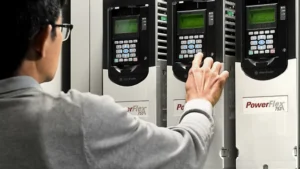
Allen-Bradley PowerFlex 40P Frequency Drive

Basic Configuration and Parameter Setup

Initial Power-Up:
After securing connections, apply power – keypad should illuminate.

Motor Data Entry:
Set these parameters precisely from motor nameplate:

  • P031 [Motor NP Volts]
  • P033 [Motor NP Amps]
  • P034 [Motor NP Freq]
  • P035 [Motor NP RPM]

Control Source Selection:
Configure A041 [Start Source A] for keypad (initial testing), digital inputs (PLC), or analog input.

Speed Reference Scaling:
For analog inputs:

  • Set P038 [Analog Input 1 Sel]
  • Scale with A051 [Anlg In1 Scale Lo] and A052 [Anlg In1 Scale Hi]

Advanced Considerations and Troubleshooting

Auto-Tune Optimization:
Execute P040 [Motor Auto Tune] to measure motor characteristics for peak performance.

Acceleration/Deceleration:
Balance P044 [Accell Time 1] and P045 [Decel Time 1] to avoid trips or sluggish operation.

Fault Management:
Interpret common codes – address root causes of overcurrent, overvoltage, and ground faults.

Preventive Maintenance:

  • Keep cooling fins dust-free
  • Regularly check terminal tightness

Conclusion: Empowering Your Industrial Automation

Mastering PowerFlex 40P setup requires attention to wiring detail, accurate parameter entry, and proactive troubleshooting – essential skills for robust automation systems.

Ready to upgrade your industrial control systems? Click here to explore Allen-Bradley PowerFlex 40P AC Drives and automation solutions from Powergear X Automation Limited.
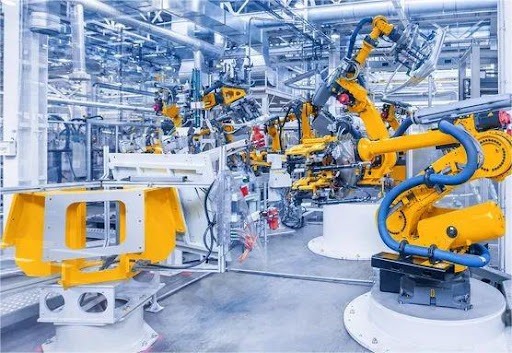
China’s Industrial Outlook: Global Leader’s Optimistic View

Future Outlook: Opportunities and Challenges for Automation Engineers

China’s industrial outlook is optimistic, with continued technological integration and increased demand for automation engineers. Opportunities in robotics, AI, and smart manufacturing are expanding as the industry evolves. Professionals must stay updated with the latest trends and continuously enhance their skills to remain competitive.

Technological Advancement: Core Driver of Industrial Automation

China Industry heavily invests in technological progress, particularly in industrial automation. The adoption of robotics and AI significantly boosts production efficiency. Widespread digitalization enhances product quality and reduces costs, making it essential for automation engineers to continuously learn and adopt new technologies to provide efficient solutions.

Industry Perspective: Balanced Development and Continuous Innovation

Despite the prevailing optimism, there is intense competition and a constant need for innovation in China’s manufacturing sector. Automation engineers must address these challenges by driving innovation and remaining competitive. Solving complex problems and collaborating across various fields are crucial for fostering industrial progress.

Infrastructure and Policy: Key Elements Supporting Industrial Growth

China’s robust infrastructure and favorable government policies significantly support industrial development. Efficient logistics systems attract investment and drive innovation. It is essential for automation engineers to understand these policies deeply, as they play a critical role in optimizing systems and promoting upgrades within the industry.

Market Confidence: China’s Strengths and Potential

Global industry leaders express rising confidence in China’s manufacturing sector, driven by its strong industrial base and significant growth potential. China’s pivotal role in the global supply chain attracts substantial investment, while the large market and consumer demand present vast opportunities. Automation engineers need to grasp these dynamics to effectively provide technical support and solutions.

Check below popular items for more information in PowergearX Technology.

ModelTitleLink
22D-D010F104Allen-Bradley AC Drive PowerFlex 40PLearn More
22D-D010H204Allen-Bradley AC Drive PowerFlex 40PLearn More
22D-D012F104Allen-Bradley AC Drive PowerFlex 40PLearn More
22D-D012H204Allen-Bradley AC Drive 5.5 kW / 7.5 HPLearn More
22D-D012N104Allen-Bradley AC Drive PowerFlex 40P 480V ACLearn More
22D-D017F104Allen-Bradley AC Drive PowerFlex 40PLearn More
22D-D017H204Allen-Bradley AC Drive PowerFlex 40PLearn More
22D-D017N104Allen-Bradley AC Drive PowerFlex 40PLearn More


A Comparison of CompactLogix vs. ControlLogix Processors

A Comparison of CompactLogix vs. ControlLogix Processors

Introduction to CompactLogix and ControlLogix Processors

Allen-Bradley’s CompactLogix and ControlLogix processors are key players in industrial automation systems. While both offer robust control solutions, they cater to different applications based on system complexity and size. Let’s explore their unique features to better understand which suits your needs.

A Comparison of CompactLogix vs. ControlLogix Processors

CompactLogix: A Compact Solution for Smaller Applications

CompactLogix processors are known for their versatility and cost-efficiency. Available in modular and all-in-one formats, they are well-suited for small to medium applications. Popular models include the L23, L30ER, and L35X. These controllers are designed to be ready for immediate use, with features like a built-in SD card slot, USB port, and embedded supercapacitor.

The ControlLogix: Built for Complex, High-Demand Systems

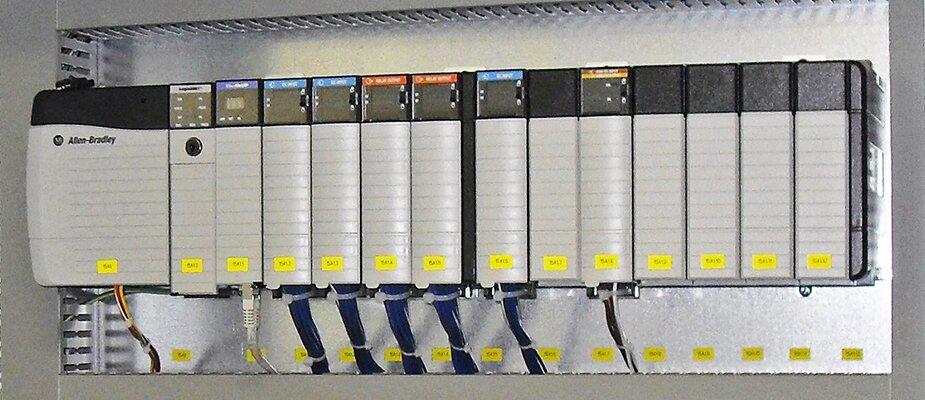
The ControlLogix series, originally released in 1999, is designed for larger, more intricate systems. These modular controllers provide expanded scalability with a power supply, processor, chassis, and communication modules. As the platform has evolved, newer models like the 5580 series offer significantly faster processing and enhanced communication capabilities, making them ideal for high-performance applications.

A Comparison of CompactLogix vs. ControlLogix Processors

Key Differences in Memory and Communication

Memory capacity is one of the most notable differences between these two families. The ControlLogix 5580 boasts up to 20 MB of user memory, while the CompactLogix 5380 reaches a maximum of 10 MB. Both processors offer enhanced communication options, including high-speed Ethernet and USB ports, but the ControlLogix 5580 provides up to 1 Gbps Ethernet, significantly improving communication speed.

Performance Enhancements in Newer Models

The latest CompactLogix 5380 and ControlLogix 5580 models offer substantial upgrades in performance. The CompactLogix 5380 comes with a 1 Gbps Ethernet port and improved memory, while the ControlLogix 5580 outperforms earlier models with its increased speed and memory capacity. The ControlLogix 5580 offers an impressive 20 times faster program scanning compared to previous versions.

A Comparison of CompactLogix vs. ControlLogix Processors

Comparison Table: CompactLogix vs. ControlLogix

FeatureControlLogix 5580ControlLogix 5570CompactLogix 5380CompactLogix 5370 L3
Controller Tasks32/1000 programs/task32/1000 programs/task32/1000 programs/task32/1000 programs/task
User Memory3 MB to 20 MB + 6 MB safety2 MB to 8 MB + 4 MB safety0.6 MB to 10 MB + 5 MB safety1 MB to 5 MB + 1.5 MB safety
Built-in PortsSingle-port Ethernet (1 Gbps)Dual-port Ethernet (100 Mbps)2 Ethernet ports (1 Gbps)Dual-port Ethernet (100 Mbps)
Communication OptionsEtherNet/IP, ControlNet™, DeviceNet™, USBEtherNet/IP, ControlNet™, DeviceNet™, USBEtherNet/IP, USBEtherNet/IP, USB
Controller ConnectionsNot Applicable500 ConnectionsNot Applicable256 Connections

Choosing the Right Processor for Your System

When selecting between CompactLogix and ControlLogix, consider your system’s size and complexity. For smaller systems with moderate I/O, CompactLogix offers a cost-effective, reliable option. On the other hand, for large-scale, high-performance applications, ControlLogix provides more robust capabilities and scalability.

Back to Top
Product has been added to your cart