
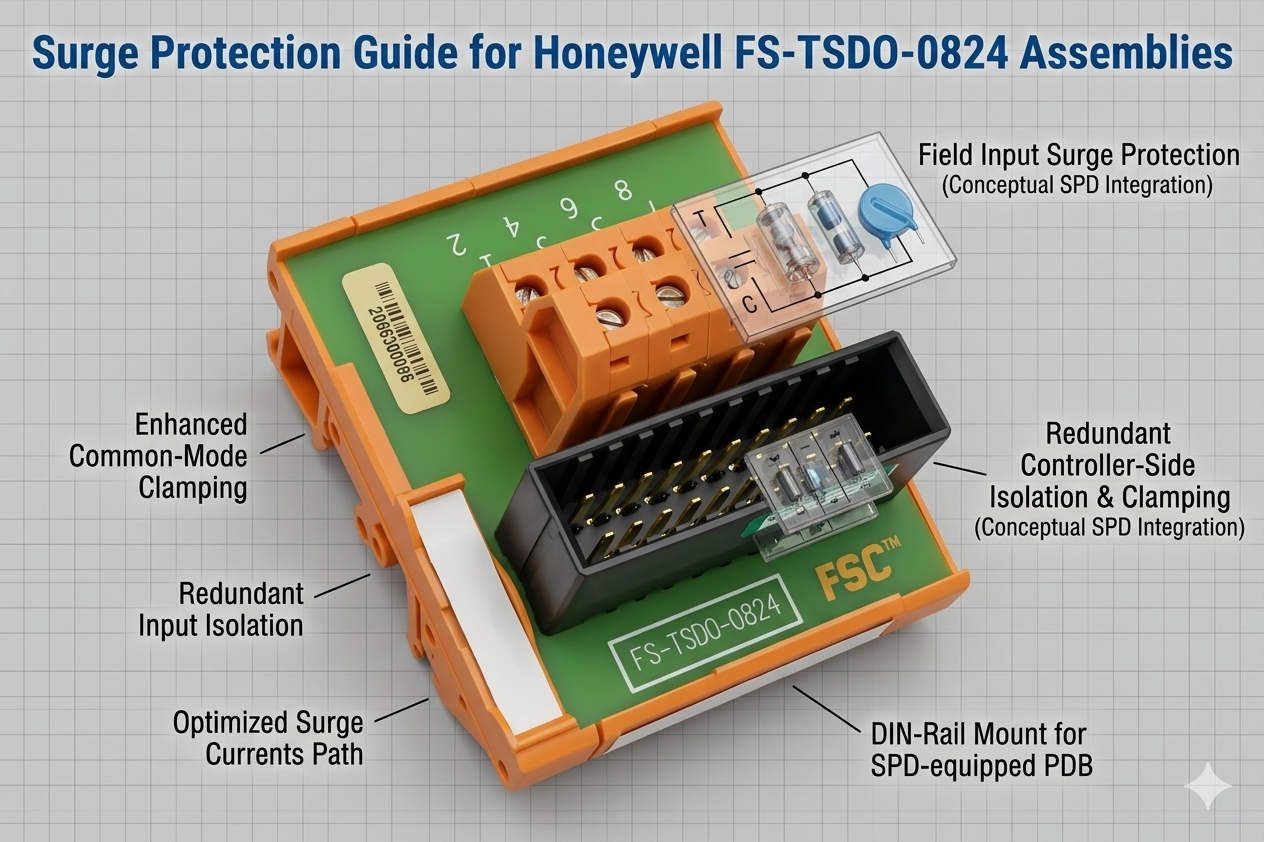
Strategic Surge Protection for Honeywell FS-TSDO-0824 Digital Output Termination Assemblies
Maximizing Reliability in Honeywell Safety Manager Architectures
The Honeywell FS-TSDO-0824 serves as a critical interface for digital output signal termination. In high-stakes environments like petrochemical plants and offshore platforms, signal integrity remains paramount. This termination assembly ensures stable communication between safety controllers and field actuators. However, the unit does not feature built-in surge suppression modules by default. Engineers must therefore evaluate external protection strategies to safeguard expensive I/O hardware from electrical transients.
Surge Protection Guide for Honeywell FS-TSDO-0824 Assemblies
The Vital Role of Surge Mitigation in Process Automation
In modern industrial automation, transient voltage spikes represent a significant threat to control system uptime. Lightning strikes or large motor switching operations often induce high-energy surges into field wiring. These events can cause immediate hardware destruction or latent insulation degradation. Adding external Surge Protection Devices (SPD) effectively shields the FS-TSDO-0824 from inductive kickback. Consequently, facility managers see a marked reduction in unplanned shutdowns and hardware replacement costs.
Technical Considerations for External SPD Integration
Successful SPD integration requires more than just physical installation. Engineers must verify that the clamping voltage aligns with the digital output card’s tolerance. Moreover, leakage current from the SPD must remain below the field device’s threshold. High leakage can lead to “false-on” states, where valves fail to close during safety demands. Based on industry reports from MarketsandMarkets, the demand for high-reliability surge suppression is growing at a CAGR of over 5% due to increasingly sensitive electronic components.
Optimizing Grounding Infrastructure for Transient Suppression
Surge protection effectiveness depends heavily on the quality of the grounding architecture. A high-impedance ground path renders even the most advanced SPD useless. In Honeywell safety cabinets, installers should prioritize short, direct grounding conductors. Ideally, these leads should measure less than 0.5 meters. Furthermore, separate instrument grounds from power grounds to prevent noise injection. According to IEC 61643 standards, maintaining low grounding impedance is essential for diverting transient currents safely away from the FS-TSDO-0824 channels.
Managing Inductive Loads and Back-EMF Challenges
Digital outputs frequently drive inductive components like solenoid valves and interposing relays. When these loads de-energize, they generate a reverse electromotive force (Back-EMF) spike. Without proper suppression, these spikes erode relay contacts and stress electronic drivers. For DC systems, flyback diodes or TVS suppressors provide excellent protection. For AC circuits, RC snubber networks effectively reduce arcing. Implementing these layered defenses extends the operational lifespan of the termination assembly significantly.
Expert Recommendations from Powergear X Automation Limited
At Powergear X Automation Limited, we believe surge protection is a non-negotiable insurance policy for outdoor field wiring. Our field experience indicates that most I/O failures in coastal refineries stem from inadequate transient management. We recommend installing SPDs at the cabinet entry point to intercept surges before they reach internal modules. While the initial investment may seem high, the long-term savings in MTTR (Mean Time To Repair) provide a clear return on investment for any factory automation project.
Selection Guide and Practical Implementation Steps
When selecting surge protection for the FS-TSDO-0824, follow these critical steps:
- ✅ Identify the signal voltage level (typically 24VDC for Safety Manager outputs).
- ✅ Verify the hazardous area classification (Ex-i or non-sparking requirements).
- ✅ Ensure the SPD response time is fast enough to protect high-speed digital logic.
- ✅ Choose DIN-rail mounted units for easier maintenance and status monitoring.
Industrial Solution Scenarios
- Refinery Tank Farms: Long-distance outdoor cables are highly susceptible to lightning; SPDs are mandatory here.
- Chemical Loading Stations: Frequent motor and pump starts create high electrical noise; layered suppression prevents signal jitter.
- Offshore Platforms: The saline environment increases corrosion; use SPDs with hermetically sealed housings and reliable status indicators.
Frequently Asked Questions (FAQ)
Q: Does adding an external SPD affect the SIL rating of a safety loop?
Technically, adding components can affect loop calculations. However, most passive SPDs have negligible failure rates. You should consult your safety functional engineer to ensure the SPD does not introduce unacceptable delay or leakage into the loop.
Q: How often should we inspect surge protectors on Honeywell systems?
We recommend an annual visual inspection and a continuity check after every major thunderstorm season. If the MOV (Metal Oxide Varistor) indicator shows thermal discoloration, replace the module immediately to maintain protection.
Q: Can I use one SPD for multiple digital output channels?
No, this is not recommended. Each output channel should have its own dedicated protection path to prevent cross-talk and ensure that a fault in one field device does not compromise the entire termination assembly.
Discover more technical solutions and high-quality parts at the official Powergear X Automation Limited website for your next project.