Will a Broadcast Storm on One Port of the GE IS420ESWBH1A Affect Other I/O Packs?
In the framework of modern industrial automation, network stability determines control system reliability. The GE IS420ESWBH1A is a premium managed Ethernet switch designed for Mark VIe control platforms. A common concern among facility engineers involves localized Layer 2 network faults. Specifically, will a broadcast storm alarm on a single port degrade the remaining nodes? This article explores how this switch manages traffic congestion to protect critical turbine operations.

The Functional Role of the IS420ESWBH1A in IONet Architectures
The IS420ESWBH1A serves as a communication backbone within the proprietary GE IONet infrastructure. It facilitates deterministic, low-latency data exchange between controllers and distributed I/O packs. Unlike standard commercial hardware, this industrial switch prioritizes time-sensitive Ethernet Global Data (EGD) traffic. Consequently, it maintains precise control loop synchronization in high-availability environments. Its ruggedized layout ensures dependable performance inside harsh power plant marshalling cabinets.
The Principle of Broadcast Storm Propagation Across Control Networks
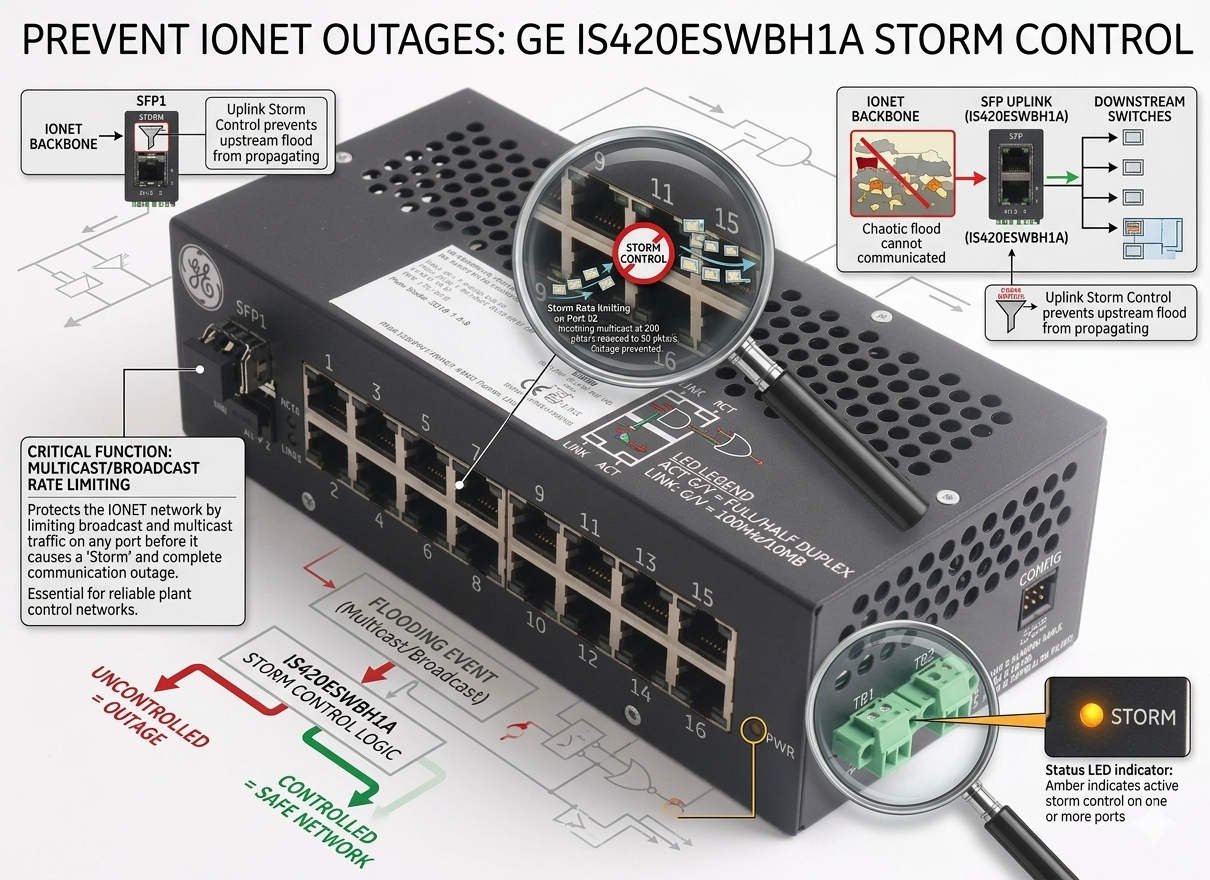
A broadcast storm occurs when excessive Layer 2 broadcast or multicast traffic floods a network segment. In factory automation, this issue typically stems from physical loops or misconfigured engineering laptops. If left unchecked, the redundant data packets saturate available switch fabric bandwidth rapidly. As a result, critical control nodes may suffer from increased packet latency or synchronization loss. Therefore, traffic suppression metrics are essential to keep network loading within deterministic boundaries.
Although the IS420ESWBH1A incorporates hardware-level storm control, severe floods can still impact performance indirectly. If unmanaged switches or external OPC gateways bridge into the IONet improperly, the switch processor consumes heavy resources. This resource drain can induce sporadic I/O communication timeouts during transient turbine startup windows. Statistics from power industry network audits indicate that improper network bridging causes nearly 35% of unexpected control dropouts.
Managed Architecture Advantages Over Unmanaged Switches
The managed capabilities of the IS420ESWBH1A provide distinct protection advantages over basic unmanaged alternatives. It features port-level rate limiting, traffic segmentation, and comprehensive event logging. These internal diagnostics allow maintenance teams to isolate abnormal data traffic before it spreads widely. Furthermore, the switch identifies the specific port generating the rogue traffic. This precise targeting minimizes diagnostic troubleshooting time during critical facility plant turnarounds.
Selection Considerations and Backward System Compatibility
Integrating the IS420ESWBH1A into older Mark VI or early Mark VIe systems requires careful planning. While the hardware physical footprint remains standard, complete functionality depends on active firmware compatibility. Engineers must verify the active software revision within ToolboxST before deploying a replacement module. Incorrect port speed autonegotiation settings on legacy I/O racks can cause intermittent link dropping. Therefore, choosing matching firmware revisions protects network fabric integrity.
Field Optimization Protocols for Control System Networks
- ✅ Topology Verification: Inspect network cabling thoroughly during plant outages to detect accidental physical loops.
- ⚙️ Traffic Monitoring: Review switch port counters and CRC error logs before replacing suspected I/O packs.
- 🔧 IT/OT Segmentation: Isolate the real-time IONet strictly from the business LAN using secure industrial firewalls.
Expert Technical Assessment from Powergear X Automation Limited
At Powergear X Automation Limited, we emphasize that network hygiene is foundational to robust DCS performance. Connecting commercial IT equipment directly to a turbine control network introduces unpredictable multicast discovery noise. We highly recommend disabling all unused switch ports to prevent unauthorized field connections. If your team is planning a network infrastructure audit or requires verified hardware replacements, explore our catalog at https://www.powergearx.com/ for certified industrial components.
Real-World Application Scenarios
In combined-cycle gas turbine installations, the IS420ESWBH1A manages data from hundreds of critical sensors. During a recent field incident, a faulty third-party HMI flooded a port with duplicate ARP requests. Because the switch had active storm suppression enabled, it throttled the rogue traffic immediately. This quick action preserved the main EGD link, preventing a full generator trip. This scenario underscores the value of using purpose-built managed switches over commercial alternatives.
Frequently Asked Questions (FAQ)
1. Why does an engineering laptop cause a storm alarm when connected to the switch?
Standard laptops often run background network discovery protocols that emit continuous multicast packets. When connected directly to the sensitive IONet fabric, this traffic bursts appear as a dangerous storm condition to the switch logic.
2. Can I replace a legacy unmanaged switch directly with the IS420ESWBH1A?
Yes, but you must configure the managed parameters to align with the GE network specification. Simply plugging it in without loading the correct configuration profile may disable advanced features like rate limiting.
3. How can we differentiate between a hardware failure and a network traffic issue?
Look at the diagnostic logs. If multiple I/O packs drop offline simultaneously while reporting high CRC counts, the root cause is almost certainly network traffic saturation rather than a sudden, concurrent hardware component breakdown.