
Over 50,000 hot-selling automation module components.
ABB CI630 Communication Interface: Optimizing Advant OCS Networks

ABB CI630 Communication Interface: Optimizing Advant OCS Networks

Enhancing Connectivity in Advant OCS Systems: The Essential Role of the ABB CI630 Communication Interface

Establishing Stable Data Highways in Industrial Automation

The ABB CI630 communication interface module functions as a critical bridge within the Advant OCS architecture. It facilitates high-speed, deterministic data exchange between controllers, such as the AC450 or AC460, and remote I/O systems. In sectors like power generation and petrochemicals, reliable communication remains a top priority. Consequently, the CI630 ensures that field data reaches the Distributed Control System (DCS) without interruption or corruption.
ABB CI630 Communication Interface: Optimizing Advant OCS Networks

Seamless Integration via MasterBus and Advant Fieldbus Protocols

The CI630 natively supports ABB proprietary protocols, including MasterBus 300 and Advant Fieldbus. This compatibility allows engineers to integrate legacy hardware with modern nodes without costly system overhauls. Moreover, these protocols provide a deterministic environment, which is vital for closed-loop regulation and safety-critical tasks. Choosing the wrong interface for third-party hardware often leads to latency or complete communication failure. Therefore, verifying the network topology remains an essential first step in any system upgrade.

Impact of Response Time on Process Control Precision

Communication refresh rates directly dictate the effectiveness of the entire DCS scanning cycle. For high-speed processes like combustion control or chemical reactions, every millisecond matters. Lower latency results in faster alarm triggers and more stable PID performance. However, high bus loads can cause jitter, leading to intermittent control fluctuations. Many technicians mistakenly blame PID parameters for stability issues when the root cause is actually bus congestion managed by the interface module.

Engineering Resilience Against Harsh Industrial Environments

Modern factory automation requires hardware that survives extreme conditions. The CI630 design emphasizes high Electromagnetic Compatibility (EMC) and temperature resistance. It reduces bit error rates in high-interference zones like power substations. As a result, the system experiences fewer packet retransmissions and less unplanned downtime. Despite its robust build, we recommend using shielded cables and proper grounding when installing modules near variable frequency drives (VFDs) to maintain peak signal integrity.

Best Practices for Installation and Maintenance

Data suggests that over 60% of communication faults stem from improper grounding and environmental factors. To ensure long-term reliability, follow these technical guidelines:

  • Grounding Management: Implement single-point grounding to prevent ground loops.
  • Shielding Integrity: Ensure the communication cable shield connects firmly at the control cabinet side.
  • Cable Routing: Maintain a minimum clearance of 20–30 cm between communication and power lines.
  • Mechanical Security: Use DIN rail clamps and locking terminals in high-vibration areas like compressor stations.
  • Surge Protection: Install dedicated Fieldbus surge arresters for long-distance outdoor communication links.

Expert Commentary from Powergear X Automation Limited

At Powergear X Automation Limited, we believe the CI630 is more than a spare part; it is a vital asset for lifecycle management. While ABB has moved many Advant modules into later lifecycle phases, the CI630 remains a preferred choice for bridging existing infrastructure toward the 800xA platform. We often observe that “intermittent” faults are usually symptoms of aging infrastructure rather than module failure. Thus, a proactive replacement strategy for mission-critical nodes is highly recommended to avoid catastrophic production losses.

Real-World Application Scenarios

  • Petrochemical Refining: Ensuring synchronized data across multiple AC450 controllers for complex distillation processes.
  • Utility Power Plants: Providing redundant communication paths to maintain turbine control during electrical transients.
  • Continuous Manufacturing: Reducing Mean Time to Repair (MTTR) by using hot-swappable communication interfaces in active loops.

Frequently Asked Questions (FAQ)

Q: How do I know if my CI630 module requires an immediate firmware update?
If you are introducing newer AC400 series controllers into an older network, firmware mismatches often cause synchronization errors. Check the revision history; if your module is several versions behind, it may not support the latest redundancy protocols required for modern DCS stability.

Q: Can the CI630 be replaced while the system is powered on?
While the hardware may support physical insertion, we advise caution. In redundant configurations, you must verify that the secondary module has taken full control of the bus before removal. Performing a “hot standby test” during scheduled maintenance is the safest way to validate this capability.

Q: What is the most effective way to troubleshoot “Communication Timeout” errors?
Start by checking the bus terminator resistance. A missing or damaged terminator causes signal reflection. If the physical layer is intact, use a protocol analyzer to check for high bus utilization rates. Often, adding too many nodes to a single CI630 interface exceeds its optimal processing capacity.

For high-quality ABB components and expert technical support, visit the official Powergear X Automation Limited website to secure your industrial supply chain.

Siemens vs. Rockwell PLC: Selecting the Right Automation System

Siemens vs. Rockwell PLC: Selecting the Right Automation System

Strategic Comparison: Siemens vs. Rockwell PLC Systems in Industrial Automation

The Core Value of Leading Control Systems

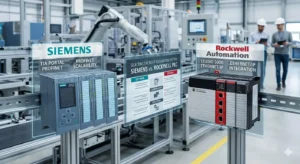
Siemens excels in complex scenarios requiring high system integration, such as automotive and chemical manufacturing. Its TIA Portal architecture significantly reduces cross-system debugging costs for large-scale projects. Conversely, Rockwell (Allen-Bradley) dominates the North American market and discrete manufacturing sectors. Rockwell offers a more intuitive learning path for beginners entering the PLC programming field. Therefore, Siemens provides global versatility, while Rockwell ensures rapid deployment for standardized production lines.

Siemens vs. Rockwell PLC: Selecting the Right Automation System

Programming Environments: TIA Portal vs. Studio 5000

The Siemens TIA Portal integrates PLC, HMI, and drives into a single unified platform. This integration eliminates frequent software switching and boosts overall engineering efficiency. Rockwell utilizes a modular approach with Studio 5000 and FactoryTalk separated into different packages. This separation helps beginners master individual functions but increases complexity during full system integration. Based on our field experience, Siemens allows direct variable linking, whereas Rockwell often requires manual tag configuration.

Optimizing Scan Time and System Response

Siemens S7-1200 and S7-1500 controllers maintain exceptional stability under heavy program loads. Rockwell CompactLogix systems provide highly responsive performance for smaller, high-speed applications. Precise scan times are vital for accurate motion control in packaging and robotics. However, improper task priority configuration in Rockwell systems can lead to cycle jitter. Siemens employs a default cyclic structure that is often more forgiving for less experienced programmers.

Industrial Communication Protocol Compatibility

Siemens natively supports PROFINET and Profibus, featuring mature OPC UA integration for Industry 4.0. Rockwell relies on EtherNet/IP, ensuring seamless compatibility with North American equipment ecosystems. Protocol selection dictates your future expansion costs and device hardware choices. Note that interfacing Siemens with EtherNet/IP devices usually requires an external gateway. Similarly, Rockwell systems need additional modules to communicate over PROFINET networks.

Field Installation and Maintenance Standards

Siemens hardware requires strict grounding practices, particularly for sensitive analog signal modules. Rockwell systems offer slightly higher tolerance for grounding variances under North American standards. We recommend single-point grounding to prevent circulating currents in your control cabinet. In high-vibration environments like mining, Siemens spring terminals offer superior reliability. Regular maintenance must include tightening Rockwell screw terminals to prevent intermittent I/O loss.

Powergear X Automation: Expert Engineering Perspective

At Powergear X Automation, we believe the choice depends on your regional ecosystem. Siemens offers the best flexibility for multi-brand integration in European and Asian markets. However, Rockwell remains the undisputed leader for projects based in the United States. Beyond the brand name, true engineering value lies in understanding electrical specifications and communication logic. We advise engineers to focus on mastering troubleshooting skills rather than just software syntax.

Technical Implementation Checklist

  • ✅ Match the PLC brand to the regional technical support network.
  • ✅ Use shielded twisted pair cables for all analog I/O.
  • ✅ Install external surge protection for outdoor control equipment.
  • ✅ Implement UPS backup for mission-critical automation controllers.
  • ✅ Verify communication gateway requirements for multi-protocol systems.
  • ✅ Optimize task priorities to prevent scan time fluctuations.

Strategic Industry Scenarios

  • High-Speed Packaging: Rockwell CompactLogix for intuitive motion control and local support.
  • Large Chemical Plants: Siemens S7-1500 with TIA Portal for massive system integration.
  • North American Retrofits: Allen-Bradley ControlLogix for compatibility with existing plant standards.

Frequently Asked Questions (FAQ)

Q1: Should I prioritize Siemens or Rockwell for a new international project?

Consider the project location and the local spare parts supply chain. Siemens is the better choice for Asian and European sites due to its vast ecosystem. For North American sites, Rockwell ensures easier access to technicians and replacement hardware.

Q2: Is it difficult to migrate legacy code to new PLC platforms?

Siemens provides robust migration tools for S7-300 to S7-1500 transitions. However, older Rockwell systems like SLC500 may require significant manual re-coding. Always budget extra time for I/O address mapping and communication verification during upgrades.

Q3: Which platform handles third-party device integration more efficiently?

Siemens TIA Portal generally offers better multi-vendor integration tools through standardized GSD files. Rockwell is highly efficient within its own “Premier Integration” ecosystem. For a mix of brands, Siemens typically reduces the total engineering hours required.

Back to Top
Product has been added to your cart