Over 50,000 hot-selling automation module components.
SE4302T01 DCS Module Improving Signal Integrity Tips

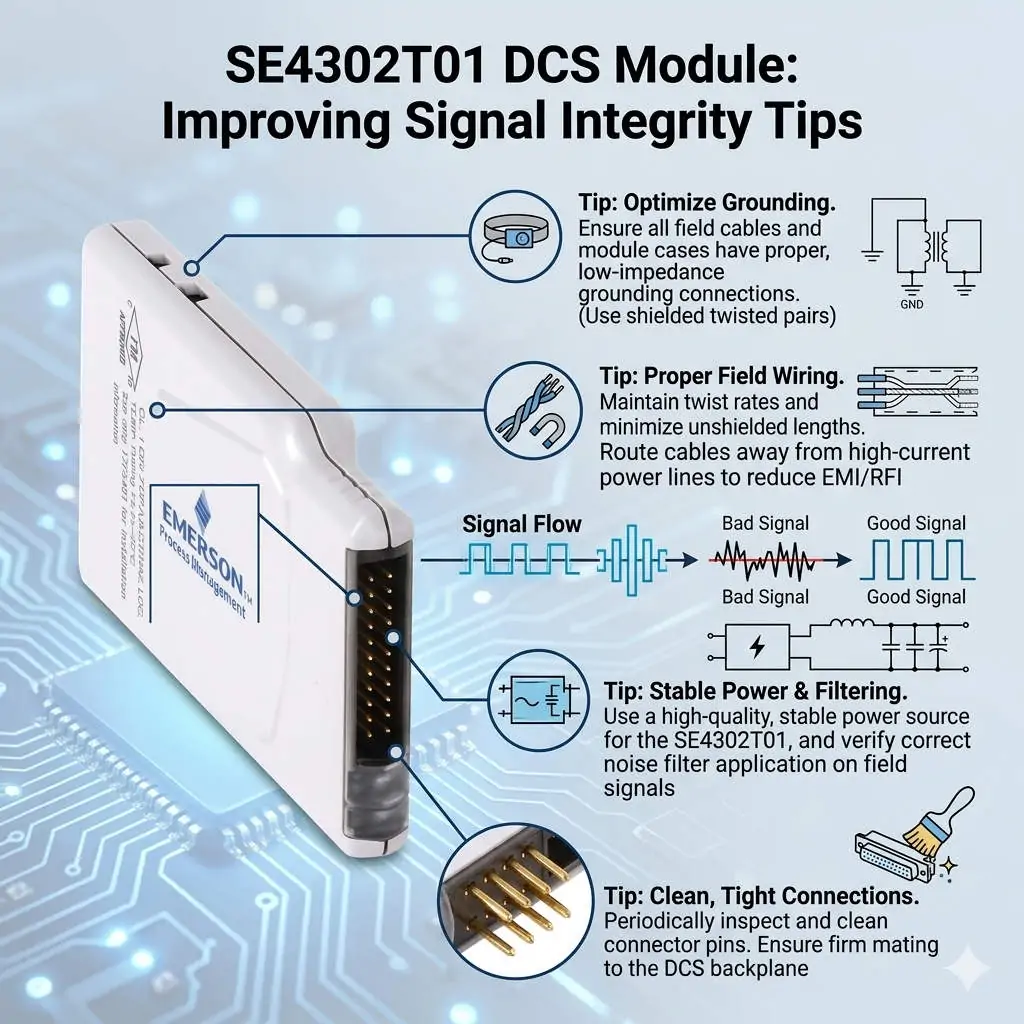
SE4302T01 DCS Module: Improving Signal Integrity Tips

Resolving Channel Interference in SE4302T01 DCS Modules through Advanced Signal Isolation

Addressing Signal Integrity in High-Demand DCS Environments

The SE4302T01 module functions as a critical interface for signal acquisition within Distributed Control Systems (DCS). However, engineers frequently encounter channel interference in petrochemical and pharmaceutical plants. These facilities often feature long cable runs and significant electromagnetic interference (EMI). While some mistake these fluctuations for hardware failure, they usually stem from signal integrity issues. Maintaining measurement accuracy is vital to prevent false trips and ensure process stability across the plant.
SE4302T01 DCS Module Improving Signal Integrity Tips

SE4302T01 DCS Module Improving Signal Integrity Tips

The Importance of Galvanic Isolation for SE4302T01 Stability

Direct exposure to field signals without proper galvanic isolation makes the SE4302T01 vulnerable. Ground loops and common-mode noise can easily penetrate the system near high-power motors or Variable Frequency Drives (VFDs). Therefore, adding an external isolator provides a necessary barrier against electrical noise. This setup significantly improves signal stability and reduces intermittent faults that plague unprotected modules. According to recent industrial automation trends, robust isolation remains a top priority for preventing unexpected downtime.

Balancing Module Response Time and High-Frequency Noise Filtering

Fast-response modules provide excellent dynamic tracking but also capture unwanted transient noise. Many engineers observe that “interference” is actually high-frequency noise misinterpreted as valid data. To solve this, you must balance responsiveness with stability. Introducing an isolator with built-in hardware filtering allows the DCS to receive clean data. Moreover, configuring software damping within the control system further refines the signal. This dual-layered approach ensures the system reacts to real process changes rather than electrical artifacts.

Compliance with EMC Standards and Environmental Immunity

Industrial sites rarely provide ideal conditions for electromagnetic compatibility (EMC). Modules operating near their immunity limits, as defined by IEC 61000 standards, often exhibit erratic behavior. This instability frequently occurs in aging plants where shielding and grounding systems have degraded over time. Isolation devices act as an additional EMC barrier. As a result, they extend the reliability of the SE4302T01 even in harsh, noisy environments where standard hardware might struggle to maintain precision.

Operational Guidance for Maintenance and Installation

Before replacing hardware, maintenance teams should verify the grounding topology of the entire loop. Improper grounding, such as multiple ground points or floating shields, causes most interference cases.

  • ✅ Ensure signal cable shields connect to ground at only one end to prevent loops.
  • ✅ Install signal isolators close to the DCS input side in mixed-signal environments.
  • ✅ Combine isolators with Surge Protection Devices (SPD) for outdoor or long-distance cable runs.
  • ✅ Periodically inspect cable integrity to identify degraded shielding or insulation.

These proactive steps often resolve “faults” without necessitating expensive module replacements.

Strategic Insights from Powergear X Automation Limited

At Powergear X Automation Limited, we emphasize that channel interference is often a system-level challenge. Replacing the SE4302T01 should be your final step after exhausting wiring and isolation checks. We have observed that adding high-quality isolators is more cost-effective than constant hardware swaps. This strategy improves long-term stability without altering the fundamental DCS architecture. Investing in proper isolation today prevents the high costs associated with process instability and false alarms tomorrow.

Industrial Application Scenarios

  • Petrochemical Refining: Prevents signal drift in temperature and pressure loops near heavy rotating machinery.
  • Pharmaceutical Manufacturing: Ensures precise measurement during sensitive batch processes where EMI from cleanroom equipment is high.
  • Retrofit Projects: Provides a practical solution for noise issues when rerouting existing cables is physically impossible.

Frequently Asked Questions (FAQ)

Q: How can I distinguish between a hardware failure and external interference?
Disconnect the field wiring and apply a local, clean 4-20mA source directly to the module input. If the reading stabilizes instantly, the issue lies in the field wiring or EMI, not the internal hardware of the module.

Q: Will adding an isolator introduce a delay in my control loop?
Most modern signal isolators have a response time in the millisecond range. While they do add a negligible delay, the benefits of a stable, noise-free signal far outweigh the slight increase in latency for 95% of industrial applications.

Q: Is it necessary to use HART-compatible isolators with the SE4302T01?
If your field instruments rely on HART protocol for remote calibration or diagnostics, you must select an isolator that supports HART pass-through. Standard isolators will strip the digital signal, leaving only the analog 4-20mA component.

For high-performance components and expert support in optimizing your DCS, please visit the official Powergear X Automation Limited website to view our latest technical solutions.


1769-IF4I vs 1769-IF4: Isolated vs Non-Isolated Analog Modules

1769-IF4I vs 1769-IF4: Isolated vs Non-Isolated Analog Modules

Choosing Between 1769-IF4I and 1769-IF4: A Guide to Analog Signal Integrity

Understanding the Role of Isolation in Industrial PLC Systems

Modern industrial automation demands high precision and equipment longevity. The Allen-Bradley 1769-IF4I serves as a robust shield against electrical noise and ground loops. In volatile sectors like chemical processing and oil & gas, this module protects the CompactLogix backplane. It ensures measurement stability for critical process variables. However, not every project requires high-level isolation. For cost-sensitive factory automation with short cable runs, the non-isolated 1769-IF4 offers an economical alternative. Engineers must evaluate the grounding risks before selecting a non-isolated path.

1769-IF4I vs 1769-IF4: Isolated vs Non-Isolated Analog Modules

Signal Integrity and Equipment Protection Mechanisms

The fundamental distinction between these modules lies in their electrical architecture. The 1769-IF4I features channel-to-channel and backplane isolation, whereas the 1769-IF4 utilizes a shared common reference. In high-noise environments near VFD-driven motors, non-isolated modules suffer from signal drift. This interference often triggers false alarms or destabilizes PID loops. Isolation prevents fault propagation across the system. It effectively safeguards both the controller and expensive upstream instrumentation from transient voltage spikes.

Impact of Electrical Noise on Process Control Accuracy

Both modules provide 16-bit resolution, yet real-world accuracy varies significantly based on noise immunity. Electrical interference effectively reduces the resolution of non-isolated setups. In precise dosing or pharmaceutical batching, even minor fluctuations lead to material waste. We observed a 2% fluctuation in a mixing skid using non-isolated inputs. Switching to the isolated 1769-IF4I eliminated this variation immediately. This proves that hardware-based isolation outperforms software-based filtering in high-stakes environments.

Balancing Conversion Speed and Control Responsiveness

While nominal update times appear similar, system-level responsiveness tells a different story. Non-isolated modules often require heavy software filtering to stabilize readings. Consequently, this adds latency to the control loop. For fast processes like gas pressure control, these delays compromise accuracy. Isolation reduces the need for aggressive filtering. As a result, the system maintains real-time responsiveness without sacrificing signal clarity.

Critical Installation and Grounding Strategies

If you choose the 1769-IF4, you must implement a disciplined electrical design. Proper grounding prevents the “floating ground” issues that cause intermittent analog spikes. Follow these technical requirements for non-isolated installations:

  • ✅ Use single-point grounding to prevent dangerous ground loops.
  • ✅ Separate analog signal cables from high-voltage power lines.
  • ✅ Avoid routing motor or heater loads in the same conduit.
  • ✅ Install DIN-rail surge protectors for outdoor or long-distance wiring.
  • ✅ Maintain recommended spacing to manage heat and EMI.

The Powergear X Automation Perspective on Engineering Value

At Powergear X Automation, we view the 1769-IF4I as more than a module; it is an insurance policy. While the 1769-IF4 is a practical choice for localized, well-grounded systems, the cost of troubleshooting one “ghost” signal often exceeds the initial savings. We recommend the isolated version for any application involving long-distance instrumentation or high EMI. In regulated industries like pharmaceuticals, stick to isolated designs to ensure GMP compliance and simplify system validation.

For more technical insights or to source high-quality Allen-Bradley components, visit our team at Powergear X Automation. We provide the expertise and inventory to keep your plant running efficiently.

Common Application Scenarios

  • Solution A (High Risk): Use 1769-IF4I for offshore rigs or refineries where lightning and motor noise are prevalent.
  • Solution B (Cost-Effective): Use 1769-IF4 for small, standalone packaging machines with sensors located within the same cabinet.

Frequently Asked Questions (FAQ)

Q1: Can I mix isolated and non-isolated modules on the same 1769 backplane?
Yes, the CompactLogix backplane supports both simultaneously. However, ensure your field wiring keeps the isolated and non-isolated signal commons physically separated to maintain the integrity of the isolated channels.

Q2: How do I know if my environment has too much EMI for a non-isolated module?
If your cabinet houses multiple Variable Frequency Drives (VFDs) or if your analog cables run longer than 15 meters, the risk of interference is high. In these cases, the isolated 1769-IF4I is the safer engineering choice.

Q3: What is the most common failure mode when downgrading to non-isolated inputs?
The most frequent issue is “signal jumping” or erratic readings caused by ground potential differences. If your sensors are powered from different sources, a non-isolated module will likely struggle with ground loop currents.

1769-OF4 vs 1769-OF4CI: CompactLogix Analog Output Guide

1769-OF4 vs 1769-OF4CI: CompactLogix Analog Output Guide

Comparing 1769-OF4 and 1769-OF4CI in CompactLogix Systems

Selecting the right analog output module is vital for system stability in industrial automation. Engineers often ask if the 1769-OF4 and 1769-OF4CI are interchangeable. While both belong to the Allen-Bradley CompactLogix family, they serve distinct electrical purposes. This guide explores their technical nuances, signal behaviors, and selection criteria.

1769-OF4 vs 1769-OF4CI: CompactLogix Analog Output Guide

Core Functional Differences and Signal Support

The primary distinction lies in the supported signal types. The 1769-OF4 acts as a universal module. It supports both voltage and current outputs across its four channels. In contrast, the 1769-OF4CI only supports current loops. It specifically handles 0–20 mA or 4–20 mA signals. Therefore, you cannot use the OF4CI if your actuators require a 0–10V signal.

According to reports, the transition toward 4–20 mA standards dominates modern process industries. Current loops offer superior resistance to electromagnetic interference. Consequently, many designers now prefer specialized modules like the 1769-OF4CI for new installations. This specialization reduces the risk of accidental voltage spikes in sensitive current-controlled loops.

The Role of Isolation in Signal Integrity

Signal noise often disrupts factory automation performance. The 1769-OF4CI offers enhanced current-loop isolation compared to the general-purpose OF4. This design choice minimizes ground loop issues in complex electrical environments. High-power motors and variable frequency drives often generate significant electrical noise. Moreover, isolated channels prevent a fault in one loop from affecting other channels.

In my experience at Powergear X Automation, ground loops cause most intermittent analog failures. Using a dedicated current module like the 1769-OF4CI often resolves these stability issues. It simplifies the grounding strategy for the entire control cabinet. This reliability is essential for industries like oil and gas where precision is mandatory.

Simplifying Configuration and Commissioning

The 1769-OF4 requires careful per-channel configuration in Studio 5000. Engineers must manually select between voltage or current modes. This flexibility occasionally leads to human error during rapid deployment. However, the 1769-OF4CI removes this complexity entirely. Since it only supports current, the configuration process becomes much faster and safer.

Standardizing on the 1769-OF4CI reduces spare parts inventory for current-only plants. It also prevents technicians from accidentally wiring a voltage device to a current-configured port. In large-scale DCS applications, such small efficiencies significantly reduce total commissioning time. Simple hardware often leads to more robust software logic.

Technical Maintenance and Installation Tips

  • Always verify the impedance of your field devices before installation.
  • Use twisted-pair shielded cables to further reduce signal degradation.
  • Ensure the external 24V DC power supply remains within specified tolerances.
  • Check the P&ID drawings to confirm no legacy voltage actuators remain.
  • Apply ferrules to all wire ends to ensure vibration-resistant connections.

Strategic Selection: Which Module Should You Buy?

The 1769-OF4 remains the best choice for versatile maintenance needs. It covers every scenario by supporting mixed signal types. Therefore, keep the OF4 in stock for legacy systems with varying requirements. On the other hand, the 1769-OF4CI is the superior choice for modern, current-only architectures. It provides better noise immunity and simpler long-term management.

For high-quality components and expert technical support, visit Powergear X Automation. We provide genuine industrial automation parts to keep your production lines running efficiently. Our team understands the critical nature of PLC hardware compatibility in modern manufacturing.

Application Scenario: Chemical Dosing Control

In a chemical processing plant, precision dosing pumps rely on 4–20 mA signals. The environment contains heavy electrical noise from mixing motors. Here, the 1769-OF4CI is the ideal solution. Its isolated current outputs ensure the pump speed remains constant. This prevents chemical imbalances and ensures high product quality. The dedicated current path protects the CompactLogix backplane from external surges.

Frequently Asked Questions

Q: Can I replace a 1769-OF4 with a 1769-OF4CI without changing the PLC code?
A: No, you must update the I/O configuration in your programming software. The controller must recognize the specific module profile to communicate correctly. Failing to update the hardware profile will result in an I/O configuration fault.

Q: What happens if my loop resistance exceeds the module’s limit?
A: The output will saturate, meaning the signal cannot reach 20 mA. This often causes control valves to stay partially closed. Always calculate the total loop resistance, including wire length, before choosing your module.

Q: Is the terminal block interchangeable between these two modules?
A: Most 1769 series modules use the same 18-point terminal blocks. However, the internal wiring layout differs between voltage and current modules. You must re-verify your wiring diagram to prevent damaging the 1769-OF4CI or your field device.

Back to Top
Product has been added to your cart