
Welcome to the cutting-edge world of industrial automation
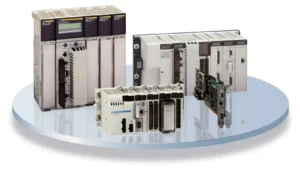
Today, we explore key components of the robust Schneider Electric Quantum PLC platform. This powerful system drives efficiency in countless factory automation settings. We will examine specific I/O and motion modules. Understanding these modules is crucial for reliable control systems design.
Understanding Digital Input Modules: 140DAI34000 and 140DAI35300
Digital input (DI) modules are the eyes of your PLC system. They monitor ON/OFF status from field devices. The Schneider Electric Quantum line features two notable DI modules.
140DAI34000: The Versatile AC Input Solution
The 140DAI34000 is a 24V AC input module. It handles signals from AC-powered sensors or switches. This module offers 16 discrete input points. Its isolation protects the internal electronics effectively. Therefore, it is ideal for noisy industrial environments. Moreover, its design ensures high signal integrity.
✅ Function: Digital AC Input
⚙️ Voltage: 24V AC Nominal
🔧 Points: 16 Discrete Inputs
140DAI35300: High-Density DC Input Power
The 140DAI35300 increases input density significantly. This module provides 32 points of 24V DC input. Using DC power is standard for many modern sensors. As a result, this module saves valuable rack space. Engineers often choose it for large-scale applications. Its high density reduces system footprint and cost.
✅ Function: Digital DC Input
⚙️ Voltage: 24V DC Nominal
🔧 Points: 32 Discrete Inputs
Digital Output Modules: Driving Industrial Actuators with Precision
Digital output (DO) modules are the hands of the DCS or PLC. They send ON/OFF commands to actuators. These actuators include relays, solenoids, and motor starters.
140DDO15310: High-Speed TTL Output for Critical Control
The 140DDO15310 features TTL (Transistor-Transistor Logic) output. TTL signaling is very fast and low voltage (5V DC). This makes it perfect for connecting to other logic circuits. Consequently, engineers use it in high-speed communication applications. It is less common for direct solenoid control.
✅ Function: Digital TTL Output
⚙️ Signal Type: TTL (5V DC)
🔧 Application: High-speed signaling, inter-logic device communication
140DDO88500: Robust High-Power DC Switching
The 140DDO88500 provides powerful DC output switching. This module typically handles 24V DC field loads directly. It offers 12 isolated output points. High current capacity is a key feature here. Therefore, it can drive larger industrial devices. This module is a workhorse in general industrial automation.
✅ Function: Digital DC Output (High Power)
⚙️ Voltage: 24V DC Nominal
🔧 Points: 12 Discrete Outputs
Understanding the Principles and Application Scenarios
The fundamental principle for all these I/O modules is electrical isolation. Isolation protects the sensitive PLC backplane from field noise. High-speed counting or simple state monitoring dictates the module choice.
Application Scenarios:
Process Plants (Oil & Gas): DI/DO modules monitor valve positions and pump status.
Manufacturing Lines: They control conveyor belts and robotic grippers.
Building Automation: They manage lighting and HVAC equipment.
The Specialized Motion Control: 140MSB10100
Motion control is a specialized subset of industrial automation. It demands very precise timing and command execution.
140MSB10100: Dedicated Servo and Stepper Control
The 140MSB10100 is a dedicated motion control module. It manages complex motion profiles for motors. This includes position, velocity, and torque control. In addition, it offloads demanding calculations from the main CPU. This improves overall system performance. A recent MarketsandMarkets report suggests motion control is a key growth area in factory automation.
✅ Function: Multi-Axis Motion Control
⚙️ Control Type: Servo and Stepper Motor
🔧 Benefit: Enhanced precision and reduced CPU load
Selecting the Right Quantum Module: Key Distinctions
Module selection depends entirely on field requirements. Distinctions exist in signal type, density, and speed.
| Feature | 140DAI34000 (AC) | 140DAI35300 (DC) | 140DDO15310 (TTL) | 140DDO88500 (DC) |
| Signal Type | AC (24V) | DC (24V) | DC (5V Logic) | DC (24V Power) |
| Point Density | Low (16) | High (32) | High (20+ typically) | Low (12) |
| Speed/Power | Standard | Standard | High Speed/Low Power | Standard/High Power |
The 140MSB10100 stands apart. It handles complex algorithms, unlike the simple I/O modules. Choosing between the 140DAI series means assessing field voltage. Output choice balances speed (TTL) versus power (High Current DC).
Author’s Insight: Powergear X Automation’s Perspective
As an experienced engineer, I see a clear trend. The push for smarter factories requires this module diversity. High-density I/O like the 140DAI35300 minimizes cabinet size. Dedicated motion control (140MSB10100) is non-negotiable for high-throughput machines. However, simple I/O remains the backbone. Therefore, correctly scoping your I/O is critical. Many projects fail due to inadequate field device power budgeting. Always over-spec your output current capacity slightly.
To explore more advanced automation solutions, please visit Powergear X Automation https://www.powergearx.com/. We offer expert consultation on designing robust control systems.
Application Case Study: Automated Packaging Line
A client needed a high-speed, flexible packaging solution.
Solution: We chose the 140DAI35300 for 24V DC sensor inputs (32 points). The 140DDO88500 controlled the pneumatic solenoids. Crucially, the 140MSB10100 managed the product indexing servo motor. This combination ensured both fast throughput and precise material handling. The system achieved a 15% increase in production rate.
Frequently Asked Questions (FAQ)
Q1: How do I decide between AC and DC input modules for a legacy system?
A1: Check the voltage of your existing field devices (e.g., limit switches). If they run on 120V AC, you must use an AC input module like the 140DAI34000. If you are installing new 24V sensors, always opt for DC inputs. DC is generally safer and less prone to electrical noise.
Q2: What is the main experiential challenge when commissioning the 140MSB10100?
A2: The biggest challenge is parameter tuning. A simple I/O module is plug-and-play. The 140MSB10100 requires precise configuration of motor parameters. You must accurately tune the Proportional-Integral-Derivative (PID) loop. This ensures smooth acceleration and deceleration, preventing mechanical stress and instability.
Q3: Can I mix Quantum I/O modules from different voltage ranges in the same rack?
A3: Yes, you can. The Quantum backplane manages the communication regardless of module voltage. However, never mix the field wiring voltages. For example, ensure 24V DC is only connected to your DC modules. Mixing field voltages can permanently damage the modules.