Over 50,000 hot-selling automation module components.
Allen-Bradley 1769-L30ER: Multi-Vendor PLC Integration Guide

Allen-Bradley 1769-L30ER: Multi-Vendor PLC Integration Guide

Seamless Multi-Vendor Integration with the Allen-Bradley 1769-L30ER CompactLogix Controller

Bridging Heterogeneous Automation Systems via Ethernet

The Allen-Bradley 1769-L30ER stands as a versatile solution for modern industrial automation. This controller excels at integrating diverse hardware within a unified Ethernet architecture. In complex environments like chemical processing or bottling lines, it acts as a strategic bridge. It facilitates high-speed data exchange between Rockwell systems and third-party PLCs, such as Siemens. Moreover, its embedded dual-port Ethernet allows for direct connectivity. This eliminates the need for expensive external gateways in many localized applications. Consequently, engineers reduce system complexity and long-term maintenance costs simultaneously.

Allen-Bradley 1769-L30ER: Multi-Vendor PLC Integration Guide

EtherNet/IP and TCP/IP Communication Fundamentals

The 1769-L30ER natively supports the Common Industrial Protocol (CIP) over EtherNet/IP. However, Siemens controllers typically utilize PROFINET or the S7 protocol. To bridge this gap, engineers often implement Open User Communication (OUC) via TCP sockets. This method enables direct data transfer without secondary protocol converters. The demand for interoperable factory automation is rising globally. Therefore, choosing the correct communication interface is vital. It prevents data loss and ensures deterministic control in high-speed production environments. Proper configuration maintains the timing accuracy required for synchronized assembly tasks.

Optimizing Network Load and Deterministic Response Times

Performance in a control system depends heavily on network optimization. The L30ER supports 100 Mbps full-duplex communication on its embedded ports. Nevertheless, actual response times vary based on the Requested Packet Interval (RPI). High node counts or improper RPI settings can introduce network jitter. In addition, network topology plays a significant role in overall stability. Star topologies often provide better isolation compared to simple daisy chains. As a result, careful traffic management prevents synchronization issues in precision manufacturing processes. This is especially critical for motion-heavy applications like robotic packaging.

Enhancing Reliability through Advanced EMC Practices

Industrial environments often subject hardware to significant electrical noise and interference. The 1769-L30ER adheres to IEC 61131-2 standards for robust industrial performance. However, reliability requires strict adherence to electromagnetic compatibility (EMC) guidelines. Engineers must use shielded twisted pair (STP) cables to mitigate signal degradation. Furthermore, separating communication lines from Variable Frequency Drive (VFD) output wiring is essential. Poor shielding frequently causes intermittent communication drops during commissioning. Therefore, establishing a solid common ground point remains a foundational requirement for any stable PLC installation.

Field-Proven Installation and Maintenance Strategies

Drawing from extensive field experience at Powergear X Automation Limited, successful integration follows specific protocols. First, implement a rigorous IP addressing scheme to avoid network conflicts. Second, utilize managed industrial switches to segment broadcast traffic effectively. In high-vibration areas, such as milling or stamping, use locking RJ45 connectors. These prevent physical signal loss due to mechanical stress. Additionally, install external surge protection in environments prone to lightning or power transients. These proactive steps ensure the 1769-L30ER remains operational throughout its intended service life.

Comparative Analysis and Hardware Selection Guide

The 1769-L30ER belongs to the CompactLogix 5370 family, offering specific advantages over legacy models. While it supports many 1769-series I/O modules, firmware compatibility is paramount. It provides more memory and faster processing than the entry-level L1 series. However, it lacks the extreme node capacity of the larger L36ER controllers. When integrating with Siemens, engineers must evaluate if the built-in TCP socket capability suffices. If structured CIP data exchange is mandatory, a dedicated protocol gateway remains the industry standard. This hardware selection directly impacts both commissioning time and total system scalability.

Expert Insight from Powergear X Automation Limited

At Powergear X Automation Limited, we believe the future of industrial automation lies in open standards. The 1769-L30ER is a powerful tool because it balances proprietary performance with open connectivity. We often recommend implementing OPC UA via middleware for large-scale plant integration. This aligns with IEC 62541 standards and ensures future-proof data visibility. While direct EtherNet/IP to PROFINET communication is not native, the L30ER’s flexibility makes it a top choice for multi-vendor sites. We suggest always performing offline communication tests in Studio 5000 before live deployment.

  • Integrated Dual Ports: Supports Device Level Ring (DLR) for high network availability.
  • ⚙️ Socket Programming: Enables custom communication with non-Rockwell devices.
  • 🔧 Compact Form Factor: Saves significant cabinet space in localized control panels.
  • Standardized I/O: Compatible with a wide range of existing 1769 expansion modules.

Industrial Application Scenarios

  • Chemical Processing: Synchronizing Rockwell-based batching with Siemens-controlled safety valves.
  • Automotive Assembly: Managing high-speed data flow between different robotic cells on a single backbone.
  • Water Treatment: Integrating remote pump stations with various PLC brands into a central SCADA.

Technical Frequently Asked Questions (FAQ)

Q: Does the 1769-L30ER support direct S7 protocol communication with Siemens?
No, it does not support the S7 protocol natively. You must use TCP/IP socket programming (OUC) on both ends or utilize an industrial gateway. For large-scale projects, a gateway is often the more maintainable solution as it requires less custom code.

Q: How do I resolve frequent “Connection Timeout” errors in multi-vendor setups?
This usually stems from RPI mismatches or high network broadcast traffic. From our experience, increasing the RPI slightly or moving the PLCs to a dedicated VLAN on a managed switch typically stabilizes the connection. Always check the Ethernet cable shielding near high-voltage sources first.

Q: Can I use standard commercial Ethernet cables for these connections?
We strongly advise against it. Commercial cables lack the shielding and jacket durability required for factory floors. Industrial-grade STP cables protect against EMI from motors and VFDs, which are the primary causes of intermittent packet loss in industrial control systems.

For more technical documentation or to explore high-quality automation hardware, visit the official website of Powergear X Automation Limited today.

Siemens vs. Rockwell PLC: Selecting the Right Automation System

Siemens vs. Rockwell PLC: Selecting the Right Automation System

Strategic Comparison: Siemens vs. Rockwell PLC Systems in Industrial Automation

The Core Value of Leading Control Systems

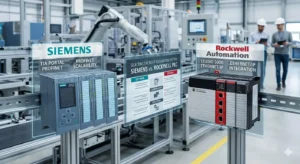
Siemens excels in complex scenarios requiring high system integration, such as automotive and chemical manufacturing. Its TIA Portal architecture significantly reduces cross-system debugging costs for large-scale projects. Conversely, Rockwell (Allen-Bradley) dominates the North American market and discrete manufacturing sectors. Rockwell offers a more intuitive learning path for beginners entering the PLC programming field. Therefore, Siemens provides global versatility, while Rockwell ensures rapid deployment for standardized production lines.

Siemens vs. Rockwell PLC: Selecting the Right Automation System

Programming Environments: TIA Portal vs. Studio 5000

The Siemens TIA Portal integrates PLC, HMI, and drives into a single unified platform. This integration eliminates frequent software switching and boosts overall engineering efficiency. Rockwell utilizes a modular approach with Studio 5000 and FactoryTalk separated into different packages. This separation helps beginners master individual functions but increases complexity during full system integration. Based on our field experience, Siemens allows direct variable linking, whereas Rockwell often requires manual tag configuration.

Optimizing Scan Time and System Response

Siemens S7-1200 and S7-1500 controllers maintain exceptional stability under heavy program loads. Rockwell CompactLogix systems provide highly responsive performance for smaller, high-speed applications. Precise scan times are vital for accurate motion control in packaging and robotics. However, improper task priority configuration in Rockwell systems can lead to cycle jitter. Siemens employs a default cyclic structure that is often more forgiving for less experienced programmers.

Industrial Communication Protocol Compatibility

Siemens natively supports PROFINET and Profibus, featuring mature OPC UA integration for Industry 4.0. Rockwell relies on EtherNet/IP, ensuring seamless compatibility with North American equipment ecosystems. Protocol selection dictates your future expansion costs and device hardware choices. Note that interfacing Siemens with EtherNet/IP devices usually requires an external gateway. Similarly, Rockwell systems need additional modules to communicate over PROFINET networks.

Field Installation and Maintenance Standards

Siemens hardware requires strict grounding practices, particularly for sensitive analog signal modules. Rockwell systems offer slightly higher tolerance for grounding variances under North American standards. We recommend single-point grounding to prevent circulating currents in your control cabinet. In high-vibration environments like mining, Siemens spring terminals offer superior reliability. Regular maintenance must include tightening Rockwell screw terminals to prevent intermittent I/O loss.

Powergear X Automation: Expert Engineering Perspective

At Powergear X Automation, we believe the choice depends on your regional ecosystem. Siemens offers the best flexibility for multi-brand integration in European and Asian markets. However, Rockwell remains the undisputed leader for projects based in the United States. Beyond the brand name, true engineering value lies in understanding electrical specifications and communication logic. We advise engineers to focus on mastering troubleshooting skills rather than just software syntax.

Technical Implementation Checklist

  • ✅ Match the PLC brand to the regional technical support network.
  • ✅ Use shielded twisted pair cables for all analog I/O.
  • ✅ Install external surge protection for outdoor control equipment.
  • ✅ Implement UPS backup for mission-critical automation controllers.
  • ✅ Verify communication gateway requirements for multi-protocol systems.
  • ✅ Optimize task priorities to prevent scan time fluctuations.

Strategic Industry Scenarios

  • High-Speed Packaging: Rockwell CompactLogix for intuitive motion control and local support.
  • Large Chemical Plants: Siemens S7-1500 with TIA Portal for massive system integration.
  • North American Retrofits: Allen-Bradley ControlLogix for compatibility with existing plant standards.

Frequently Asked Questions (FAQ)

Q1: Should I prioritize Siemens or Rockwell for a new international project?

Consider the project location and the local spare parts supply chain. Siemens is the better choice for Asian and European sites due to its vast ecosystem. For North American sites, Rockwell ensures easier access to technicians and replacement hardware.

Q2: Is it difficult to migrate legacy code to new PLC platforms?

Siemens provides robust migration tools for S7-300 to S7-1500 transitions. However, older Rockwell systems like SLC500 may require significant manual re-coding. Always budget extra time for I/O address mapping and communication verification during upgrades.

Q3: Which platform handles third-party device integration more efficiently?

Siemens TIA Portal generally offers better multi-vendor integration tools through standardized GSD files. Rockwell is highly efficient within its own “Premier Integration” ecosystem. For a mix of brands, Siemens typically reduces the total engineering hours required.

Integrating Quantum Module with Industrial Automation Protocols

Integrating Quantum Module with Industrial Automation Protocols

Integrating the Quantum CPU Module with Industrial Ethernet: EtherNet/IP and PROFINET Compatibility

The evolution of smart manufacturing demands that high-performance computing modules, like the Quantum CPU, connect effortlessly with existing industrial networks. System integrators frequently ask about the Quantum CPU’s ability to communicate with market-leading Industrial Ethernet protocols such as EtherNet/IP and PROFINET. This detailed guide clarifies compatibility and outlines essential integration strategies for your industrial automation projects.

Integrating Quantum Module with Industrial Automation Protocols

Understanding the Quantum CPU’s Native Communication Architecture

The Quantum CPU Module is engineered for robust control and real-time data processing in control systems. Its core architecture prioritizes foundational networking capabilities. Typically, the module features built-in support for open, widely used protocols. This usually includes standard Ethernet TCP/IP and Modbus TCP. However, native support for proprietary Industrial Ethernet protocols often depends on the specific manufacturer’s design philosophy. The initial focus is on high-speed internal processing, not necessarily on protocol-specific external interfaces.

Achieving EtherNet/IP Connectivity for Factory Automation

EtherNet/IP dominates the North American factory automation landscape. This protocol relies on the Common Industrial Protocol (CIP) for data exchange. Direct, built-in support for EtherNet/IP on the Quantum CPU is uncommon. Therefore, engineers must implement supplementary solutions to achieve seamless integration. These integration methods usually involve two primary options:

  • External Communication Module: Utilizing a manufacturer-specific or third-party EtherNet/IP communication module that plugs directly into the Quantum backplane.
  • Protocol Gateway Device: Deploying an industrial gateway to translate Modbus TCP (supported by the Quantum CPU) to the required EtherNet/IP CIP messages.

Choosing the right approach depends on required data throughput and system complexity.

Integrating the Quantum CPU into a PROFINET Environment

PROFINET is the prevalent choice in European industrial automation, especially for systems built around Siemens PLCs. Full PROFINET functionality requires real-time (RT or IRT) capabilities. The Quantum CPU Module typically requires an add-on solution, much like with EtherNet/IP. The goal is enabling the Quantum to function as a PROFINET I/O Controller (Master) or I/O Device (Slave).

System integrators typically use one of the following methods:

  • Dedicated Expansion Card: Installing a specialized PROFINET interface card, often certified by the PROFINET user organization.
  • Third-Party Gateways: Employing a gateway to bridge the Quantum’s native communication (e.g., Modbus TCP) to the PROFINET network.

In addition, verifying the necessary firmware level is crucial. Some manufacturers offer firmware that enables non-native protocol support via standard Ethernet ports.

The Flexibility of Open and Standard Protocols

Even without native EtherNet/IP or PROFINET support, the Quantum CPU Module provides robust alternatives. Standard protocols ensure broad compatibility across different vendor equipment. The most common pathways include:

  • Modbus TCP: Excellent for data exchange with supervisory DCS or PLC systems.
  • OPC UA: The trend toward unified architecture favors OPC UA for secure, platform-independent data integration.
  • MQTT: Advanced Quantum models often support MQTT for lightweight, cloud-based data publishing.

Moreover, these open standards significantly reduce vendor lock-in, which is a key consideration for modern control systems.

Author’s Commentary: A Pragmatic Approach to Integration

From my experience in industrial automation, I advise against relying on native support for these protocols in general-purpose CPU modules. The strength of the Quantum lies in its processing power, not protocol standardization. Therefore, the use of high-quality industrial gateways is often the most reliable and cost-effective solution. Gateways isolate the proprietary network from the core CPU, enhancing overall system stability. I believe this modular approach is superior for systems requiring high uptime, consistent with Industry 4.0 principles.

Key Considerations for Successful Quantum Integration

Engineers must follow specific steps to ensure successful protocol integration:

  • Step 1: Check the Datasheet: Always verify the exact model’s support for specific communication modules.
  • Step 2: Define Network Role: Determine if the Quantum needs to be a Scanner/Controller (initiating communication) or an Adapter/Device (responding to requests). This affects the required module.
  • Step 3: Validate Gateway Performance: Ensure any chosen gateway can handle the required I/O count and data refresh rate for the application.

Technical Integration Checklist

  • ✅ Utilize dedicated Industrial Ethernet communication modules.
  • ⚙️ Ensure firmware supports protocol-specific features.
  • 🔧 Configure the control systems network role correctly (Controller/Scanner or Device/Adapter).

FAQ: Practical Integration Insights

Q1: Will using an external gateway negatively affect the communication speed or latency?

A: Using a gateway introduces a small, measurable latency, typically in the millisecond range. However, modern, high-speed industrial gateways are designed specifically to minimize this impact. For non-deterministic, supervisory data exchange, the latency is usually negligible. For critical, motion control systems requiring sub-millisecond updates, a direct I/O link or a native protocol module is usually required over a gateway.

Q2: What is the primary benefit of using a Quantum CPU in an existing EtherNet/IP network if native support is limited?

A: The main benefit is leveraging the Quantum’s specialized computing power. Engineers use the Quantum for complex, real-time control loops or data pre-processing (like advanced analytics or predictive maintenance algorithms) before passing summarized data to the main PLC or DCS via a gateway. It acts as an intelligent co-processor in the industrial automation setup.

Q3: Is Modbus TCP secure enough for data transmission, or is PROFINET/EtherNet/IP better?

A: Modbus TCP is inherently less secure than modern protocols like PROFINET or EtherNet/IP, as it often lacks built-in encryption and authentication features. Therefore, when using Modbus TCP for the Quantum, system security (e.g., firewall, VLAN segmentation, and VPNs) must be implemented externally to protect the data exchange. Protocols like OPC UA are generally preferred for secure, standardized communication in modern control systems.

Powergear X Automation Limited specializes in integrating high-performance computing modules, like the Quantum CPU, with diverse Industrial Ethernet protocols. We deliver robust and reliable control systems solutions. To learn more about our integration expertise and industrial gateway solutions, please visit us here: https://www.powergearx.com/

Harnessing the Power of Ethernet/IP with the PowerFlex 525 Drive

Harnessing the Power of Ethernet/IP with the PowerFlex 525 Drive

Introduction

In industrial automation, connecting devices is key. The PowerFlex 525 drive is a true game-changer. It offers seamless integration with Ethernet/IP. This guide helps you unlock its full potential. You can achieve better control and efficiency. As an engineer, I’ve seen firsthand how this drive simplifies complex systems. Its built-in Ethernet/IP port makes setup a breeze. You can manage your motor and system data effortlessly. This capability is crucial for modern manufacturing. It helps you stay competitive and agile.

Harnessing the Power of Ethernet/IP with the PowerFlex 525 Drive

Product Overview

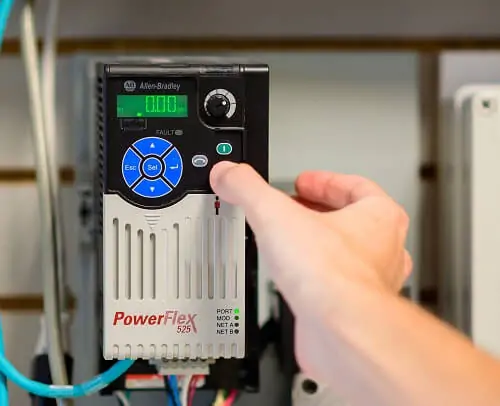
The PowerFlex 525 is a versatile AC drive. It’s designed for global applications. This drive has a compact, space-saving design. It also features a modular control and power section. This design allows for quick installation and setup. The PowerFlex 525 can be mounted vertically. It’s also easy to mount side-by-side. The drive works in temperatures up to 70°C. It’s a reliable solution for tough environments. Its integrated Ethernet/IP port is a major benefit. It provides easy network connectivity.

Technical Specifications

  • Ethernet/IP is a standard feature.
  • This drive supports Zero Stacking.
  • It has flexible motor control options.
  • The voltage range is 100 to 600V.
  • The power range is 0.4 to 22 kW.
  • It has an ambient temperature rating of 70°C.
  • The drive features a removable keypad.
  • The keypad allows for easy programming.
  • It includes a built-in EMI filter.
  • The filter reduces electromagnetic interference.

Key Benefits and Unique Insights

The PowerFlex 525 drive offers big advantages. Its most powerful feature is the integrated Ethernet/IP. This port eliminates the need for extra communication modules. This saves you money and panel space. I’ve found this feature invaluable. It simplifies wiring and configuration tasks. You can quickly add the drive to your network. This speeds up your project timeline. Another unique benefit is its Dual-Port Ethernet/IP option. This allows for ring topology (DLR). DLR makes your network more fault-tolerant. If one link fails, data still gets through. This is critical for uptime and reliability.

Harnessing the Power of Ethernet/IP with the PowerFlex 525 Drive

Choosing the Right Drive

Selecting the right drive is important. Consider your application’s needs. The PowerFlex 525 is great for many tasks. It works well for conveyors, fans, and pumps. Its fast setup time is a huge plus. This drive also supports Connected Components Workbench. This software simplifies programming. You can configure and monitor the drive easily. I often recommend this drive for new projects. It offers a great balance of features and value. It’s a smart investment for the future.

This guide should help you understand the PowerFlex 525. It’s more than just a motor controller. It is a vital part of your automation system. We have genuine Allen-Bradley products. They are available for a great price.

Click below links to explore our PowerFlex 525 drives. Enhance your automation systems today.

ModelTitleLink
25A-E012N104Allen-Bradley PowerFlex 523 AC Drive (600V AC)Learn More
25A-E019N104Allen-Bradley PowerFlex 523 AC DriveLearn More
25B-B062N104Allen-Bradley PowerFlex 525 Drive (20HP)Learn More
25B-E027N104Allen-Bradley PowerFlex 525 AC Drive (0.4kW)Learn More
25B-D1P4N104Allen-Bradley PowerFlex 525 AC DriveLearn More
Back to Top
Product has been added to your cart