



Product details
Product Overview
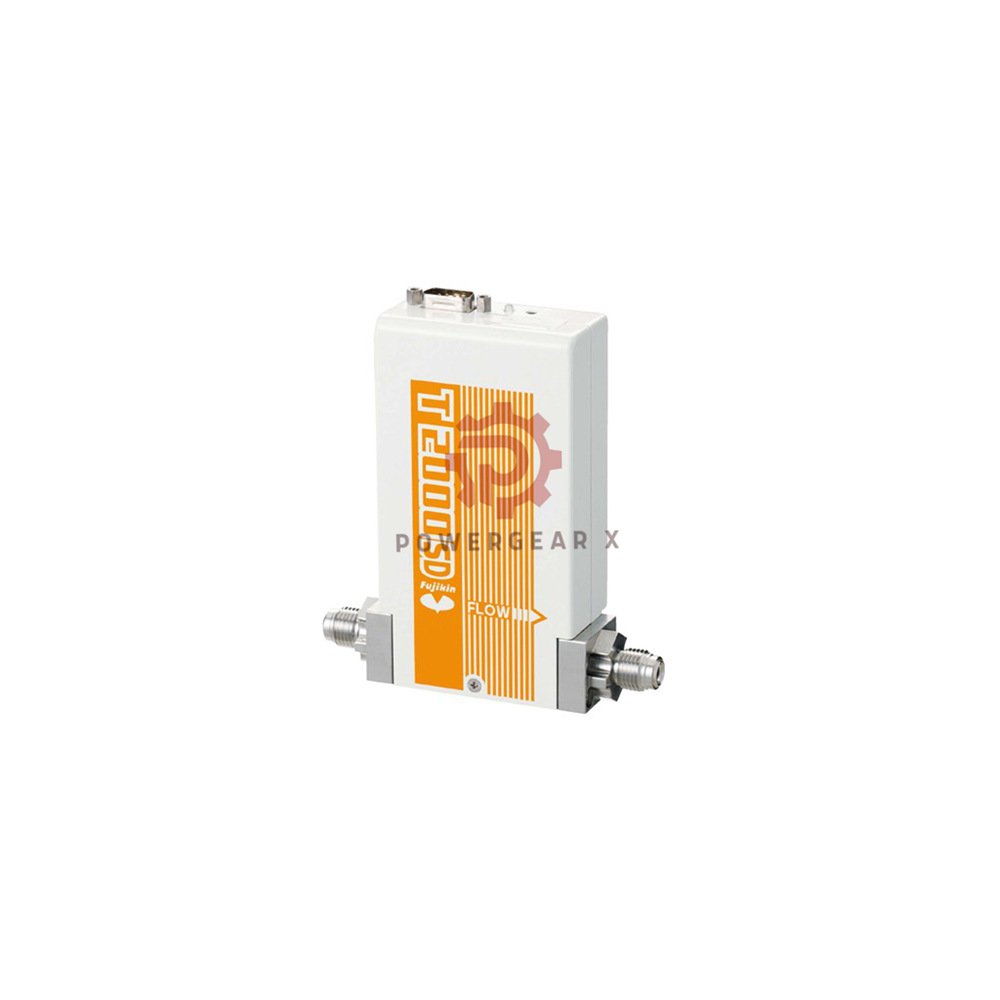
FCST2050 is a piezo-actuated flow controller from the Fujikin FCST T2000 Series. It controls reactive and corrosive gases with speed and precision. The metal-sealed diaphragm valve limits particle generation. A low-temperature thermal sensor keeps readings stable over long runs. This module suits semiconductor, flat panel, and solar processes that demand clean gas delivery.
The unit covers a 21 to 50 SLM full-scale range (N2 equivalent). Accuracy reaches ±1% S.P. from 25 to 100% of set point. Response time stays within 1 second. Analog 0-5 VDC and digital RS-485 or DeviceNet interfaces simplify integration.
Key Benefits
- Clean operation: piezo diaphragm valve cuts particle generation.
- Stable sensing: low-temperature thermal sensor holds accuracy.
- Reactive gas ready: handles O3, halogens, and corrosive media.
- Fast response: reaches set point in 1 second or less.
- Flexible control: analog and digital options in one unit.
Technical Specifications
- Brand: Fujikin
- Model: FCST2050
- Series: FCST T2000 Series (FCS-T2000 Piezo Actuator)
- Full-scale flow range: 21 – 50 SLM (N2 equivalent)
- Accuracy: ±1% S.P. (25-100% of set point); ±0.25% FS (2-25%)
- Repeatability: ±0.2% FS
- Response time: ≤1 sec
- Control range / turndown: 2-100% FS
- Gas type:
- Piezo actuator for high-reactivity and low-stability gases
- O3, halogen, and reactive process gases
- N2, Ar, He, H2, and semiconductor gases
- Special 1-3 SCCM micro-flow option
- Operating pressure:
- Max operating pressure: 350 kPaG
- Required differential pressure: 100-300 kPa (21-30 SLM)
- Required differential pressure: 150-300 kPa (31-50 SLM)
- Proof pressure: 1 MPaG
- Wetted materials: SUS316L stainless steel, PCTFE
- Seals: Metal seal (Au gold gasket)
- Electrical interface:
- Analog: 0-5 VDC (±15 VDC supply)
- Digital: RS-485, DeviceNet
- Heated option: No (standard unheated version)
- Operating temperature: 5-50°C
- Dimensions: 131 (H) × 124 (W) × 71 (D) mm
- Power supply: ±15 VDC; +15 VDC approx. 100 mA; -15 VDC approx. 50 mA
- Valve type: Piezo actuator (diaphragm valve, N/O or N/C)
- Leak integrity: ≤1×10⁻¹¹ Pa·m³/s He (external leak)
- Compliance: RoHS compliant; CE; EP surface finish
Installation Guide
- Mount the unit on a clean, vibration-free surface.
- Keep the gas path dry and free of particles.
- Check differential pressure before startup.
- 21-30 SLM: 100-300 kPa
- 31-50 SLM: 150-300 kPa
- Do not exceed 350 kPaG operating pressure.
- Wire analog and digital lines away from noise sources.
- Confirm ±15 VDC supply polarity before power-on.
Setup and Maintenance
- Zero the sensor after warm-up.
- Set flow via 0-5 VDC or RS-485 commands.
- Check response with a step test at 1 sec.
- Inspect the metal seal at planned intervals.
- Keep the unit within 5-50°C for best stability.
- Use dry N2 for line purge before service.
Compatibility Notes
- Works with O3, halogen, and reactive process gases.
- Supports N2, Ar, He, H2, and common semiconductor gases.
- RS-485 and DeviceNet link to standard control systems.
- Analog 0-5 VDC fits most mass flow controllers.
- Micro-flow option covers 1-3 SCCM needs.
Certification and Compliance
- RoHS compliant
- CE marked
- EP surface finish
- External leak rate: ≤1×10⁻¹¹ Pa·m³/s He
Packing List
- 1 × FCST2050 flow controller
- 1 × user manual
- 1 × calibration certificate
- 1 × connector kit
- 1 × protective cap set
FAQ
- Q: Can this unit handle ozone?
- A: Yes. The piezo diaphragm valve and metal seal suit O3 service.
- Q: What flow range does it cover?
- A: It covers 21 to 50 SLM, with a 1-3 SCCM micro-flow option.
- Q: How fast does it respond?
- A: Response time is 1 second or less.
- Q: Which interfaces are available?
- A: Analog 0-5 VDC, plus RS-485 and DeviceNet digital links.
- Q: What pressure drop is needed?
- A: Use 100-300 kPa for 21-30 SLM and 150-300 kPa for 31-50 SLM.
- Q: Is a heated version offered?
- A: No. This is the standard unheated version.
- Q: From experience, what causes drift?
- A: Users often trace drift to unstable inlet pressure. A steady supply and a short warm-up fix most cases.
- Q: How do I avoid seal damage?
- A: Field reports show that slow pressure changes and clean gas extend seal life. Avoid sudden surges.



There are no reviews yet.